

Audio By Carbonatix
Veteran CNN journalist Christiane Amanpour cancelled an interview with Iranian President Ebrahim Raisi after he demanded she wears a headscarf for their meeting in New York.
Amanpour pointed out that no previous presidents had requested this when she interviewed them outside Iran.
She says a Raisi aide told her it was because of "the situation in Iran".
The death of a woman detained in Iran for allegedly breaking headscarf rules has sparked violent unrest there.
Mahsa Amini, 22, fell into a coma last week, hours after morality police arrested her.
Officers reportedly beat Ms Amini's head with a baton and banged her head against one of their vehicles. The police have said there is no evidence of any mistreatment and that she suffered "sudden heart failure".
The protests, now in their seventh day, have reached 80 other cities and towns in the Islamic Republic. At least 17 people have been killed.
The interview would have been Mr Raisi's first on US soil, during his visit to the UN General Assembly.
Amanpour said she had been ready to conduct it when one of the president's aides insisted she covered her hair at Mr Raisi's request.
"We are in New York, where there is no law or tradition regarding headscarves," she said later on Twitter.
Amanpour said Mr Raisi's aide had made it clear an interview would not happen if she did not wear a headscarf, saying it was "a matter of respect".
Her team walked away from the interview refusing what she called the "unprecedented and unexpected condition".
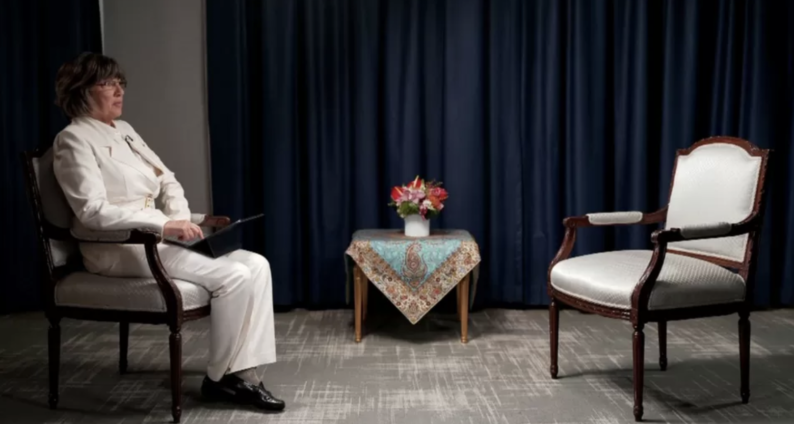
The US anchor later posted a picture of herself without a headscarf in front of an empty chair where Mr Raisi would have sat for their interview.
Mr Raisi was elected last year and signed an order in August to enforce a new list of restrictions.
These included the introduction of surveillance cameras to monitor and fine unveiled women or refer them for "counselling", and a mandatory prison sentence for any Iranian who questioned or posted content against the hijab (headscarf) rules online.
The restrictions led to an increase in arrests but also sparked a surge in women posting photos and videos of themselves without headscarves on social media - something that has only intensified in the days following Ms Amini's death.

It's a question women correspondents confront when interviewing senior officials where headscarves are an issue. When we work in Iran, where covering is obligatory, we've had to comply.
In the past, Iranian officials have accepted the rule doesn't apply beyond their borders. But the image of an unveiled female correspondent - and one with Iranian ancestry - questioning an ultra-conservative president on what is now an explosive issue at home must have been seen as too politically risky.
There's a similar sensitivity in Taliban-run Afghanistan. Some senior Taliban have even told us there can't be images of them sitting with a woman journalist. But some are less strict.
Many of us are usually guided by what works best to achieve the best interview. There's a balance between not showing disrespect and not accepting dictates. But when the interview is about headscarves, that's a different story.
Latest Stories
-
Interest payments to average a high 20% of government revenue over next 4 years
2 hours -
Strategy of accumulating foreign reserves, gold carries high fiscal cost – S&P Global
2 hours -
Weak institutional arrangements, high debt servicing constrain Ghana’s rating – S&P
2 hours -
Bond market: Turnover declined by 28% to GH¢1.56bn
3 hours -
Volta Region National Public Speaking contest advances drug prevention conversation
3 hours -
New health training facility at Ampoma-Jema to address admission shortfalls, but Minister flags missing amenities
3 hours -
Black Challenge unveiled with sights set on Amputee World Cup glory
3 hours -
Pay striking teachers before expressway spending, Dr Kingsley Agyemang tells government
4 hours -
Customs intercepts assault rifle, two pistols and 610 rounds of ammunition at Tema Port
4 hours -
PKO boxers secure wins at Odwira Festival
5 hours -
South Tongu Records Rise in Teenage Pregnancy
5 hours -
Cabinet threw out US health compact faster than anything I’ve seen – Mahama
5 hours -
MoFA urges Finance Ministry to reverse World Bank food programme withdrawal over GH¢643m commitments
5 hours -
NAGRAT demands signed timelines before calling off strike
5 hours -
National Investment Quiz: West Africa SHS, St. Louis SHS advance to semi-finals
6 hours