

Audio By Carbonatix
The new shipment of doses should give a shot in the arm to Germany's vaccination drive, which has faced criticism for being too slow and poorly supplied.
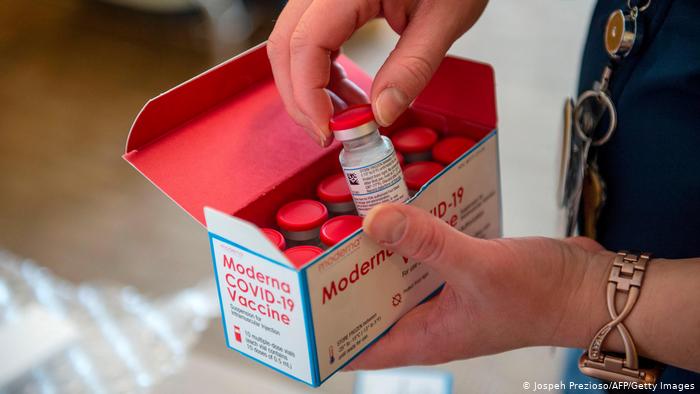
German vaccination centers received the first doses of the Moderna vaccine on Tuesday, as health officials ramp up a vaccination campaign that has been criticized for its relatively slow start.
The first doses arrived at German storage facilities in Lower Saxony on Monday.
Over 63,000 doses were shipped out on Tuesday, and some 2 million doses are expected to be delivered to Germany's 16 federal states by the end of March, according to the German Ministry of Health.
Up to 50 million doses of the Moderna vaccine are expected to be shipped to Germany by the end of 2021.
Vaccination off to sluggish start
Hundreds of vaccination centers have been set up across Germany in sports halls and arenas, with capacity for up to 300,000 shots a day, according to Health Minister Jens Spahn.
However, Germany's federal states have criticized the central government for not securing enough doses.
More than 600,000 people in Germany have received a first dose of the Covid vaccine, according to the Robert Koch Institute (RKI), which is little less than half of the 1.3 million doses that were supplied in a first shipment at the end of December.
Another 2.7 million doses of the BioNTech-Pfizer vaccine are expected by mid-February, according to the Health Ministry.
Tobias Kurth, director of the Insitute for Public Health (IPH) at Berlin's Charite Hospital told DW that the vaccination drive will take time to be fully rolled out.
"The numbers of people who have been vaccinated in Germany or in other countries is not enormous," he said. "We need several weeks and months before we see a turnaround in the number of infections because of the vaccination."
On Tuesday, the RKI reported a record number of vaccinations, with over 60,800 people receiving a shot. Vaccinations in Germany are entirely voluntary.
Equivalent to BioNTech-Pfizer
Vaccinations using BioNTech-Pfizer vaccine, the first to receive EU approval, began in Germany on December 27.
Like the BioNTech-Pfizer, Moderna's vaccine is also a so-called mRNA vaccine, a new kind of vaccine that teaches cells how to trigger a immune response to the virus without injecting parts of that virus into the body.
Thomas Mertens, the head of Germany's vaccine commission, said that both vaccines are "equivalent in effectiveness and safety."
Latest Stories
-
Total revenue & grants stood at GH¢144.5bn in July 2026, lower than targeted amount – BoG
9 minutes -
Ghana Sports Fund urges sports federations to submit credible proposals and measurable targets
13 minutes -
Musk says US government may be behind slowdown of Ukraine drone speeds
30 minutes -
Picking Chief Justices nearing retirement could give Mahama immense power – Bentil
40 minutes -
Netflix to shed 1,000 jobs in steepest cuts since 2022
1 hour -
Burnham had two hospitality dinners with Man City chairman, deleted records show
1 hour -
Semenyo ‘froze’ after alleged racist abuse, court told
1 hour -
‘Shameless’ – Mourinho critical of Vinicius Jr ban timing
2 hours -
Loyalty can outweigh competence in Chief Justice selection – Bentil
2 hours -
Man City suffer as PSG masterclass sets up Champions League win
2 hours -
Customer Service Africa CEO urges business leaders to observe staff and customer interactions
2 hours -
On night of mayhem for Liverpool, Barcola arrives in style
2 hours -
Muzic Mensah finds healing and renewed love in new single ‘WayƐ Late’
2 hours -
FIFA to offer extra £2.6bn for football development
2 hours -
Government backing is no EPA permit – Authority warns GoldBod, ministries
3 hours