

Audio By Carbonatix
Cultural theorist, financier, and gallerist V. L. K. Djokoto has delivered a thought-provoking assessment of President John Dramani Mahama’s first year in office, describing the administration not merely as a series of policy shifts but as a fundamental attempt to redefine Ghana’s relationship with its colonial legacy.
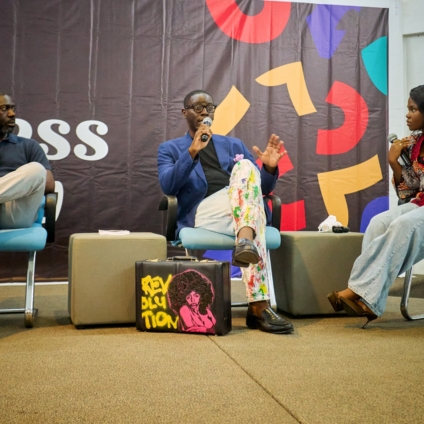
Djokoto, 30, managing partner of the historic family office D. K. T. Djokoto & Co. and Editor-in-Chief of the Accra Evening News, frames Mahama’s return to the presidency as “an experiment in dialectics — the return of the same that is no longer identical, the repetition that constitutes difference, the historical spiral that ascends rather than merely circles.”
“What we witness in Ghana is nothing less than an experiment. This nation became the stage for the first democratically elected non-consecutive second term,” Djokoto said.
“Here was a leader returning to power after eight years in the wilderness — not through revolution or constitutional manipulation, but through the ballot box. The question is not whether Mahama can govern. The question is whether democratic systems possess within themselves the capacity for evolution through their own cycling.”
Central to Djokoto’s analysis is the 24-hour economy initiative, which he interprets not merely as a labour policy but as an effort at “the decolonisation of time itself.”
He argues that the traditional eight-hour workday, imported from industrial Manchester, bears little relation to Ghana’s tropical climate, agricultural cycles, or indigenous conceptions of labour and rest.
“The 24-hour economy represents sovereignty — the right of a postcolonial nation to construct its own chronology rather than perpetually inhabiting time zones established by empire,” he said.
Djokoto, who previously led the communications team for Vice President Jane Naana Opoku-Agyemang during the 2020 campaign, does not shy away from the contradictions in Mahama’s governance: austerity alongside ambition, heritage invocation alongside technological embrace, claims of African authenticity alongside global capital integration.
He frames these tensions as structural necessities rather than policy failures. “To govern postcolonial Ghana is to occupy the space between, to make decisions within overlapping but incommensurable value systems,” he said.
While acknowledging measurable economic improvements — including inflation dropping from 24% to 13.7% and the cedi strengthening by 48% against the US dollar — Djokoto raises philosophical questions about the translation of statistics into lived experience. “Numbers improve, but does suffering diminish? Markets stabilise, but do opportunities expand?”
Djokoto also contextualises the historic inauguration of Professor Jane Naana Opoku-Agyemang as Ghana’s first female Vice President through the lens of “epistemic justice.” He cautions, however, against “naive celebration,” emphasising that the mere presence of women in positions of authority does not automatically ensure feminist governance.
Even the $10 billion “Big Push” infrastructure initiative receives philosophical treatment in his analysis. Djokoto suggests that infrastructure is both physical and metaphysical, determining whose mobility matters, whose connections count, and which regions are integrated into the national framework. He points to the Wenchi-Wa road, connecting Bono East, Savannah, and Upper West Regions to Burkina Faso and Mali, as evidence of “sophisticated geoeconomic thinking” that strengthens Ghana’s regional position.
In his recent book Revolution, Djokoto chronicles Anlo heritage alongside contemporary Ghanaian politics, framing Mahama’s first year as one of “not synthesis but suspension — holding contradictions in productive tension rather than collapsing them prematurely.” He concluded: “History will judge not whether Mahama succeeded in constructing a 24-hour economy or attracting diaspora tourism, but whether he expanded what Ghanaian governance can imagine and attempt.”
Djokoto has emerged as one of Ghana’s leading young cultural theorists. His Ka xoxowo Salon in Airport Residential hosts intellectual gatherings and showcases emerging artists, while D. K. T. Djokoto & Co, established in 1950, has advised institutions including the European Union in Ghana, the Ministry of Finance, and the Ghana Investment Promotion Centre.
Whether Djokoto’s philosophical framing resonates beyond academic circles remains uncertain, but his intervention offers a distinctive perspective on Ghana’s trajectory under Mahama, insisting that governance is inseparable from questions of culture, time, identity, and historical consciousness.
Latest Stories
-
Venezuela frees 39 political prisoners after post-Maduro talks
14 minutes -
EU unlocks humanitarian aid for crises worldwide
17 minutes -
Tenth woman’s body found as South Africa police probe killings
26 minutes -
Black woman found hanging from tree was dead before body was ‘staged’, police say
30 minutes -
Final day: 3rd Republic Bank-JoyNews Habitat Fair clinic underway at Junction Mall, Nungua
32 minutes -
Nor’easter brings flooding as New York and New Jersey declare emergency
43 minutes -
Africa’s richest man helps fund $660m fuel pipeline between Ethiopia and Djibouti
1 hour -
Security lapses at Utah campus where Charlie Kirk was killed, review says
1 hour -
White House bars CNN from travelling with Trump on Air Force One
1 hour -
Pope praises young people’s ‘energy and commitment’ at huge open-air Mass in Paris
2 hours -
Nyankamam residents benefit from free medical screening, healthcare outreach
2 hours -
Ghana, Boeing explore setting up regional aircraft maintenance hub
2 hours -
Bangkok roads submerged as flood disaster declared
2 hours -
Four killed in helicopter crash near Montreal
2 hours -
Ghana could have national airline back in skies within 18 months – Boeing to Mahama
2 hours