

Audio By Carbonatix
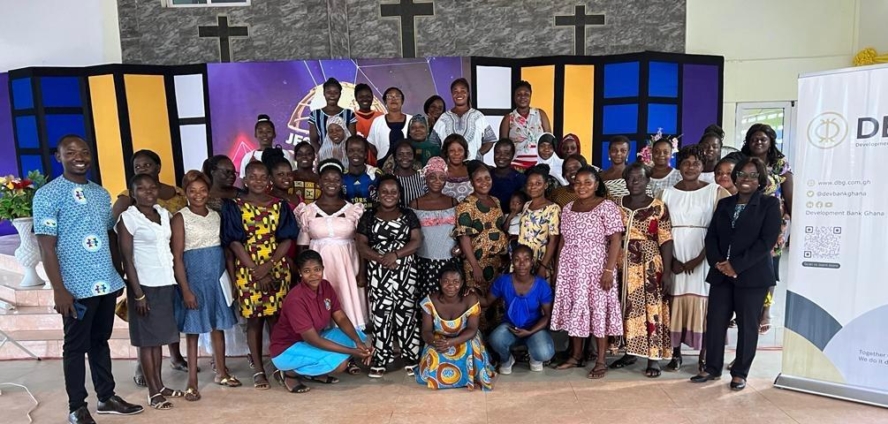
Development Bank Ghana (DBG) and Ghana Enterprises Agency (GEA) have successfully concluded a series of capacity-building training programmes aimed at women-led Micro, Small, and Medium Enterprises (WMSMEs).
The programmes which form part of a collaborative agreement between DBG and the GEA, formerly known as the National Board for Small Scale Industries (NBSSI), seek to support female entrepreneurs running micro, small and medium-sized businesses.
Since it began operations in 2022, DBG has been intentional about making businesses bankable with the objective to make them attracting the right funding to upscale their operations.
In making businesses bankable, DBG recognises capacity-building, especially, training as a key vehicle in achieving this aim.
It is against this effort that DBG entered into an agreement with GEA as a key Partner in rolling out capacity-building programmes, particularly for female-owned/led businesses.
Phase 1 of the training series which took place across the southern zone of the country comprising the Greater Accra Region, Western, Eastern, Central, Volta and the Oti Regions, recorded a total of 1,204 Entrepreneurs (1,197 Females and 7 Males) in attendance.
Participants were taken through various themes including Business Planning Process, Financial Management, and Marketing which includes advertising, promotion and the use of social media as a tool to grow businesses.
Manager, Business Development Services (Gender & Youth) of DBG, Sefakor Carlotta Boadu, reiterated at the various sessions of some of the training programmes, the need for women to be empowered and the need for women to realise that they are capable and able to lead businesses that can grow to become generational enterprises.
The Deputy Chief Executive Officer of GEA, Mrs Anna Armo-Himbson, monitored some of the Training Workshops in the Greater Accra and Western Regions.
She expressed excitement at collaborating with DBG to promote women entrepreneurs as a pipeline for financial support through DBG's PFIs. She said the effort was clearly aligned to GEA's focus to support women-owned/led businesses to enable them to rub shoulders with their male counterparts.
She encouraged them to participate fully in the training and apply the skills to enhance their business operations so that they effectively compete and contribute towards Ghana’s economic development.
In Ghana, women-owned businesses contribute significantly to the growth and development of the economy, and account for 44 percent of all Micro, Small and Medium Enterprises (MSMEs) in the country.
The contribution of women-owned businesses in Ghana is further emphasised in the MasterCard Index of Women Entrepreneurs which in 2020 ranked Ghana (36.5 percent) among the world’s three leading economies with the most women-owned businesses with Uganda (39.6 per cent) and Botswana (38.5 per cent).
The training organised by the two institutions is expected to impact over 3,000 women across all 16 Regions of Ghana. It is also expected that 1,000, out of that number would be onboarded onto the Ghana Integrated Financial Ecosystem (GIFE) and also go on to gain certification on the Pillar 1 of GIFE that is the SME Financial Empowerment (SFE) component.
The Project is also anticipated to create 1,200 sustainable jobs and a further 1,000 businesses linked to wider markets across the globe.
Ghana Enterprises Agency (GEA) is the apex governmental body dedicated to the promotion and development of MSMEs in Ghana.
With the passage of Act 1043 by Parliament in 2020 and assented to by the President, GEA is mandated to coordinate, implement and monitor the activities of the MSME Sector in Ghana.
Development Bank Ghana is a wholesale financial institution established by the Government of Ghana. DBG acts as a provider of long-term capital to the market with a mission to foster strong partnerships to finance economic growth, create jobs, and build capacity for SMEs. The organisation is committed, aligned and strengthened to achieve UN Sustainable Goals (SDGs) ambitions and targets while implementing environmental, social, and governance (ESG) strategy aimed at creating shared value and impact with purpose.
Latest Stories
-
How does a Ghanaian team make it to the BAL?
32 minutes -
Ghana’s investment climate presents opportunities for industrial growth and job creation.
32 minutes -
‘I paid thousands to a company for jobs that never came’
46 minutes -
SSNIT intensifies informal sector enrolment drive with Techiman float
1 hour -
Ghana seeks long-term mining investments that benefit local communities – Armah-Kofi Buah
1 hour -
GHATOF demands compensation for 85 businesses affected by La Pleasure Beach demolition
1 hour -
Bono Regional Minister calls for investor education to drive economic growth
1 hour -
Ghana’s Ambassador to China, Kojo Bonsu, presents credentials to Nepalese President
1 hour -
Fairtrade Africa’s Cocoa Hubs Project strengthens rural service centres in cocoa-growing communities
2 hours -
MPs are not development officers – Edem Kpotosu
2 hours -
SEC cautions investors against fraudulent investment schemes
2 hours -
Land Ministry urges rCOMSDEP operators to reserve earnings for land reclamation
2 hours -
Commercial drivers give authorities one week to clear traders from lorry terminals, bus stops
2 hours -
Trump calls off livestream of Fort Hood attacker’s execution by firing squad
2 hours -
Nana B denies claims that Kojo Bamba was his driver and bodyguard
2 hours