


Audio By Carbonatix
The world is facing an "unrelenting march" of diabetes which now affects nearly one in 11 adults, the World Health Organization (WHO) says.
In a major report it warned cases had nearly quadrupled to 422 million in 2014 from 108 million in 1980.
High blood sugar levels are a major killer - linked to 3.7 million deaths around the world each year, it says.
And officials said the numbers would continue to increase unless "drastic action" was taken.
The report lumps both type 1 and type 2 diabetes together, but the surge in cases is predominantly down to type 2 - the form closely linked to poor lifestyle.
As the world's waistlines have ballooned - with one-in-three people now overweight, so too has the number of diabetes cases.

Dr Etienne Krug, the WHO official in charge of leading efforts against diabetes, told the BBC: "Diabetes is a silent disease, but it is on an unrelenting march that we need to stop.
"We can stop it, we know what needs to be done, but we cannot let it evolve like it does because it has a huge impact on people's health, on families and on society."
Failing to control levels of sugar in the blood has devastating health consequences.
It triples the risk of a heart attack and leaves people 20 times more likely to have a leg amputated, as well as increasing the risk of stroke, kidney failure, blindness and complications in pregnancy.

Diabetes itself is the eighth biggest killer in the world, accounting for 1.5 million deaths each year.
But a further 2.2 million deaths are linked to high blood sugar levels. And 43% of the deaths were before the age of 70.
Moving burden
In the 1980s the highest rates were found in affluent countries.
But, in a remarkable transformation, it is now low and middle income countries bearing the largest burden.
Dr Krug told the BBC News website: "That's where we see the steepest increase. Knowing that's where most of the population lives in the world, it does show numbers will continue to increase unless drastic action is taken."
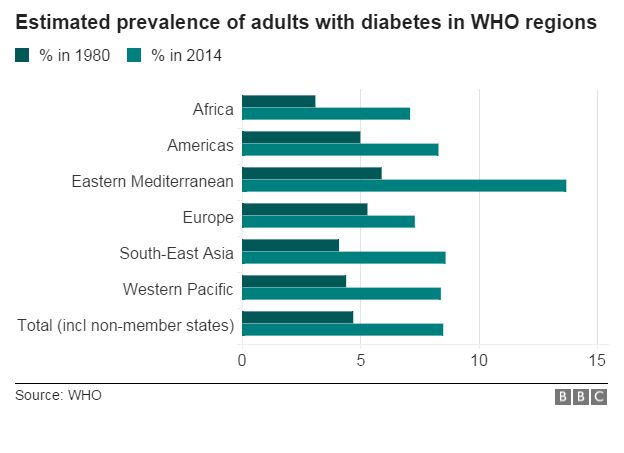
The Middle East has seen the prevalence of diabetes soar from 5.9% of adults in 1980 to 13.7% in 2014.
Dr Slim Slama, a WHO specialist in region, told the BBC News website: "We are the region that has experienced the greatest rise in diabetes, moving from 6 million to 43 million - it is a huge, huge increase.
"In Qatar or Kuwait we have more than 20% of the population with diabetes and when you look at subgroups - people beyond 45 or 60 years old - it's 30-40% and things are even more worrying."
He said growing and ageing populations were behind part of the rise, but diet and inactivity were a major problem.
More than three quarters of teenagers in the region are doing less than the recommended level of exercise, he said.
Latest Stories
-
GABET raises concerns over teacher training and resources for new SHS curriculum
3 seconds -
Daily Insight for CEOs series
9 minutes -
Government moves to make public institutions buy from Ghanaian farmers
14 minutes -
Diesel price to remain below GH¢20 per litre in October after government intervention – NPA
18 minutes -
Yaw Ampofo Ankrah suspended as NSA Director-General amid World Cup visa controversy
22 minutes -
SSNIT increases stake in Societe Generale Ghana to 24.36%
37 minutes -
Africa cannot rely on government budgets alone to finance climate ambitions – Deputy Finance Minister
57 minutes -
COMAC gives Finance Ministry 14 days to suspend implementation of Section 136 of Customs Act
57 minutes -
WhatsApp introduces optional parental controls for teenagers
60 minutes -
Afoko could help Bawumia pursue ‘clean break’ ahead of 2028 – Dr Amakye-Boateng
1 hour -
Global Capacity Hub conference connects Ghanaian businesses to technology, investment opportunities in London
1 hour -
Overcharge passengers and face sanctions, GPRTU warns drivers
1 hour -
Government seeks $165m to complete operational phase of Boankra Integrated Logistics Terminal
1 hour -
‘Show us the evidence’ – Upper West teachers demand proof of arrears payments
1 hour -
GH¢1 D-Levy suspension will offer relief to fuel consumers – COPEC
1 hour