


Audio By Carbonatix
Kojo Baffour Ahenkora has been been battling with end-stage kidney failure for eight years. His kidneys are unable to filter blood, extract excess water for proper urination or perform other functions properly.
In order to survive, he has become has become a regular visitor at the Korle Bu Renal Unit. Each week, he visits the health facility three times to get the assistance of the dialysis machine to perform the duties of his once healthy kidneys.
However, the cost involved with the dialysis treatment makes him wonder how much longer he can undergo the procedure.
Over the past week, people living with kidney failure have been at the forefront of news coverage because of the recent hike in the price of dialysis treatment at the Korle Bu Teaching Hospital.
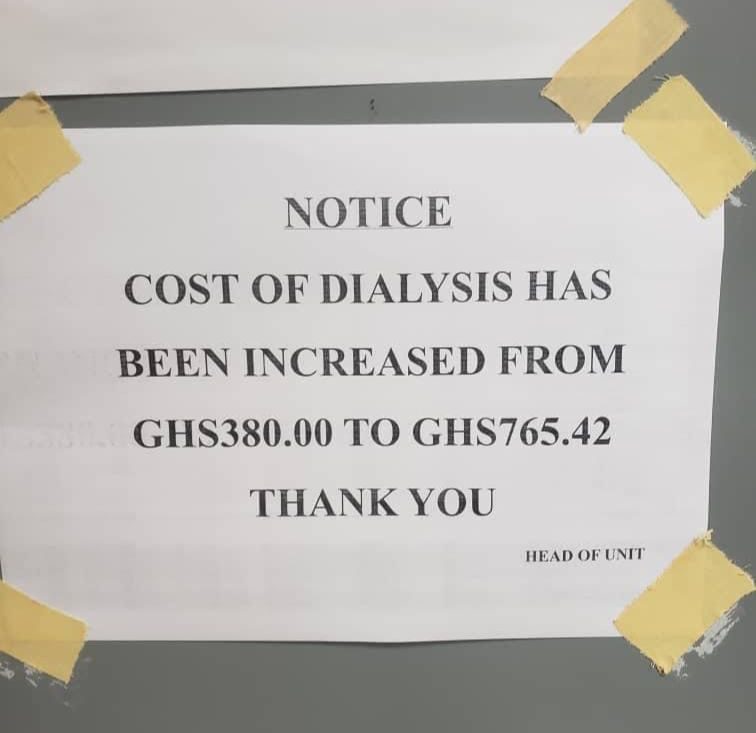
The Korle Bu Teaching Hospital earlier blamed the high cost of taxation for the recent increase in the cost of dialysis.
The news, in the days that followed, has given the general public an insight into the huge costs patients and their families are incurring because of their illness.
Mr Ahenkora says although he has been on dialysis for nearly decade, it doesn't get easier. For him, he has been able to meet the financial demands of treatment because of a charity organisation that works with Korle Bu and with the help of friends and family.
Speaking at JoyNews’ Thought Leadership Event on dialysis, Mr Ahenkora said that without that help many patients would not be alive today.
However, since the limitation of dialysis to emergency cases at Korle Bu due to a shortage in consumables, he says getting treatment at private facilities has become a challenge.
This is because they have to pay between GH₵500 to GH₵1000 every session, he said. Mr Ahenkora added that because he is not fit, he is jobless and unable to solely get those funds for his sessions.
“On my diagnosis, I'm supposed to do three (dialysis a week), but I don't have the means, so I do twice a week. Even twice a week, I'm not able to do it. I manage it sometimes and go for once a week,” he added.
Mr Ahenkora noted that although he has loved ones who help sometimes, it is not enough and has to resort to calling friends and other companions for help. Unfortunately, some of them have also started to avoid his calls.
“Now we are becoming a burden to society. You pick up a phone, you want to call your friend and he knows you're coming to ask for money so they don't answer the call…eventually you turn into a beggar and it's so embarrassing. Sometimes, like I keep saying, you wish one day you wake up and you are gone peacefully.”
“It's almost about a week, I have not gone for it (dialysis) I'm just managing the situation…sometimes you can't sleep at night, you can't breathe when you lie down, so, you have to sit down throughout the night. But if the money is there and you are doing regular dialysis, you will be fit. So it's a very challenging issue.”
Mr Ahenkora said that hospitals are not charity homes to be offering the services for free and thus it is important for the government to provide aid for patients.
Also on the show, a patient, Thomas Vincent Cann, said having renal failure for a decade has been not just physically draining but emotionally and psychologically as well, for him, his family and his friends.
Mr Cann said in the early days of his diagnosis he had to be referred to see a psychologist adding “I was going through a lot and there are times that I wanted to give up, there are times you want to end it all, die peacefully and then everything ends.”
“There were times it got to that stage, you question is it really worth it, struggling and all of that. But I went through psychological therapy and that even boosted my confidence. Because there were times I didn't want to see my own picture I couldn't look into the mirror. I had changed physically, everything had changed and I kind of didn't like what I was seeing. The new me that I was seeing was really hard to take,” Mr Cann said.
He added that on top of his issues, his friends had to use the media to raise funds for his dialysis treatment and he found himself being talked about on radio and TV. He avoided the media so he could stop hearing people talk about him.
It has been a decade and although he works, Mr Cann says that the treatment can have an effect on a person’s productivity.
He stated that because of the long queue at the facility, he gets to the hospital as early as 3:30 a.m., queue for about four hours, sit for the treatment that takes about four hours and even after he feels drained.
Mr Cann said if he does not go early, it means he will not be able to leave the hospital early and make time for work.
“Thankfully my bosses understand me so sometimes I get that flexibility to sometimes you know go to work and all that,” he added.
Latest Stories
-
Iran war lands ‘triple blow’ to flood-ravaged Sri Lankans
25 minutes -
Gunmen kill at least 11 people at Afghanistan picnic spot
39 minutes -
Woman, 25, in court for stealing baby at Bogoso
40 minutes -
Trump unveils giant gold-accented victory arch design for US capital
43 minutes -
We spoke to the man making viral Lego-style AI videos for Iran. Experts say it’s powerful propaganda
48 minutes -
Hungarians vote in big numbers on whether to end Orbán rule and elect rival
48 minutes -
At least 30 feared dead in crush at Haitian tourist site
49 minutes -
Boxing: Abdul Ahmed wins WBA Africa Cruiserwight title after dispatching Nigeria’s Eradeye
1 hour -
Nearly 2,000 displaced, schools damaged as windstorm wreaks havoc in Gushegu
1 hour -
Ghana’s Derrick Kohn to work under Marie-Louise Eta as she becomes first woman to coach men’s Bundesliga team
1 hour -
Accra Open Championships conclude with strong performances ahead of African Championships
2 hours -
Ghana to begin camping with 12 athletes after Accra Open Championships – Bawa Fuseni
2 hours -
Anthony Joshua declines showdown with Tyson Fury but admits they ‘probably’ clash next
2 hours -
Tyson Fury dominates Makhmudov, calls out Joshua next
2 hours -
I have supported highway authority financially to fix roads in my constituency – A Plus
4 hours