

Audio By Carbonatix
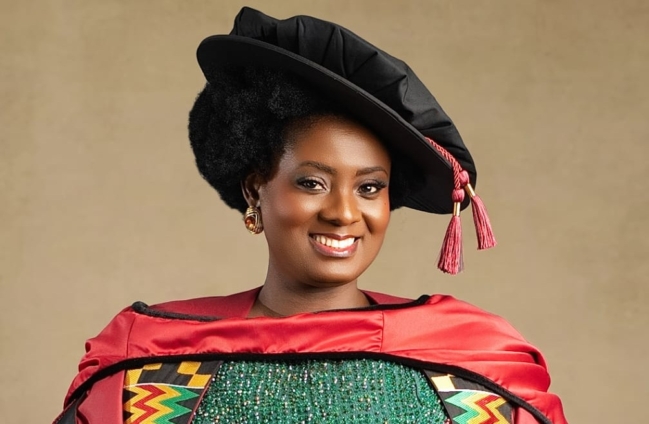
Former Deputy Minister for Communications, Victoria Lakshmi Hamah, has added a new academic milestone to her career after earning a Doctor of Philosophy (PhD) in Public Administration from the University of Ghana Business School (UGBS).
Dr. Hamah’s degree was conferred on Tuesday, February 10, 2026, at the Great Hall, celebrating a moment of academic excellence, resilience, and impactful scholarship. The achievement follows years of dedicated research examining women’s representation and influence in Ghana’s parliamentary system.
Her dissertation, titled “Gender Asymmetry in Ghana’s Parliamentary Committees: A Critical Analysis of Women’s Representation and Legislative Influence”, offers a rigorous examination of the institutional and cultural dynamics that shape women’s participation in legislative leadership.
Gendered scrutiny
In a reflective statement shared on her Facebook page titled ‘Humble Recollections: From Storming Seas to the calm Shore: My Doctoral Journey Through Power and Gender’, Dr. Hamah described earning her PhD as a significant milestone in a journey shaped by her experiences with power, gender, and political scrutiny in Ghana’s public life.
She also noted that her story had often been defined by reductive narratives rather than the structural realities of women’s leadership in politics.
“The narrative of my public life over a decade, unfortunately, has been reduced to scandal,” she wrote, stressing that such framing is “analytically convenient rather than empirically faithful.”
According to her, the challenges she faced in government were not rooted in incompetence but in a broader political culture uncomfortable with women who assert authority without apology. She noted that her appointment as Deputy Communications Minister was accompanied by “sustained challenges to legitimacy that bore little relation to competence or mandate.”
Dr. Hamah recounted how her visibility in power became intensely gendered, stating that “my body became a site of public scrutiny, my confidence recoded as excess, and my political presence constrained by a culture uneasy with women who occupy power without deference.”
Institutional hypocrisy
Reflecting on the controversy that later surrounded her time in office, she said the response from the institution felt more moralistic than fair, focusing on punishment rather than taking the full context into account.
“When my public controversy emerged, the institutional response was swift, moralistic, and largely indifferent to context,” she wrote, adding that accountability was used selectively while “structural hypocrisy remained uninterrogated.”
For Dr. Hamah, the episode revealed deeper institutional flaws within Ghana’s political system, including “a preference for spectacle over justice, and a willingness to sacrifice women to preserve institutional comfort rather than confront its own contradictions.”
However, she insisted that her exit from executive office did not represent defeat. Instead, she said it marked the beginning of a new phase of political engagement through scholarship. “My departure from office did not signal retreat, but a critical reckoning,” she explained, rejecting the notion that removal from office amounts to erasure.
She described her decision to pursue doctoral study as intentional, not escapist. “I turned to systematic inquiry as the continuation of my political engagement through scholarly means.”
Dr. Hamah’s dissertation
Her dissertation examines how “institutional design, political culture, and asymmetrical power relations condition women’s participation and constrain their legislative influence.”
Dr. Hamah emphasised that her work was grounded in empirical analysis rather than personal narrative, noting: “This work is not autobiographical reflection disguised as scholarship; it is a rigorously grounded political intervention informed by lived experience and sustained empirical analysis.”
Beyond academia, she highlighted her long-standing advocacy for women’s political empowerment through the Progressive Organisation for Women’s Advancement (POWA), which she founded to protect women operating within “structurally hostile environments”.
“Women’s political participation must be actively protected,” she emphasised, explaining that her experiences in government only “sharpened my understanding of its necessity.”
System change
Dr. Hamah noted her focus was not on personal redemption but systemic change. “My intellectual and professional trajectory is not oriented toward rehabilitation or redemption, but toward transformation.”
Positioning herself as both scholar and practitioner, she argued that she now understands power “both from within institutional authority and from its margins.”
Dr. Hamah further reflected on political vulnerability as a form of exposure and strength: “I have learned that in politics, falling is not synonymous with failure; often, it signals that one has exposed what the system would rather leave unseen. That exposure, in itself, is a form of power,” she concluded.
Dr. Hamah recently spent two months in the Czech Republic on an Erasmus Exchange Programme at the Mendel University to enhance the competencies of her PhD research.
In 2024, she was also selected for the Bergen Summer Research School organised by the University of Bergen in Norway, where she undertook a course in Artificial Intelligence (AI) in Education.
Latest Stories
-
“Whatever the decision of CAS, we will respect it” – CAF President Motsepe after AFCON final meetings in Morocco
49 seconds -
Emma Ankrah: When waiting becomes part of treatment – Reflections on hospital care
4 minutes -
Ghana urges travellers to prepare for new EU border system roll-out
14 minutes -
Mahama enforces fuel coupon ban for ministers as cabinet moves to slash fuel taxes
18 minutes -
Task force probes strange fish deaths in Tema
21 minutes -
Neglected traffic lights turn Awoshie–Anyaa highway into deadly hotspot
42 minutes -
EOCO declares Dr Gabriel Tanko Kwamigah-Atokple a fugitive over alleged gold fraud
54 minutes -
GSE records GH¢1.09bn trade in equity market; 10 stocks register gains
1 hour -
Fuel prices: Ghana places 15th in Africa
1 hour -
Africa must look inward: Reframing resilience in a shifting global economy
2 hours -
7 dead, 2 missing after boat capsizes on Volta Lake
2 hours -
Miss Diaspora Ghana 2026 launched to deepen diaspora ties and drive development
2 hours -
US issues travel warnings for Nigeria and São Tomé and Príncipe as security risks mount
2 hours -
Ivan Toney questions refereeing in Saudi Pro League title race after Al-Ahli draw
2 hours -
Angola appoint Aliou Cissé as new head coach
2 hours