


Audio By Carbonatix
When it comes to height, Dutch men and Latvian women tower over all other nationalities, a new study confirms.
The average Dutchman is now 183cm (6ft) tall, while the average Latvian woman reaches 170cm (5ft 7in).
The research, published in the journal eLife, has tracked growth trends in 187 countries since 1914.
It finds Iranian men and South Korean women have had the biggest spurts, increasing their height by an average of more than 16cm (6in) and 20cm (8in).
In the UK, the sexes have gone up virtually in parallel by about 11cm (4in). "Mr Average" in Britain is now 178cm (5ft 10in) tall; Ms Average stands at 164cm (5ft 5in).
This contrasts for example with men and women in the US, where the height of the nation's people started to plateau in the 1960s and 1970s. Over the century, they have seen increases of just 6cm and 5cm (a couple of inches), respectively.
Indeed, Americans have tumbled down the rankings. Back in 1914, they had the third tallest men and fourth tallest women on the planet. Today they are in 37th and 42nd place.
The height charts are now utterly dominated by European countries, but the data would suggest that growth trends in general in the West have largely levelled out.
The smallest men on the planet are to be found in East Timor (160cm; 5ft 3in).
The world's smallest women are in Guatemala, a status they also held back in 1914. According to the survey data, a century ago the average Guatemalan 18-year-old female was 140cm (4ft 7in). Today she has still not quite reached 150cm (4ft 11in).
East Asia has seen some of the biggest increases. People in Japan, China and South Korea are much taller than they were 100 years ago.
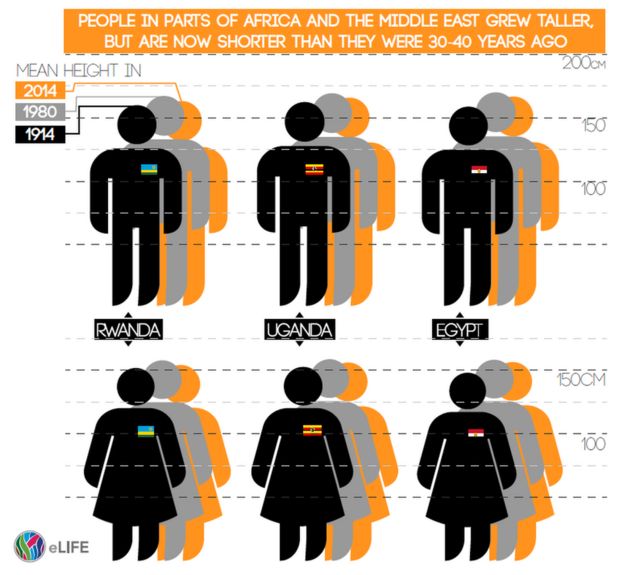
"The parts of the world where people haven't got particularly taller over this 100 years of analysis are in South Asia (such as India, Pakistan and Bangladesh) and in sub-Saharan Africa. Here the increase in height is between 1-6cm in those regions," explained co-author James Bentham from Imperial College London.
In fact, in parts of sub-Saharan Africa, average heights have actually fallen since the 1970s. Nations like Uganda and Sierra Leone have seen a few centimetres come off the height of the average man.
Some of the variation in height across the globe can be explained by genetics, but the study's authors say our DNA cannot be the dominant factor.
Lead scientist Majid Ezzati, also from Imperial, told BBC News: "About a third of the explanation could be genes, but that doesn't explain the change over time. Genes don't change that fast and they don't vary that much across the world. So changes over time and variations across the world are largely environmental. That's at the whole population level versus for any individual whose genes clearly matter a lot."
Good standards of healthcare, sanitation, and nutrition were the key drivers, he said. Also important is the mother's health and nutrition during pregnancy.
Other research has shown that height is correlated with both positive outcomes and a few negative ones.
Tall people tend to have a longer life expectancy, with a reduced risk of heart disease. On the other hand, there is some evidence that they are at greater risk of certain cancers, such as colorectal, postmenopausal breast and ovarian cancers.
"One hypothesis is that growth factors may promote mutated cells," said another Imperial co-author, Elio Riboli.
The eLife paper - A Century of Trends in Adult Human Height - was put together by the NCD Risk Factor Collaboration, a group of 800 or so scientists, in association with the World Health Organization.
The work, which was funded by the Wellcome Trust and Grand Challenges Canada, was presented here in Manchester at the biennial EuroScience Open Forum.
The nations with the tallest men in 2014 (1914 ranking in brackets):
- Netherlands (12)
- Belgium (33)
- Estonia (4)
- Latvia (13)
- Denmark (9)
- Bosnia and Herzegovina (19)
- Croatia (22)
- Serbia (30)
- Iceland (6)
- Czech Republic (24)
The nations with the tallest women in 2014 (1914 ranking in brackets):
- Latvia (28)
- Netherlands (38)
- Estonia (16)
- Czech Republic (69)
- Serbia (93)
- Slovakia (26)
- Denmark (11)
- Lithuania (41)
- Belarus (42)
- Ukraine (43)
Latest Stories
-
GABET raises concerns over teacher training and resources for new SHS curriculum
21 seconds -
Daily Insight for CEOs series
10 minutes -
Government moves to make public institutions buy from Ghanaian farmers
14 minutes -
Diesel price to remain below GH¢20 per litre in October after government intervention – NPA
18 minutes -
Yaw Ampofo Ankrah suspended as NSA Director-General amid World Cup visa controversy
22 minutes -
SSNIT increases stake in Societe Generale Ghana to 24.36%
37 minutes -
Africa cannot rely on government budgets alone to finance climate ambitions – Deputy Finance Minister
58 minutes -
COMAC gives Finance Ministry 14 days to suspend implementation of Section 136 of Customs Act
58 minutes -
WhatsApp introduces optional parental controls for teenagers
1 hour -
Afoko could help Bawumia pursue ‘clean break’ ahead of 2028 – Dr Amakye-Boateng
1 hour -
Global Capacity Hub conference connects Ghanaian businesses to technology, investment opportunities in London
1 hour -
Overcharge passengers and face sanctions, GPRTU warns drivers
1 hour -
Government seeks $165m to complete operational phase of Boankra Integrated Logistics Terminal
1 hour -
‘Show us the evidence’ – Upper West teachers demand proof of arrears payments
1 hour -
GH¢1 D-Levy suspension will offer relief to fuel consumers – COPEC
2 hours