

Audio By Carbonatix
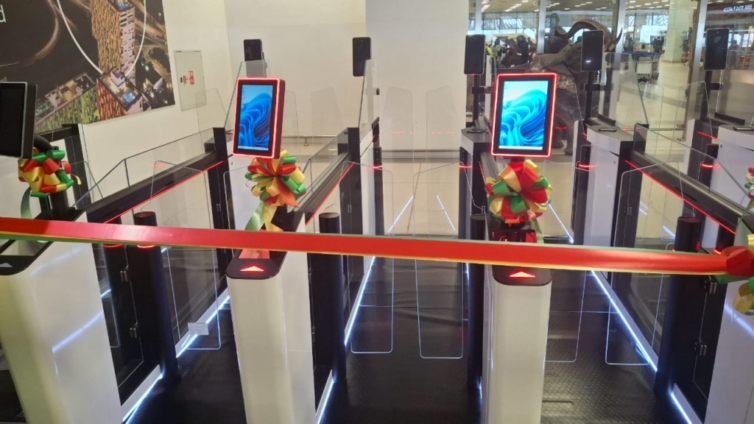
The Ghana Immigration Service (GIS) has refuted false claims on social media that the recently commissioned electronic gates at the Kotoka International Airport (KIA), cost the nation $240m.
In a press release issued on Thursday, December 19, 2024, GIS stated emphatically that the installed E-gates at the KIA, cost the nation $1.7m and not $240m as falsely claimed.
The statement further explained that the GIS is implementing a new integrated border management system known as the "Immigration 360", at all of the nation's entry points, and ceased the opportunity to present in detail, various components and costs of the integrated border management system, which has the installation of the e-gates as a component of the system.
"The Ghana Immigration Service is implementing a new integrated border management system known as the “Immigration 360”.
"The system seeks to fully automate passenger processing and data management at all the forty-eight (48) approved entry/exit points to Ghana and other operational commands. The new system seeks to address challenges with sovereignty, interoperability and other inadequacies associated with the existing systems installed at twelve (12) approved borders," said the press release.
"It is inaccurate that the e-Gate system installed at the KIA cost a total amount of $240 million dollars."
"The e-Gate system alone (comprising 15 units of e-Gates with accessories) which form part of the border management system being installed at KIA costs $1.7 million (i.e., $1,760,479.80)."
With regards to the $240m being mentioned, the Ghana Immigration Service explained it is for the entire cost of phase one and two of the border management system at all of the nation's 48 entry points, including installations, maintenance, licensing and taxes.
"The $240 million referenced in the circulating article on social media is in relation to the whole cycle cost of the project (including the initial implementation cost of $94,664,374.57)," the statement said.
"The $240 million includes two (2) periodic wholesale upgrades of the critical components of the system and cost of maintenance and licenses over the 10-year cycle of the project."
"The first upgrade type is in three (3) replacement cycles of key components of the system. The second upgrade type is two (2) 5-year upgrade cycles within ten (10) years to replace major components of the technical infrastructure. This is to ensure a refresh of the system at all times and to ensure the hand back of a brand-new system at the end of the ten-year period."
"After accounting for VAT and other taxes, the total comes to $274 million, which includes maintenance and hands-on support services over a ten-year period to guarantee the system is operational around-the-clock."
Latest Stories
-
Star Oil paid GH¢2.7bn in taxes, levies in nine months of 2026
14 minutes -
Samson’s Take: The rule of law is cheaper before the bulldozer
15 minutes -
GRA blames system failure for delay in issuing receipt over passenger’s customs duty
36 minutes -
Livestream: Newsfile discusses World Cup visa scandal, beach demolitions, education strikes, BRICS bid
40 minutes -
NC-PTAs welcomes end of teachers’ strike, urges parents to prepare children for Monday
50 minutes -
Government procures over 2,000 transformers as Ghana’s electricity access hits 89.13% – Energy Minister
1 hour -
UTAG-UG threatens strike on October 19 over unpaid allowance
1 hour -
Let The Constitution direct Chieftaincy to deliver “All Development Is Local”
3 hours -
John Jinapor outlines renewable energy, nuclear power priorities for 2027
3 hours -
Ghana explores centre of excellence for hearing, communication and cochlear implant care
4 hours -
Schizophrenia-related disorders lead mental health cases recorded in Ghana
4 hours -
Dutch authorities enlist Ghana in hunt for fugitive drug lord Bolle Jos
5 hours -
Ghana housing finance conference adopts communiqué to improve affordable housing access
9 hours -
Special Initiatives Minister urges Wa Technical Institute to enrol more girls as EU-backed solar training lab opens
10 hours -
In the matter of my first year at the Bar
10 hours