


Audio By Carbonatix
Travel to the US is falling, a decline some in the tourism industry blame on US President Donald Trump.
The number of international visitors fell by 4% in the first seven months of 2017, according to the US National Travel & Tourism Office.
The trend occurred across all regions, with Africa and the Middle East reporting some of the most dramatic declines.
The decrease in the US contrasts with rising tourism globally.
Some have dubbed the fall in the US a "Trump slump", pointing to the president's America First rhetoric and anti-immigrant comments, as well as tighter visa rules for some countries and other restrictions.
"When people travel, they're looking for a pleasant emotional experience," said Vincent Wolfington, former chair of the World Travel and Tourism Council.
"The perception is it's probably too much trouble at this point in time to visit the US."
What are the trends?
After years of steady increases, international travel to the US peaked in 2015 at 77.5 million visitors.
The number of travellers fell about 2% in 2016, a decline that accelerated in the first seven months of 2017, according to the National Travel and Tourism figures.
The fall is not uniform.
Visitors from Canada - typically the source of the greatest number of foreign travellers - increased by 4.6% year-on-year through July, according to the US.
But visits from the next two major tourist markets - Mexico and the UK - slipped in the period.
Travel from China, which accounted for the fifth highest number of visitors, also fell, while it held steady in Japan, the number four market.
Why is this happening?
In the important UK market, a weaker pound is likely dissuading visitors, said David Tarsh, a spokesman for ForwardKeys, a Spain-based company that analyses travel patterns.
But broadly speaking, the dollar's value has fallen sharply this year, making it cheaper for most foreigners to travel in the US than it was in 2016.
Though the dollar remains relatively strong compared to five years ago, Mr Wolfington said he thinks sentiment is the driving factor, as global surveys show approval of US leadership has fallen.
He said US tourism suffered similarly after the attacks on the World Trade Center in 2001, when the US emphasised border security and launched the unpopular invasion of Iraq.
"Non-US citizens got the impression they were not welcome in the US," said Mr Wolfington, who identifies as a political independent. "Today we're facing the same situation."
Mr Tarsh said ForwardKeys has not been able to isolate the impact of the president's policies and rhetoric. But the firm expects long-haul bookings to the US to continue to lag the rest of the world in 2018.
"We can't say that it is causative, but at the same time we can't see how it could be helpful," he said.
How does this compare globally?
The decline in foreign travellers makes the US an outlier.
International tourist arrivals increased by 7% last year, led by gains in Europe, the United Nations reported recently.
The report, based on preliminary figures, said Spain is on track to replace the US as the number two travel destination, after France.
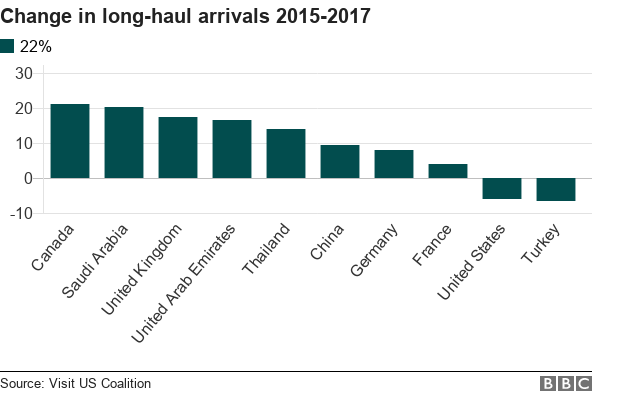
Between 2015 and 2017, just two of the top 12 global destinations - the US and Turkey - experienced declines in long-haul travel, according to the Visit US coalition, a collection of travel industry groups that are drawing attention to the fall.
The coalition is casting its proposals as an economic imperative for the US.
"Our guiding principle is that we can have strong national security and still welcome legitimate international visitors," Roger Dow, president of the US Travel Association, said in a statement, which called the decline "troubling".
Spending by international visitors has fallen 3.2% - or by more than $250m- in the first 10 months of 2017, according to the Commerce Department.
The World Travel and Tourism Council says tourism contributed about 8% to gross domestic product in 2016.
Latest Stories
-
NDC threatens sanctions over oversized campaign posters, gives aspirants 5 days to comply
15 minutes -
Star Oil paid GH¢2.7bn in taxes, levies in nine months of 2026
29 minutes -
Samson’s Take: The rule of law is cheaper before the bulldozer
30 minutes -
GRA blames system failure for delay in issuing receipt over passenger’s customs duty
51 minutes -
Livestream: Newsfile discusses World Cup visa scandal, beach demolitions, education strikes, BRICS bid
55 minutes -
NC-PTAs welcomes end of teachers’ strike, urges parents to prepare children for Monday
1 hour -
Government procures over 2,000 transformers as Ghana’s electricity access hits 89.13% – Energy Minister
2 hours -
UTAG-UG threatens strike on October 19 over unpaid allowance
2 hours -
Let The Constitution direct Chieftaincy to deliver “All Development Is Local”
3 hours -
John Jinapor outlines renewable energy, nuclear power priorities for 2027
3 hours -
Ghana explores centre of excellence for hearing, communication and cochlear implant care
4 hours -
Schizophrenia-related disorders lead mental health cases recorded in Ghana
5 hours -
Dutch authorities enlist Ghana in hunt for fugitive drug lord Bolle Jos
5 hours -
Ghana housing finance conference adopts communiqué to improve affordable housing access
9 hours -
Special Initiatives Minister urges Wa Technical Institute to enrol more girls as EU-backed solar training lab opens
10 hours