

Audio By Carbonatix
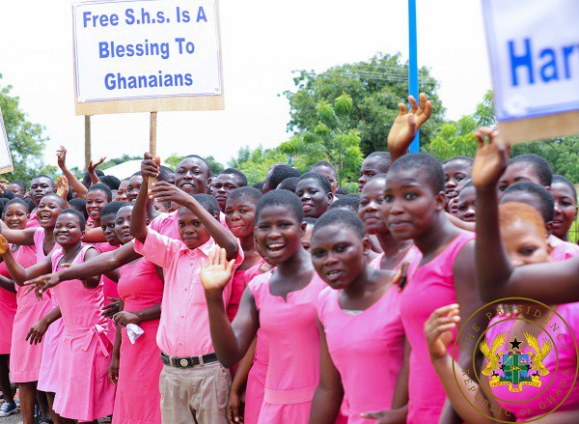
Executive Director of the Institute for Education Studies, Dr. Peter Anti, says that Ghana has admittedly downplayed on the variables of quality in its education policy resulting in the poor learning outcomes.
His comments are in agreement with an International Monetary Fund assessment of the Free SHS policy which had stated that while the policy had improved access to second cycle education, it had failed to meet quality requirements thus the poor learning outcomes.
The Fund had suggested government revised the policy to ensure that these quality variables are met to improve learning outcomes.
Speaking on PM Express, Dr. Anti noted that it appears the government had not fully anticipated the challenges the Free SHS policy will pose to second cycle education system thus their unpreparedness in addressing the falling quality of education in the sector.
“You see if you look at our education system, there have been variables that have been classified as quality variables by the Ministry of Education and then the Ghana Education Service. But these quality variables are used to assess how we are delivering education to the people who need it.
“So when you increase access, what you’re technically doing is that you are supposed to make sure that there is corresponding improvement in the quality variables to ensure that those quality variables do not suffer because of the increase in enrollment,” he said.
Listing some of the quality variables the government had failed to meet, he said;
“One of them is student to teacher ratio. And if you look at the number of students that are accessing secondary education now, you look at it and you see that the class sizes have increased. So if I’m an external evaluator and I come and I’m evaluating your programme, and I see that in your policy document you’re saying that you need a student to teacher ratio of one is to 25, between 25 and 35, and you’re having one teacher is to 65, one teacher is 58 students, it means that there is a problem with your quality variable in that perspective.
“The other quality variables including student to desk ratio, student to textbook ratio and all those things. And these things are supposed to lead to an expected outcome or output which is technically the performance that the students will put up when they write their BECE, and then an extension of the students’ contribution to the total development of the country which we call educational outcomes.”
According to him, the IMF must have noticed all these shortcomings before making their suggestion for reform.
“So I think that they looked at all these things and they realised that truly we’ve increased access but by extension, we have downplayed on the variables of quality and that is leading to the poor learning outcomes that they’re talking about.”
Latest Stories
-
Sammi Awuku to question GMA in Parliament over vessel linked to alleged drug trafficking
4 minutes -
Trapped miner rescued from flooded Mexican tunnel after 14 days
12 minutes -
NPRA to prosecute employers over unpaid Tier 2 Pension contributions — Deputy CEO warns
18 minutes -
ACCPA calls for Africa’s strategic repositioning at NUS, Singapore
26 minutes -
Oil prices rise as concerns grow over ‘fragile’ US-Iran ceasefire
29 minutes -
NPP revises internal election guidelines to strengthen transparency and inclusiveness
1 hour -
NACOC set to issue licences to qualified applicants for cannabis cultivation – Deputy Director-General
1 hour -
Easter Outreach: Victory Bible Church offers free healthcare, NHIS support to hundreds
2 hours -
NPP cannot pressure Mahama to sign a bill not yet received—Solomon Owusu
2 hours -
MPs, institutions deepen support for Ghana Sports Fund with fresh contributions
2 hours -
Four people die trying to board boat in Channel crossing attempt
2 hours -
Abirem MP announces GH₵500,000 education fund to support needy students
2 hours -
African stakeholders call for stronger ‘One Health’ action on climate and health crises
2 hours -
DVLA to commission 5 new service centres in Greater Accra
2 hours -
Agenda 111 and the right to health: A broken social contract
2 hours