

Audio By Carbonatix
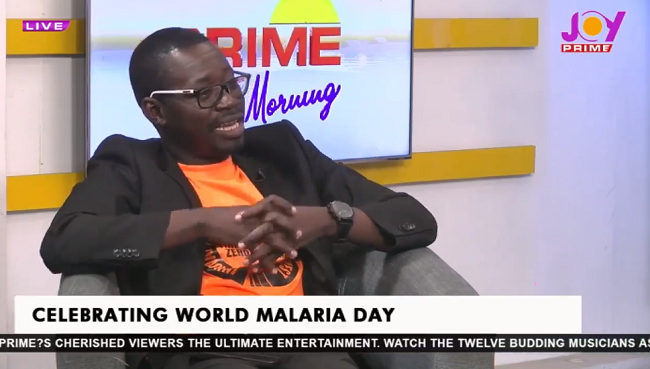
All Ghanaian residents have been advised to join the fight against the total eradication of malaria in the country.
Malaria is a life-threatening disease caused by parasites that are transmitted to people through the bites of infected female Anopheles mosquitoes. It varies based on the species of Plasmodium.
Between January and September 2022, Ghana recorded a total of 3,745,398 confirmed malaria infections out of 7,749,627 tests conducted, data shown by the National Malaria Elimination Programme (NMEP).
The figure shows a decrease in malaria infection as compared to 4,133,020 malaria cases recorded in the same period in 2021.
Also, the country has witnessed a reduction in malaria deaths, from 196 in 2021 to 120 in 2022.
Considering the progress in the management of malaria cases in the country, the Deputy Programmes Manager of the National Malaria Elimination Programme, Dr Nana Peprah, who spoke on Joy Prime’s morning show, has called on individuals to support the fight.
He said complete eradication of the ailment can only be done with the help of the media and opinion leaders who are closer to the citizenry.
"We cannot eliminate malaria without individuals owning the fight. We need to get everybody on board to agree that this is the opportunity for us to eliminate it," he said on Tuesday.
Regardless of the fact that most people have complained about the hotness of the mosquito nets, the medical practitioner entreated the public to utilise the interventions available.
Ghana has become the first country in the world to approve a new malaria vaccine from Oxford University.
The vaccine (R21) has been described as a "world-changer" by the scientists who developed it and appears to be hugely effective, in stark contrast to previous ventures in the same field.
The mosquito-borne disease kills more than 600,000 people each year, most of them children in Africa.
Despite the arrival of the vaccine in the country, Dr Nana Peprah noted that it is still undergoing some medical pruning for total approval of implementation by stakeholders.
"It’s looking good, but it's early days. At the programme level, we have to wait for all the approval processes to be done, and stakeholders will agree that let’s start implementation before we start. So, for now, it is RTSS until we have approval processes completed," the Deputy Programmes Manager notified.
According to a survey by the Ghana Statistical Service, the Oti region has the highest number of malaria cases at 15%.
People across the globe celebrate World Malaria Day on April 25, 2023, every year. The theme for this year is "Time to Deliver Zero Malaria: Invest, innovate, implement."
As part of the education, people are required to keep their surroundings clean to avoid mosquitoes, especially with the invasion of a new breed of mosquito known as Anopheles stephensi.
Latest Stories
-
AU’s 10-year reparations agenda is essential to address historic injustices – Spio-Garbrah
8 minutes -
Ghana can’t remain vulnerable to global economic disruptions— Dr Tutu-Boahene
22 minutes -
‘No nepotism’ – Former NSA Board Chairman demands world-class coach after Otto Addo exit
27 minutes -
Volta Region seen as top choice for luxury weekend breaks — V. L. K. Djokoto
36 minutes -
Halt small-scale mining for one year to fight galamsey – Hopeson Adorye
40 minutes -
President Mahama orders full probe into ‘Big Push’ procurement exposé
58 minutes -
Weija-Gbawe MP calls for commissioning of Weija paediatric hospital
1 hour -
Ghanaians dying in Russia–Ukraine war: The danger is real
1 hour -
Player ratings: Oppong earns high marks as Sibo and Adjetey draw low scores in Germany defeat
1 hour -
Pres. Mahama pledges action on 1.2m out-of-school children after School for Life raises concern
1 hour -
Suhum MP vows NPP will probe Gold-for-Reserves in 2029
2 hours -
Ghana to host Zimbabwe’s President Mnangagwa on three-day state visit
2 hours -
Ghana pushes for stronger West African blue economy partnership at Liberia fisheries investment conference
2 hours -
Ghana hosts high-level African climate strategy meeting ahead of COP31 and COP32
2 hours -
Today’s Front pages : Tuesday, March 31, 2026
2 hours