

Audio By Carbonatix
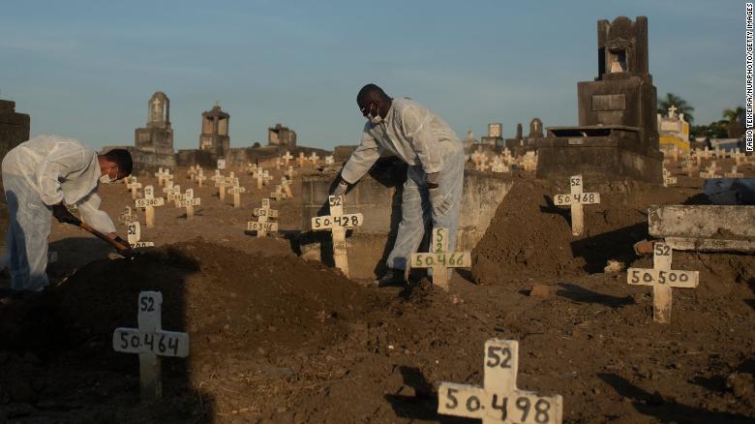
More than 4 million people around the world have died of Covid-19, according to data from Johns Hopkins University.
In total, three countries account for more than a third of all global deaths. The United States, which has the highest number of fatalities at 606,000, accounts for 15% of the global total, followed by Brazil and India.
The grim milestone, announced Wednesday, comes as new cases and deaths are dropping in the US and Europe, where significant numbers of residents have been vaccinated. But some developing countries, such as Indonesia, are still facing surging outbreaks, as authorities struggle to secure enough vaccines to protect citizens.
The Delta variant, a more transmissible and possibly more dangerous strain of coronavirus, is also contributing to an increase in cases in some countries and regions. In the US, the Delta variant now makes up more than half of all new infections, according to estimates from the US Centers for Disease Control and Prevention (CDC).
An average of 7,900 Covid-19 deaths were reported each day over the past week, according to JHU. That is 46% less than the global peak of more than 14,700 daily deaths in January, but 57% higher than the pace of about 5,000 daily deaths from this time last year.
The global death toll exceeded 1 million on September 18, 2020, 191 days after the World Health Organization declared the novel coronavirus outbreak a global pandemic. It took 115 days for the global death toll to hit 2 million, 88 days to surpass 3 million, and another 89 days to reach 4 million.
Given the difficulty in accurately tracking the spread of the virus especially in the developing world, many experts believe the global death toll is likely significantly higher than the officially reported number.
In a statement on Thursday, United Nations Secretary-General Antonio Guterres warned the pandemic is "far from over," warning of the emergence of more transmissible, more deadly variants that are more likely to undermine the effectiveness of current vaccines if the virus is allowed to continue to spread.
"Vaccines offer a ray of hope -- but most of the world is still in the shadows. The virus is outpacing vaccine distribution," he said, calling for a global plan to boost vaccine production, ensure equitable distribution and tackle vaccine hesitancy.
"To realize this plan, I am calling for an Emergency Task Force that brings together all the countries with vaccine production capacities, the World Health Organization, the global vaccine alliance GAVI and international financial institutions able to deal with the relevant pharmaceutical companies and manufacturers, and other key stakeholders," he said.
Latest Stories
-
Ghana ranked joint 6th in 2026 Absa Africa Financial Markets Index
38 minutes -
Demand and savings deposits decreased in August 2026, but currency outside banks increased by 4%
1 hour -
Fiscal policy implementation poses downside risk to inflation – BoG
2 hours -
Organised Labour should seek fair adjustment, not excessive pay rise – Labour consultant
2 hours -
BoG maintains medium-term inflation target of 8 ± 2%
2 hours -
Sammi Awuku urges NPP Germany to unite ahead of 2028 elections
2 hours -
The Inconvenient Truth: We cannot pray for the cure while protecting the disease
3 hours -
MTN Ghana trains civil society organisations on artificial intelligence
4 hours -
GoldBod FX framework aims to make dollar supply predictable – Acheampong
4 hours -
How does a Ghanaian team make it to the BAL?
4 hours -
Ghana’s investment climate presents opportunities for industrial growth and job creation.
4 hours -
‘I paid thousands to a company for jobs that never came’
5 hours -
SSNIT intensifies informal sector enrolment drive with Techiman float
5 hours -
Ghana seeks long-term mining investments that benefit local communities – Armah-Kofi Buah
5 hours -
GHATOF demands compensation for 85 businesses affected by La Pleasure Beach demolition
5 hours