

Audio By Carbonatix
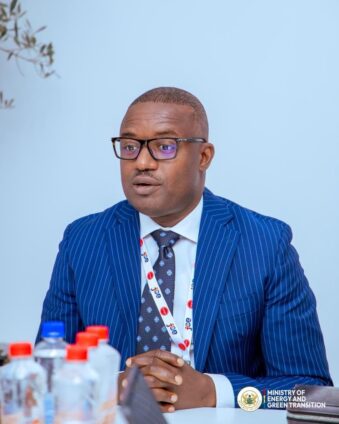
Minister for Energy and Green Transition, Dr. John Abdulai Jinapor, has outlined an ambitious roadmap to strengthen Ghana's downstream petroleum sector, arguing that resilient policies, expanded local refining capacity, innovation and sustained investment are critical to securing the country's energy future and driving economic transformation.
Delivering the keynote address at the 7th Ghana International Petroleum Conference (GhIPCon 2026) in Accra, Dr. Jinapor said recent global energy disruptions have demonstrated that countries must prepare for uncertainty long before crises emerge.
Speaking on the conference theme, "Building a Resilient Downstream: Policy, Innovation and Investment for Growth," the Minister noted that geopolitical conflicts, supply chain disruptions, volatile international oil prices and the global energy transition have fundamentally reshaped the world's approach to energy security.
He stressed that resilience cannot be achieved through temporary interventions but through deliberate policy decisions, strategic investments, innovation and strong collaboration between government and industry.
According to him, Ghana's downstream petroleum sector remains central to the country's economic growth, powering transportation, industry, agriculture, mining and commerce while supporting the daily livelihoods of millions of Ghanaians.
"The performance of this sector affects every household and every business in our country. A reliable, efficient and resilient downstream industry is therefore essential not only for energy security but also for economic competitiveness, industrial growth and national development," he said.
The Minister commended stakeholders across the petroleum value chain for ensuring uninterrupted fuel supply during one of the most challenging periods in recent years despite significant disruptions in global energy markets.
He acknowledged the sacrifices made by oil marketing companies, bulk distribution companies, transport operators and regulators, as well as government interventions that helped cushion consumers from soaring fuel prices.
Dr. Jinapor disclosed that for eight consecutive weeks, government absorbed part of the increase in fuel prices, at one point subsidising diesel by as much as GH¢2.00 per litre, equivalent to GH¢9.50 per gallon.
While describing the intervention as necessary, he cautioned that long term energy security cannot depend on temporary price support measures.
Instead, he called for sustained investments in domestic refining, strategic petroleum reserves, modern storage facilities, efficient transportation networks and diversified supply chains to improve Ghana's ability to withstand future external shocks.
On the policy front, the Minister reaffirmed government's commitment to providing a predictable regulatory environment that encourages investment, promotes fair competition, protects consumers and enhances transparency across the downstream sector.
He said the Ministry of Energy and Green Transition, together with the National Petroleum Authority, continues to implement reforms aimed at improving efficiency and ensuring the sector remains responsive to changing market conditions.
Dr. Jinapor also highlighted encouraging developments in Ghana's upstream petroleum sector after years of declining crude oil production.
According to him, renewed investment, improved field management and stronger collaboration with industry partners are beginning to reverse the decline.
He revealed that the Jubilee Field recently recorded daily production of about 95,000 barrels of oil, the highest output recorded in a long time, while gas production has also increased by more than 50 million standard cubic feet per day.
The Minister said the improved production outlook provides a stronger foundation for expanding domestic refining and reducing Ghana's dependence on imported refined petroleum products.
As part of government's value addition agenda, he recalled President John Dramani Mahama's decision to allocate a one million barrel parcel of Jubilee crude oil to local refineries, describing it as a strategic move to retain more value within the domestic economy.
He announced that the next allocation of Jubilee crude will be supplied to the Tema Oil Refinery as government works to revitalise the state owned refinery and strengthen Ghana's refining capacity.
Dr. Jinapor further disclosed that ongoing expansion projects at both the Tema Oil Refinery and Sentuo Oil Refinery are expected to enable the two facilities to meet approximately 70 percent of Ghana's domestic demand for refined petroleum products upon completion.
He explained that increasing local refining capacity would reduce the country's dependence on imported fuels, ease pressure on foreign exchange demand, improve supply reliability, strengthen Ghana's balance of payments and create thousands of jobs across the petroleum value chain.
"Every refinery is more than an industrial facility. It creates an ecosystem of economic activity, supporting transport and logistics companies, engineering services, local contractors, manufacturers, technology providers and thousands of skilled jobs," he stated.
The Minister also underscored the importance of technology and innovation in enhancing the competitiveness of the petroleum industry.
He said digitalisation, automation, intelligent logistics and data driven regulation are transforming petroleum operations globally by improving efficiency, reducing losses and increasing transparency.
Dr. Jinapor called for stronger participation by indigenous Ghanaian companies, increased technology transfer and greater investment in developing the skills required for the future energy industry.
Addressing the global energy transition, he reiterated Ghana's commitment to cleaner energy while maintaining that petroleum products will continue to play a significant role in the country's energy mix for many years.
He said Ghana's objective is to pursue a just transition that balances current energy demands with investments in cleaner fuels, improved efficiency and emerging technologies.
The Minister concluded by urging stakeholders to use the conference to build partnerships, unlock investments and develop practical solutions that will strengthen Ghana's downstream petroleum industry.
He expressed confidence that with the right policies, investments and innovation, Ghana can position itself as the leading energy and petroleum hub in West Africa.
Latest Stories
-
AI gains can lift three times as many people out of poverty in Ghana – World Bank
5 minutes -
Police arrest suspect over jewellery theft during fire outbreak
2 hours -
EOCO returns Hanan’s £6,700, GH¢2,750 and devices after defence challenge
3 hours -
Opplift Youth Entrepreneurs Summit 2026 equips entrepreneurs with skills, mentorship and support
3 hours -
Rival clubs want range of punishments for Man City
3 hours -
Tear gas in Paris and Marseille as school protests grow across France
3 hours -
Kane inspires England to win over Czech Republic in UEFA Nations League
3 hours -
Finland orders halt to work on two Google data centres
3 hours -
Substitute Merino scores twice as Spain win in Croatia
4 hours -
Ronaldo wants Portugal ‘punishment’ but not retiring
4 hours -
White House defends Trump comment to let Iran ‘take out’ LA and San Diego
4 hours -
Asos confirms hackers sent ‘unauthorised’ notification to app users
4 hours -
US televangelist Jim Bakker, disgraced from sex scandal and fraud, dies at 86
4 hours -
Congolese-born golfer to represent Ghana at Turkish Airlines World Cup grand final
4 hours -
Amazon wins global rights to stream Emmys in six-year deal
4 hours