

Audio By Carbonatix
Every day across Ghana, thousands of people hop onto commercial motorbikes, popularly known as Okada, to beat traffic, reach workplaces, schools and markets, or access communities where conventional transport is unavailable. For many, these motorcycles have become an indispensable part of daily life. Yet every journey carries a risk, and far too often, that risk is made worse by the simple decision not to wear a helmet.
Road crashes continue to claim lives and leave many others with life-altering injuries. Among the most vulnerable are commercial motorbike riders and their passengers, many of whom either do not own helmets or choose not to wear them despite the well-known dangers.
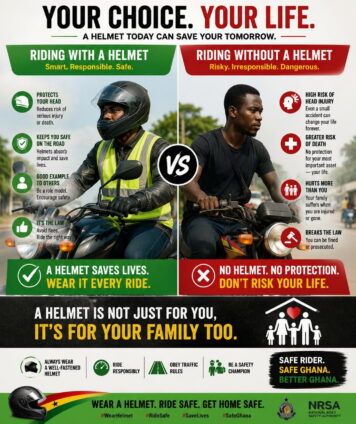
It is against this backdrop that the Helmet for Life Movement, a University of Media, Arts and Communication (UniMAC-IJ) MA in Development Communication Group One students-led social initiative, has launched a nationwide campaign to encourage helmet use as a life-saving habit rather than an optional accessory.
The campaign seeks to tackle one of the biggest challenges confronting road safety in Ghana: changing public attitudes and behaviours. While many people acknowledge that helmets save lives, compliance remains low due to reasons ranging from discomfort and cost to misconceptions and inadequate public education.
According to the Communication Director of the Movement, Ms Kafui Mawunyo Siabi, research has consistently shown that wearing a helmet can reduce the risk of serious head injuries by up to 70 per cent. Yet countless riders and passengers continue to travel without one, exposing themselves to potentially fatal consequences should an accident occur.
The Movement believes that improving helmet use is not only about enforcing traffic laws but also about transforming mindsets. It wants Ghanaians to see helmets in the same way they view seat belts, an essential safety measure that should never be ignored.
At the heart of the campaign is a behaviour change communication strategy that combines education, storytelling and digital engagement. Through social media platforms such as TikTok, Instagram and Facebook, the campaign will share compelling stories of accident survivors whose lives were saved because they wore helmets.
Using hashtags such as #HelmetSavesLives and #RideSafeGhana, the initiative hopes to create a nationwide conversation about road safety. Riders will also be encouraged to participate in online challenges by posting photographs of themselves wearing helmets, helping to normalise safe riding practices.
Short educational videos will further demonstrate the potentially devastating consequences of riding without helmets, while showcasing how a simple protective gear can mean the difference between life and death.
Beyond the digital space, the campaign is taking practical steps to remove barriers that discourage helmet use. The Movement is collaborating with helmet manufacturers to make certified helmets more affordable through discounted prices. It is also working with transport unions to strengthen compliance at commercial motorbike stations and encouraging schools to educate young people about road safety through posters and awareness programmes.
These partnerships recognise that lasting behaviour change requires more than public messaging. It demands collective action involving government agencies, transport operators, manufacturers, educational institutions and communities.
The campaign comes at a time when commercial motorcycles have become an increasingly important means of transportation, particularly in urban centres where traffic congestion continues to worsen. Although the service offers speed and convenience, it has also contributed to a growing number of road crashes involving riders and passengers.
Road safety experts have repeatedly stressed that many fatalities resulting from motorcycle crashes are linked to traumatic head injuries, injuries that could often be prevented or significantly reduced through proper helmet use.
Changing this reality requires sustained public education alongside effective enforcement of existing road traffic regulations. While the law requires both riders and passengers to wear protective helmets, enforcement has often been inconsistent, allowing unsafe practices to become commonplace.
The Helmet for Life Movement hopes to reverse this trend by making helmet use a social norm rather than an exception. Its approach reflects the growing importance of behaviour change communication in addressing public health and safety challenges. Instead of relying solely on punishment, the campaign seeks to inspire voluntary compliance by appealing to people's desire to protect themselves and their loved ones.
Ultimately, every helmet worn represents a life that may be saved, a family spared the pain of losing a loved one, and a nation taking another step towards safer roads.
As motorcycles continue to play a vital role in Ghana's transport system, promoting helmet use should remain a shared responsibility. Riders, passengers, transport unions, policymakers and the public all have a part to play in ensuring that every journey ends safely.
The message of the Helmet for Life Movement is simple but powerful: a helmet is more than protective gear; it is a commitment to life. In a country striving to reduce road fatalities, that commitment could make all the difference.
Latest Stories
-
Government working to address economic challenges driving youth into galamsey – Mahama
7 minutes -
Domestic Capital Africa campaign targets US$600bn pension funds for SME growth
7 minutes -
Women leaders’ wisdom and work deserve recognition – Mahama
17 minutes -
NRSA to refund surplus from auctioned vehicles of non-subscribers after deducting towing costs
19 minutes -
Ghana must integrate AI into mainstream education – DigiMarkt Project Board
19 minutes -
Armwrestling: Ghana unveils World Armwrestling Championship squad, appeals for travel support
19 minutes -
NPRA cites pensions college, data bank to justify 10-storey building project
25 minutes -
16 arrested as security team recovers guns, ammunition at Gbane mining site
25 minutes -
African group demands action on climate finance and adaptation ahead of COP 31
26 minutes -
CAF President announces 33% increase in annual subventions for the 54 CAF member associations
32 minutes -
We must account for every cedi entrusted to us as public officials – Ato Forson
1 hour -
Supreme Court rejects Solomon Asamoah’s bid to overturn Sky Train ruling
1 hour -
Nungua Traditional Stool, WT Plastics partner to establish factory, create 1,400 jobs
1 hour -
Mahama describes Ghana’s religious diversity as its greatest treasure, defends fairness to all faiths
1 hour -
Police to arrest motorists who use pedestrian footbridges – ACP Obeng
1 hour