

Audio By Carbonatix
Fidelity Bank Ghana has once again positioned itself at the forefront of Ghana’s export-led growth agenda, with a strong call for cutting-edge sustainable solutions to unlock the full potential of the horticultural sector.
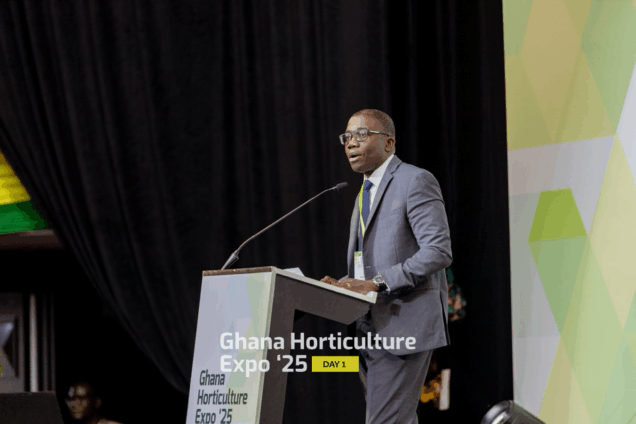
Speaking at the Ghana Horticultural Expo 2025, under the theme “Innovation, Sustainability, and Digital Transformation for a Competitive Horticultural Sector”, Julian Opuni, Managing Director of Fidelity Bank Ghana, delivered a message that underscores the critical role of the sector in driving inclusive growth, foreign exchange generation, and national development.
“It’s not just about what we extract from the ground, but what we grow, process, and export to the world,” Mr. Opuni remarked as he addressed a distinguished gathering of policymakers, development partners, agribusiness leaders, exporters, and government agencies.
He reflected on the bank’s growing involvement in the sector, highlighting Fidelity Bank’s strategic partnership with the Federation of Associations of Ghana Exporters (FAGE), which has already yielded tangible results.
“Since the launch of our Export Club partnership with FAGE two years ago, we have disbursed over GH¢45 million through our ‘BRIDGE-in Agriculture’ program with Mastercard and an additional GH¢100 million through various credit facilities.
"This financial injection has directly strengthened foreign exchange inflows and contributed to Ghana’s broader economic stability,” he emphasised.
The Fidelity Bank MD described the 2025 Expo theme as “absolutely necessary” given today’s evolving global market dynamics, where traceability, compliance, climate change, and consumer transparency are no longer optional but essential for competitiveness.
“These might seem like challenges, but they're also tremendous opportunities for Ghana to truly redefine our place in global value chains,” he said.
Beyond its financing role, Mr. Opuni reaffirmed Fidelity Bank’s commitment to serve as a true partner to the horticultural sector.
“We want to be more than just a financier; we want to be an enabler — actively partnering with agribusinesses, exporters, and institutions to unlock the immense potential of horticulture.”
He stressed that horticulture remains one of Ghana’s strongest levers for inclusive growth, job creation for youth and women, food security, and sustainable foreign exchange generation.
Recognising that access to finance remains a key barrier for many players in the horticultural sector, Fidelity Bank is taking deliberate steps to close that gap.
“That’s precisely why we’re hosting targeted sessions throughout this expo to demystify our export finance offerings,” Mr. Opuni announced.
“Next month, in collaboration with FAGE, we will host a practical masterclass for exporters to walk them through our products, explain the requirements, and help businesses become truly investment-ready.”
These initiatives reflect Fidelity Bank’s broader strategy of building capacity across the export ecosystem, extending beyond conventional financing to include trade guarantees, risk-sharing schemes, and innovative digital platforms that simplify and accelerate access to capital.
However, the Fidelity Bank MD was quick to emphasise that finance alone is not enough. “We must build strong ecosystems.
"This means supporting policies that make cross-border trade more predictable, investing in cold chain infrastructure and logistics, and embracing sustainability as a real competitive advantage, not just a slogan.”
He urged all stakeholders to adopt a long-term, collaborative approach that places innovation, sustainability, and digitalisation at the centre of Ghana’s horticultural development agenda.
As the Expo progresses, Fidelity Bank continues to demonstrate its commitment to Ghana’s export sector, positioning itself as a forward-looking financial institution that goes beyond transactional banking to support national priorities and economic transformation.
“We are proud to stand with you, not just as a bank, but as a partner for progress. Together, we can grow something truly bigger: a vibrant, export-led economy that delivers real value for farmers, businesses, communities, and the nation as a whole,” Opuni concluded.
Latest Stories
-
Total expenditure as of July 2026 amounted to GH¢147.07bn, 16% below target – BoG
1 hour -
Total revenue & grants stood at GH¢144.5bn in July 2026, slightly below target – BoG
2 hours -
Ghana Sports Fund urges sports federations to submit credible proposals and measurable targets
2 hours -
Sally Rooney books withdrawn in UK over Palestine Action support
2 hours -
Musk says US government may be behind slowdown of Ukraine drone speeds
2 hours -
Picking Chief Justices nearing retirement could give Mahama immense power – Bentil
2 hours -
Netflix to shed 1,000 jobs in steepest cuts since 2022
2 hours -
Burnham had two hospitality dinners with Man City chairman, deleted records show
3 hours -
Semenyo ‘froze’ after alleged racist abuse, court told
3 hours -
‘Shameless’ – Mourinho critical of Vinicius Jr ban timing
3 hours -
Loyalty can outweigh competence in Chief Justice selection – Bentil
3 hours -
Man City suffer as PSG masterclass sets up Champions League win
4 hours -
Customer Service Africa CEO urges business leaders to observe staff and customer interactions
4 hours -
On night of mayhem for Liverpool, Barcola arrives in style
4 hours -
Muzic Mensah finds healing and renewed love in new single ‘WayƐ Late’
4 hours