

Audio By Carbonatix
The government is positioning Ghana’s horticulture sector as a key driver of export growth, with renewed efforts to improve production, processing, certification and access to international markets.
The Minister of Trade, Agribusiness and Industry, Elizabeth Ofosu-Adjare, says government’s priority is to ensure that the increasing production of fruits, vegetables and other horticultural products translates into greater economic value for Ghana.
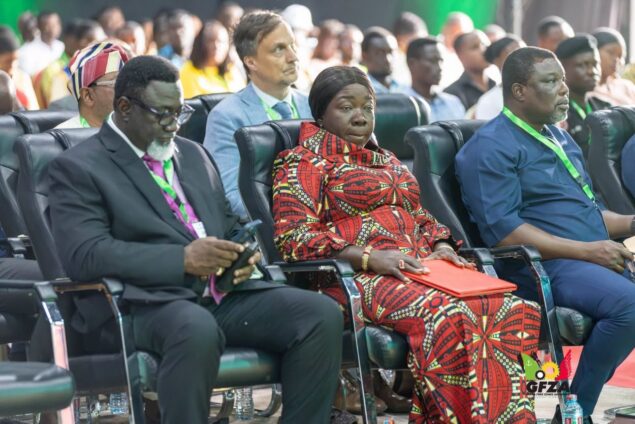
Speaking on behalf of President John Dramani Mahama at the third Ghana International Horticulture Expo in Accra, the minister said Ghana’s non-traditional exports exceeded US$5 billion in 2025, creating an opportunity for the country to expand its earnings from agriculture.
“The opportunity now is to retain more value from the products we produce.”
Ofosu-Adjare said horticulture presented a clear opportunity for government to strengthen the connection between farmers, industry and export markets.
“We see this clearly in horticulture, where excellent produce can quickly lose its value if cold storage, processing, packaging, transport, and market connection do not work efficiently.”
She said the government’s newly approved agribusiness policy was designed to address some of the major challenges affecting the sector, including raw material supply, financing, value addition and market access.
According to the minister, government will also implement the Feed the Industry programme to strengthen local production and supply industries with the raw materials they require.
But Ofosu-Adjare stressed that increasing production alone would not guarantee export success.
She said Ghanaian horticultural products must meet international requirements on food safety, plant health, traceability, certification, packaging and quality standards if they are to compete effectively in regional and international markets.
Government, she said, is therefore working with key agencies to streamline certification and testing, expand laboratory and inspection services, and build the capacity of farmers, processors and exporters.
“The ultimate aim is a coordinated, one-stop system of support that helps our producers get certified faster, comply consistently, and compete with confidence in the regional [and] international markets.”
President of the Federation of Associations of Ghanaian Exporters, Davies Narh Korboe, said the next challenge was to build on the achievement and work towards US$10 billion and beyond.
He argued that Ghana must “produce what we consume, process what we produce, and export what the world is willing to buy,” describing this as the bridge between agricultural self-reliance and economic sovereignty.
The call for value addition comes amid concerns over the challenges confronting agricultural producers, including inadequate irrigation, expensive financing, post-harvest losses, weak cold-chain infrastructure, fragmented supply chains, logistics costs and inconsistent standards.
Korboe said the farmer may be at the beginning of the agricultural value chain but should not remain at the bottom of the wealth-creation process.
He said greater value must be retained within Ghana through incomes, jobs, businesses and investments generated from agricultural production.
The Tree Crops Development Authority also highlighted opportunities to develop industries around commodities such as cashew, coconut, oil palm, rubber and mango.
Its Chief Executive Officer, Dr Andy Osei Okrah, said processing these commodities locally could create employment, promote enterprise development, facilitate technology transfer and increase export earnings.
Meanwhile, the Chief Executive Officer of the Ghana Export Promotion Authority, Francis Kojo Kwarteng Arthur, said non-traditional exports reached US$5.006 billion in 2025, representing a 30.7 percent increase from US$3.83 billion in 2024.
The figures, he said, put Ghana on course towards its US$10 billion non-traditional export revenue target by 2030.
Latest Stories
-
Your next home could be here: 3rd JoyNews Republic Bank Habitat Clinic opens at Junction Mall today
4 minutes -
GCAA assures safety won’t be sacrificed to attract more airlines
8 minutes -
AFCON 2027Q: Queiroz furious with ‘joke’ penalty awarded Cote d’Ivoire in Black Stars defeat
12 minutes -
GCAA backs more domestic airlines to drive down airfares
25 minutes -
SHC launches nationwide audit, gives occupants 21 days to regularise property interests
36 minutes -
Manhyia South MP describes EOCO arrest attempt as ‘provocation’
41 minutes -
Appiagyei appeals to Lordina Mahama, Jane Naana over detention of Ghana Jollof accused
46 minutes -
New regional hospitals will bring specialist care closer to Oti, Savannah and Western North – Health Ministry
51 minutes -
Gender Minister delivers Mahama’s address at launch of State of Africa’s Children Report
56 minutes -
Lambussie NCCE engages stakeholders on rule of law, anti-corruption fight
1 hour -
Lands Minister cuts sod for Phase Three of Appiatse Redevelopment Project
1 hour -
GNFS swift response saves three bedrooms from fire at Amasaman
1 hour -
Hate speech, vitriol, threats, and inciting comments: Can we stop it already?
1 hour -
African states must strengthen safeguards against AI-driven electoral manipulation – Kwasi Prempeh
1 hour -
Volta Economic Forum shifts from talk to real investments
1 hour