


Audio By Carbonatix
Former world number one Serena Williams said she almost died giving birth to daughter Alexis Olympia Ohanian Jr in September.
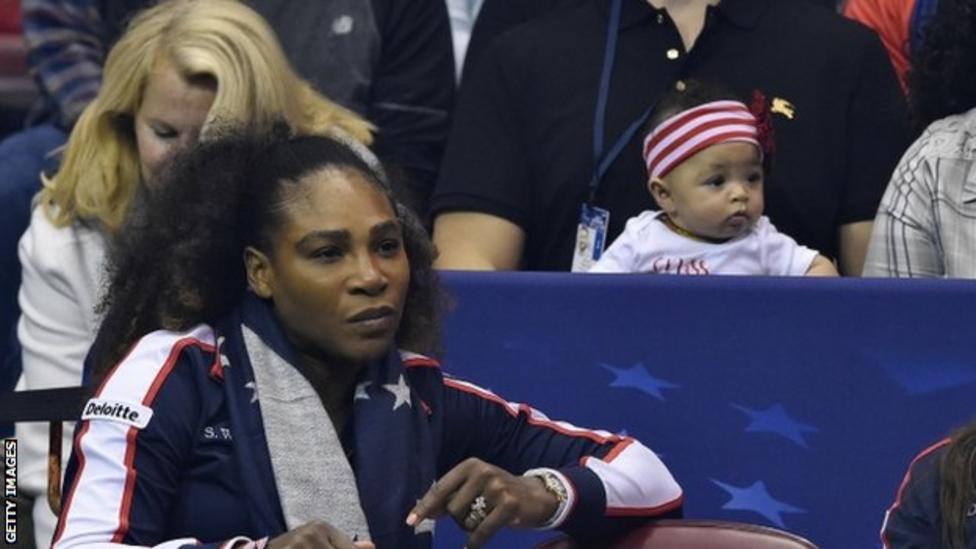
The American, 36, made her competitive return earlier in February when she teamed up with sister Venus for the United States in the Fed Cup.
But the 23-time Grand Slam winner has revealed that giving birth "sparked a slew of health complications".
"I am lucky to have survived," she wrote in an article for CNN on Tuesday.
"My daughter was born by emergency C-section after her heart rate dropped dramatically during contractions. The surgery went smoothly.
"But what followed just 24 hours after giving birth were six days of uncertainty."
Williams, the most successful female player of the Open era, has previously said she was bedridden for six weeks after giving birth.
'I live in fear of this situation'
Williams' victory at the Australian Open in 2017 was her 23rd Grand Slam title, achieved while she was eight weeks pregnant.
The American is now just one shy of the all-time record held by Australian Margaret Court, but missed this year's Australian Open in January to give her more time to recover from the birth.
Speaking about the birth, Williams continued: "It began with a pulmonary embolism, which is a condition in which one or more arteries in the lungs becomes blocked by a blood clot.
"Because of my medical history with this problem, I live in fear of this situation. So, when I fell short of breath, I didn't wait a second to alert the nurses.

"First my C-section wound popped open due to the intense coughing I endured as a result of the embolism. I returned to surgery, where the doctors found a large haematoma, a swelling of clotted blood, in my abdomen.
"When I finally made it home to my family, I had to spend the first six weeks of motherhood in bed."
Williams, who has not yet decided whether she will compete at this year's remaining three Grand Slams, has thanked the medical team for keeping her alive.
"I am so grateful I had access to such an incredible medical team of doctors and nurses at a hospital with state-of-the-art equipment.
"They knew exactly how to handle this complicated turn of events. If it weren't for their professional care, I wouldn't be here today."
Latest Stories
-
Drug bust: NACOC should be part of port inspection team – Twum-Barimah
28 seconds -
Ward appointed Liverpool’s sporting director
45 seconds -
This isn’t the first cocaine bust; NPP must stop the politicisation – NACOC deputy boss
4 minutes -
Drug bust case: Only Customs officers, MPS officials in scanning room – NACOC
1 hour -
I don’t mind being insulted; I have a crocodile skin – President Mahama
1 hour -
Samson’s Take: Verify the badge – and verify the story
2 hours -
President Mahama explains why Ghana must rethink regulation of TikTok, other new media platforms
2 hours -
Rule of law must be protected – GBA condemns EOCO action against Baffour Awuah
3 hours -
950,000 barrels of Sankofa crude head to TOR as GNPC deepens domestic refining
3 hours -
Scales of deception removed – Annoh-Dompreh attacks new cocoa price
4 hours -
Young Positivist Writes : My Experience with GCLP
5 hours -
Strong Day 1 turnout sets tone for Day 2 of Republic Bank-JoyNews Habitat Fair Clinic
5 hours -
Ghana Army warns new soldiers against social media misuse, uniform abuse
6 hours -
AMA calls for science-led action to tackle environmental health risks in Accra
6 hours -
NPP Canada Organizer BigMo urges Diaspora to support Kodua Frimpong
7 hours