

Audio By Carbonatix
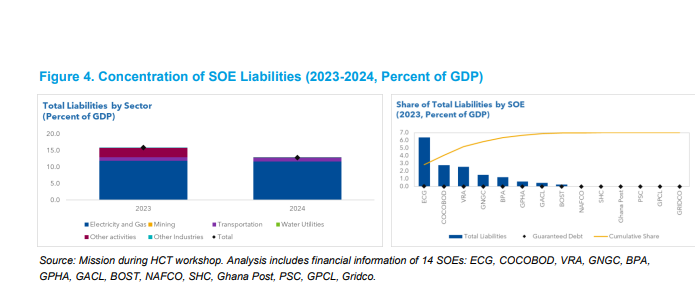
The International Monetary Fund (IMF) has expressed worry about the continued build-up of liabilities across Ghana’s State-Owned Enterprises (SOEs) portfolio, with total aggregate liabilities reaching 25% of Gross Domestic Product (GDP).
According to the Fund, liabilities growth outpaces asset growth, rising from GH¢35 billion (19.0% of GDP) in 2015 to GH¢282 billion (about 25% of GDP) in 2024.
It said this rapid growth of liabilities compared to assets has heightened fiscal concerns.
It raised this issue in its Technical Assistance Report on Ghana titled “Advancing SOE Fiscal Risks Management, Financial Oversight, Governance and Investment Implementation".
ECG alone accounted for GH¢71 billion of aggregated SOE liabilities (or 6.0% of GDP), making it the single largest contributor to the sector’s debt burden and a principal source of fiscal risk for the Government.
Other large entities such as VRA and GNPC also contributed significantly to the liability stock, underscoring a concentration of debt among a few highly leveraged SOEs.
SOEs Leverage Profile at Risk
The Fund also mentioned that SOEs’ leverage profile is particularly at risk because much of the debt is denominated in foreign-currency or carries implicit government backing.
According to the Bretton Woods institution, these factors create a key channel of fiscal and external vulnerability. “In parallel, the energy SOEs carry extensive obligations under power purchase agreements (PPAs), many of which are US dollar-indexed and backed by government guarantees, which magnify the foreign-exchange and refinancing risks and link the SOEs’ balance sheets closely to the sovereign’s own debt position”.
SOEs account for the largest share of assets and revenue among all specified entities in Ghana.
Among the specified entities reporting to State Interest and Governance Authority (SIGA), SOEs generated total revenue of GH¢133.7 billion (11.5% of GDP) in 2024.
The size of the SOE portfolio has broadly grown in line with the economy over the past decade, with total assets fluctuating around 34% of GDP and reaching GH¢395 billion in 2024.
The SOE liabilities have accumulated at a faster pace, rising from GH¢35 billion (19% of GDP) in 2015 to GH¢282 billion (about 25% of GDP) in 2024.
Latest Stories
-
If the Ghana Premier League is financially weak and structurally fragile, Africa will expose its weaknesses
11 minutes -
Accra-Kumasi Expressway: 48 Engineer Regiment can deliver if well resourced – Political Lecturer
26 minutes -
Businesses above GH¢750,000 turnover must register for VAT – GRA
29 minutes -
Kenya confirmed hosts of World Athletics Championships 2029
40 minutes -
No more pothole ambulance rides: Mahama’s roads will change lives – Agbodza tells Upper West farmers
1 hour -
‘Physically better’ Kudus can start against Liverpool – De Zerbi
1 hour -
Bonsu Baah sets up opener in Al Qadsiah win over Al Wasl
1 hour -
Ghana has now become a distribution hub for drugs
2 hours -
Africa Nations Volleyball Championship: Ghana’s Black Spikers leave for tournament in Tunisia
2 hours -
Today’s Front pages: Tuesday, September 15, 2026
2 hours -
Auditing the Auditor-General: How special audit understated a COVID-19 expenditure
3 hours -
A Partnership for Progress: Why the ProMark–KPMG collaboration matters for Africa’s digital assets future
3 hours -
Catholic Bishops pressure gov’t to sign long-delayed mission schools agreement
4 hours -
Cedi under fresh pressure as Christmas import demand drives dollar surge
5 hours -
Ato Forson eyes first-week November for 2027 Budget, promises jobs and major infrastructure push
5 hours