

Audio By Carbonatix
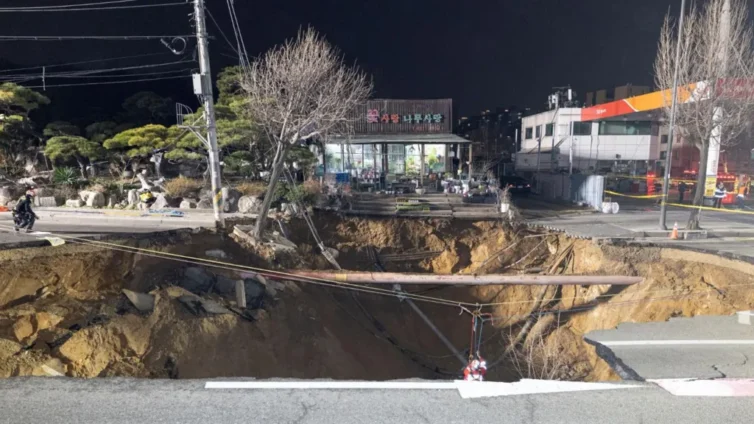
A man who fell into a large sinkhole in South Korea's capital Seoul has been found dead, according to the local fire department.
The man was riding his motorbike in the Gangdong district when the road caved in at about 18:30 local time (09:30 GMT) on Monday.
Rescuers found his body underground on Tuesday morning around 11:00 local time, about 50m (164ft) from where he had fallen in.
A car driver was also injured in the incident, which has gone viral on South Korean social media.
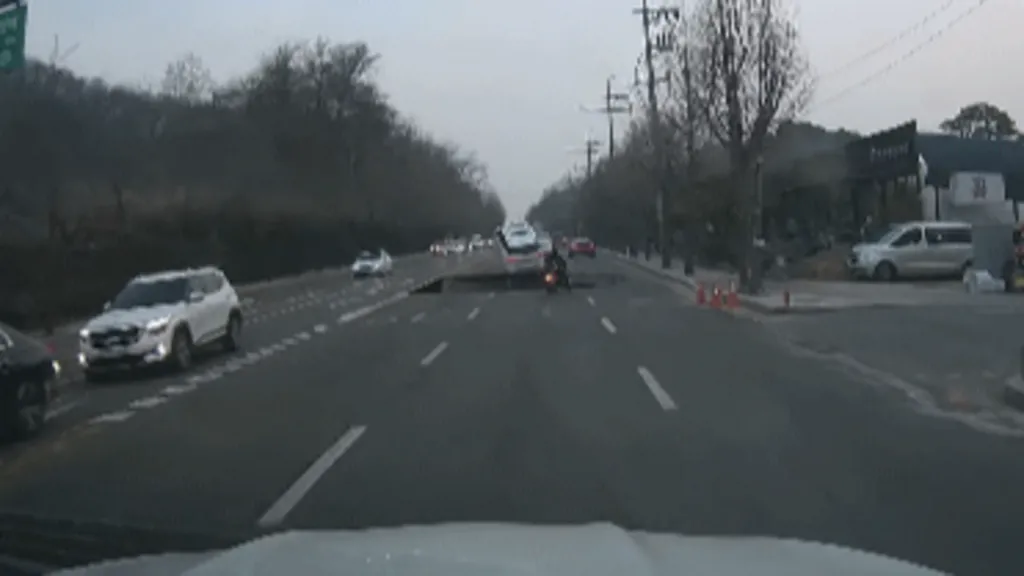
A dashcam video widely circulating online appears to show the moment the road caved in near a traffic junction. It shows the motorcyclist falling into the hole, while a car travelling in front of him narrowly escapes it.
Earlier on Tuesday, rescuers found a mobile phone and the motorcycle in the hole which is 20m wide and 20m deep, according to local media.
The man, said to be in his 30s, has yet to be named by authorities.
Kim Chang-seop, head of Gangdong fire station said at an earlier briefing that there were 2,000 tons of soil and water mixed inside the hole.
Authorities have yet to reveal the cause of the sinkhole.
A report recently submitted to the Seoul city government showed that 223 sinkholes occurred in the city in the past decade.
These were caused by poor infrastructure management, ageing or damaged pipes, long-term subsidence and accidents caused by excavation work.
In January, a truck driver went missing after his vehicle fell into a sinkhole at a junction in the Japanese city of Yashio.
Last August, a search for a woman who disappeared into a pavement sinkhole in Kuala Lumpur's city centre was called off after a week.
One of the most common reasons for a sinkhole is when rocks like limestone or chalk break down. Sometimes this process can happen gradually, where the depression becomes larger over time.
In other instances, the limestone sits below another layer of rock, which means that as it gets dissolved there are no immediate signs at the surface.
The overlying rock, sometimes clay or sandstone, will then suddenly collapse into the depression beneath - this is called a collapse sinkhole.
But human activities such as excavation works can also accelerate the formation of sinkholes or cause the ground to collapse in a similar way.
Latest Stories
-
Labour Minister wants SOEs to help shape new public pay system
1 hour -
IPEC will ensure Equity and Sustainability in SOEs Compensation
2 hours -
White House bars CNN from travelling with Trump on Air Force One
2 hours -
Fennis wins second consecutive ITF J60 title in Accra
2 hours -
Spain beat England in thriller after Kane penalty miss
3 hours -
GPL 2026/27: Zaidan’s late goal ends Hearts of Oak unbeaten start
3 hours -
CEOs demand clarity on pay harmonisation, board autonomy as FWSC engages SOEs bosses over IPEC transition
3 hours -
2026 Women’s Super Cup: FC Savannah, Epiphany Warriors maintain top spots ahead of final group games
3 hours -
‘Is EOCO responsible for determining lawyers’ fees?’ – Baffour Awuah
3 hours -
David Beckles claims second J60 Accra title
3 hours -
No France cocaine suspect linked to Mahama, Vice President’s security details – NACOC
3 hours -
Anwelle Foundation launched in Jirapa to tackle poverty, youth unemployment
4 hours -
Joy Sports Editor Fentuo Tahiru Fentuo to moderate inaugural Music Meets Football Summit in Zambia
4 hours -
Court premises too volatile for Baffour Awuah’s attempted arrest by EOCO – Inusah Fuseini
4 hours -
Drug bust: Under no circumstances will NACOC leadership be compromised – Twum-Barimah
4 hours