

Audio By Carbonatix
The Minority on Parliament’s Roads and Transport Committee has opposed government’s decision to downgrade the Suame Interchange project in Kumasi from a four-tier to a three-tier design.
The caucus says this is despite what it describes as already secured and approved funding for the original scope of the interchange.
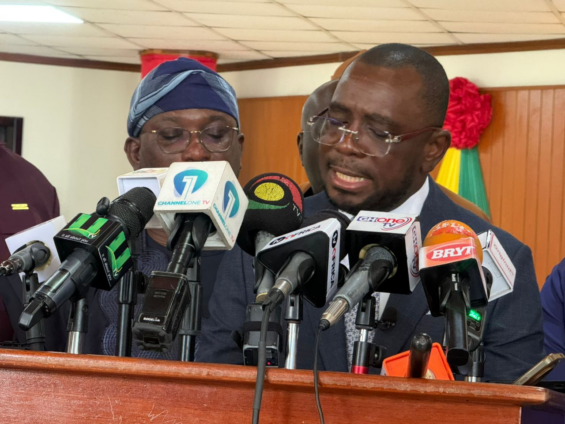
Addressing a press conference in Accra on Tuesday, March 24, the Ranking Member of the Committee, Kennedy Nyarko Osei, expressed concern that altering the project design raises serious questions about value for money, transparency and adherence to parliamentary approvals.
According to the Minority, Parliament in 2022 approved a financing package of €156.4 million and $47 million from Deutsche Bank and African Export-Import Bank, respectively, for the construction of the interchange and ancillary works, based on the original four-tier design.
Mr Osei questioned the rationale behind the proposed downgrade, particularly in light of claims that funding constraints necessitated the revision.
“This raises a fundamental question: if the financing facility was approved by Parliament for a four-tier interchange, why would the current government seek to downgrade the project while citing funding constraints?” he asked.
The Minority described the Suame Interchange as a critical infrastructure project, given its strategic importance to the Ashanti Region’s industrial and commercial activities.
The Suame enclave, home to the renowned Suame Magazine, serves as a major hub for vehicle repairs, metal fabrication and spare parts trade.
Mr Osei warned that reducing the scale of the interchange could undermine its long-term capacity to handle traffic volumes and limit its socio-economic impact.
“The Suame Interchange is not just another project; it is a strategic intervention to ease congestion and support one of the most vibrant industrial zones in the country. Any attempt to reduce its scope must be carefully justified,” he stated.
He further stressed that infrastructure projects financed with public funds must deliver maximum value and align with their originally intended design and capacity.
“We will vigorously advocate for the full implementation of the originally approved four-tier design to safeguard public interest and ensure that taxpayers derive the full benefits of this investment,” Mr Osei added.
The Minority indicated that it would resist any attempt to alter the project without clear justification and proper parliamentary oversight, insisting that public infrastructure investments must not be subject to arbitrary changes.
Beyond the Suame Interchange, the Minority raised broader concerns about developments in the road and transport sector, pointing to what it described as a pattern of stalled projects, funding gaps and policy inconsistencies.
It cited the reported abandonment of more than 1,000 ongoing road projects across the country, many of which were at advanced stages of completion.
The group also expressed concern over delays in railway development, noting that several near-completed projects, including the Tema–Mpakadan and Kojokrom–Manso lines, remain non-operational. It warned that failure to complete such projects risks undermining over $1 billion invested in the railway sector in recent years.
Additionally, the Minority highlighted growing financial pressures within the sector, including arrears estimated at about GH¢20 billion and what it described as inadequate releases from the Road Fund to meet existing obligations.
It noted that delayed payments have forced many contractors to abandon project sites, further slowing infrastructure delivery.
The press conference also touched on concerns regarding major proposed projects such as the Accra–Kumasi Expressway, with the Minority calling for full disclosure of construction and compensation costs before implementation proceeds.
Despite the concerns raised, the Minority reiterated its support for infrastructure development initiatives that are transparent, well-funded and efficiently executed, while pledging to continue its oversight role to ensure accountability in the sector.
Latest Stories
-
OSP has performed creditably despite constraints – Edem Senanu
2 minutes -
Trump tells the UK and other countries ‘go get your own oil’ from Strait of Hormuz
23 minutes -
Black Stars and the Art of Sacking: When the Coach Must Always Go First
31 minutes -
Ghana to roll out digital maps under new land sector reforms
38 minutes -
Ghana not fully ready for World Cup – Sports Minister
43 minutes -
NPA steps up “Stay Back, Stay Safe” campaign in Eastern Region
45 minutes -
Ethical Dilemma in Banking: The Case of a Teller in the Cash Cage
1 hour -
Emceeing is 20% talk, 80% event management – Kafui Dey
1 hour -
Supreme Court sets April 21 to hear Wesley Girls’ religious rights case
1 hour -
UniMAC-IF holds workshop on Vertical Revolution: Mastering micro-dramas for African digital economy
1 hour -
Pan-African Progressive Front hosts landmark online conference ahead of Geneva Forum
1 hour -
Civil society is not an adversary of gov’t, but partners in nation-building – Mahama
1 hour -
Defeamekpor calls for interdiction of Land Ministry’s director of finance
1 hour -
Atebubu Paramount Chief visits NPA boss to strengthen ties
1 hour -
TGMA Group of the Year nominees to be announced this week – Robert Klah
2 hours