

Audio By Carbonatix
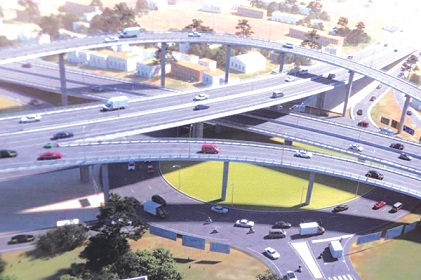
The New Patriotic Party (NPP) Ashanti Caucus in Parliament has warned that the government’s decision to reduce the Suame Interchange Project from its original four-tier design to a two-tier configuration will not solve Kumasi’s traffic crisis.
The caucus said it could turn the project into an “expensive but ineffective bottleneck.”
In a press statement delivered by MP for Bantama and former Minister for Roads and Highways, Francis Asenso-Boakye, the caucus said the decision was “deeply concerning, technically unsound, and unfair to the people of Kumasi and the Ashanti Region.”
The Roads and Highways Minister recently announced that government had scaled down the project, citing debt-related constraints and difficulties with contractor drawdown.
But the Ashanti MPs insist the Suame Interchange was deliberately designed as a four-tier solution because Kumasi’s congestion is not a single-junction problem, but a corridor-wide challenge affecting multiple areas of the city.
They said the project was initiated under the Akufo-Addo administration to address “severe and worsening traffic congestion” in Ghana’s second-largest and fastest-growing city.
They recalled that in July 2022, Parliament approved both the Commercial Agreement and the Loan Agreement for the project’s phase one works, financed by Deutsche Bank S.A. of Spain and backed by an Export Credit Guarantee from the Spanish Export Credit Agency (CESCE).
According to the caucus, the financing structure underscored the project’s “international credibility, bankability, and technical soundness.”
They stressed that Kumasi is not only a regional capital, but also a national transport hub linking north to south, east to west, and major economic corridors, markets, industrial zones and transit routes.
The caucus said congestion at Suame, Krofrom, Bantama, Abrepo Junction, Anomangye, Magazine, Abusuakruwa and across the Kumasi metropolis has reached “unbearable levels.”
They said the situation has resulted in “excessive travel times,” “lost productivity,” “increased fuel consumption,” “higher accident risks,” and “deterioration in the quality of life for residents and businesses.”
The MPs argued that the four-tier interchange design was not “arbitrary,” but the outcome of “detailed traffic modelling, engineering analysis, and long-term urban planning.”
They also noted that even after disruptions from Ghana’s IMF programme and debt restructuring, government had earlier prioritised the project by reallocating funding under the Afreximbank loan facility to keep work going.
They said that following a major relocation of utility services, final engineering designs and foundation works began in 2024.
Crucially, the caucus said detailed engineering designs had been completed for all four tiers, describing it as a “unified, integrated system rather than a modular or optional arrangement.”
Phase one of the project included a four-tier grade-separated interchange at Suame Roundabout, an overpass at Krofrom Junction, an underpass at Abrepo Junction, and the widening of critical sections of the Kumasi Inner Ring Road.
Phase two was designed to include additional overpasses at Anomangye, Magazine New Road, and Abusuakruwa; dualisation of Offinso Road (N10) to a 2 × 3-lane carriageway; construction of about 15 kilometres of local roads; and improvements to key intersections.
The caucus said the approach was “deliberately crafted” to address both current congestion and future traffic growth.
They warned that reducing the interchange to two tiers “fundamentally undermines the integrity of the project.”
They said a two-tier design “will not eliminate traffic conflict points,” “will not accommodate projected traffic growth,” and “will simply shift congestion from one junction to another.”
They cautioned that attempting to build only some levels would require revising completed engineering designs, which could trigger “delays,” “cost overruns,” “technical compromises,” and “contractual complications.”
“In urban transport engineering, under-designing is often worse than doing nothing, because it locks a city into congestion for decades,” the statement said.
The Ashanti Caucus also raised a series of questions for the government, including why the Suame Interchange is being “short-changed” if funding could be mobilised for the Ofankor–Nsawam Road and other major projects.
They questioned why the project was captured under government’s “Big Push Road Programme” in 2025 to guarantee continuous funding, but is now being scaled down.
They also cited the Finance Minister’s claim that GHS 43 billion has been allocated to road infrastructure this year and asked why “a fraction” cannot be applied to complete Suame as designed.
The caucus further questioned why government is financing 64 new road projects through Public Procurement Authority processes if it claims it lacks funds.
They also criticised what they described as inconsistency on the Accra–Kumasi dual carriageway, questioning why a 64%-complete project would be abandoned while a new greenfield three-way expressway is pursued at a higher cost and risk.
The MPs said the decisions raise a “troubling question” about whether government is deliberately deprioritising projects initiated under the Akufo-Addo administration in favour of projects it can brand as its own.
“If so, it is Ghanaians, not political opponents, who will bear the consequences,” the statement warned.
The caucus insisted Kumasi deserves better, describing the city as Ghana’s second-largest, a strategic national transit hub, and one that continues to grow rapidly in population and vehicle ownership.
They described any attempt to scale down the project as “technically indefensible,” “economically unwise,” and “politically unjust.”
The Ashanti Caucus called on government to restore the original four-tier design, reprioritise funding to complete the project, and engage transparently with Parliament and the people of Kumasi on the way forward.
“Kumasi deserves infrastructure that reflects its national importance, not half-solutions justified by selective constraints,” the statement concluded.
Latest Stories
-
Imagination Africa, Mentors Chess Academy to host second African Genius Chess Championship at Ghud Park
2 hours -
Nana B passport claims a diversionary tactic — Abu Jinapor
3 hours -
Pope Leo diagnosed with cancer as doctors remove lobe of lung, Vatican says
3 hours -
Legal Aid Commission takes free legal services to Techiman main lorry terminal
3 hours -
Nana B denies seeking passport favour, accuses Ablakwa of failing to account for GH¢16.4m
3 hours -
Young girls demand climate action, stronger protection against child marriage
3 hours -
Ex-gang boss sentenced to 40 years for orchestrating Tupac Shakur’s murder
3 hours -
From near-deferral to three awards: UMaT graduate’s academic journey
3 hours -
Atta Akyea denies seeking presidential pardon for Wontumi in galamsey case
4 hours -
Photos: Mahama commissions 85-bed Police Hospital ward, donates two ambulances
4 hours -
GTEC directs Ghana’s public universities to reopen by October 16 and begin lectures on October 19
4 hours -
Star Oil donates GH¢1million towards construction of new CID facility
4 hours -
Court hands Adjetey Sowah, two others lifetime bans after Amputee Football legal dispute
4 hours -
NDC appoints Julius Kwame Anthony as a Deputy Communications Director
4 hours -
Ghana repatriates 120 Nigerians rescued from suspected cybercrime centres
4 hours