


Audio By Carbonatix
Zimbabwe has auctioned cattle worth $1m (£770,000) to raise money for the African Union (AU) Foundation to help end the "donor dependency syndrome", President Robert Mugabe has said.
He added that he had donated 300 cattle from his herd, and other Zimbabweans doubled the number as they wanted to contribute towards a "noble cause".
Mr Mugabe handed the $1m cheque to the AU at its leaders' summit in Ethiopia.
The donation comes amid a severe cash and food crisis in Zimbabwe.
Last year, more than four million people were in need of food aid in the southern African state after rains failed.
However, there has been a bumper harvest this year, with the country expected to be self-sufficient for the first time in years.
The opposition blames the government for food shortages, saying its controversial land reform programme has ruined the farming sector.
Zimbabwe has also been forced to introduce so-called bond notes after running out of the US dollar, the main currency people use.
Hyperinflation forced the government to abandon the Zimbabwe dollar in 2009.
Foreign Minister Simbarashe Mumbengegwi said the cattle had been donated mostly by farmers who had benefited from the land reform programme, the state-run Herald newspaper reported.
Their donation was an "expansion" of a 2015 pledge by Mr Mugabe to donate 300 cattle, he added.
Speaking at the summit, Mr Mugabe said it was a "modest contribution" and a "symbolic step" towards helping to end the "donor dependency syndrome" in Africa.
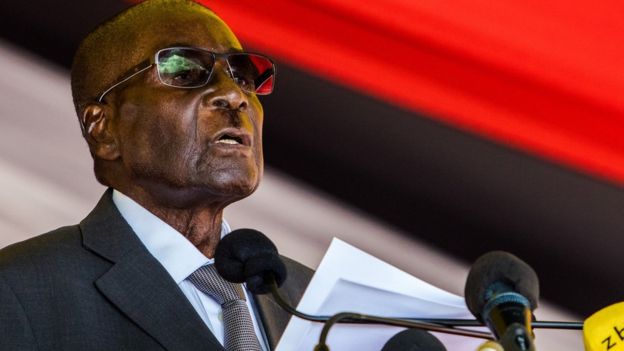
"As an African and a farmer, the donation of cattle came naturally to me, given that our continent is rich in cattle and cattle are held as a store of wealth," Mr Mugabe said.
On its website, the AU Foundation says it focuses on development programmes for youth and women, and promoting gender equality.
Mr Mumbengegwi said the donation was significant as it showed that the AU could find innovative ways to raise money for its projects.
Mr Mugabe, during his term as AU chairman in 2015 and 2016, campaigned for the AU to be self-financed as about 60% of its budget came from foreign donors, the Herald reported.
Latest Stories
-
10th woman found dead in South Africa’s string of killings
25 seconds -
French Embassy trains Ghana Police CTU in counter-terrorism operations
31 minutes -
UPSA uncovers mass results manipulation involving 178 students, over 500 results compromised
1 hour -
ECG announces planned power outages in parts of Tema from Sept. 29 to October 1
1 hour -
Sylvester Mensah urges Latenu FM to promote trade, export opportunities in Ga
2 hours -
Ga language under threat of decline as children shy away from speaking it – Sylvester Mensah
2 hours -
‘Let every Ga child you raise know the Ga language and story’ – Sylvester Mensah
2 hours -
‘We are not deterred’ – Ablakwa responds to backlash over South Africa evacuation
2 hours -
NCA announces major voice and data disruption across Northern Ghana due to fibre cuts
3 hours -
Photos: Housing solutions take centre stage at Day 2 of the 3rd Republic Bank-JoyNews Habitat Fair
3 hours -
Ghana Air Force passes out 293 recruits after six months of intensive training
4 hours -
EOCO vrs Baffour Awuah: EOCO should have secured warrant before arrest attempt at court – Inusah Fuseini
4 hours -
Triple fibre cuts disrupt telecom services across Northern, Oti regions – Sam George
4 hours -
Politicisation could undermine parliamentary probe into cocaine seizures – Dr Osae-Kwapong
4 hours -
EOCO chases MP: Can Section 41 cure lacuna in EOCO Act? – Inusah Fuseini asks
4 hours