

Audio By Carbonatix
Businessman and President of Groupe Nduom, Dr Papa Kwesi Nduom, has declared a renewed era of optimism and determination following a landmark Court of Appeal ruling that overturned the revocation of GN Savings’ licence.
He described the decision as a victory for justice, indigenous enterprise and financial inclusion in Ghana.
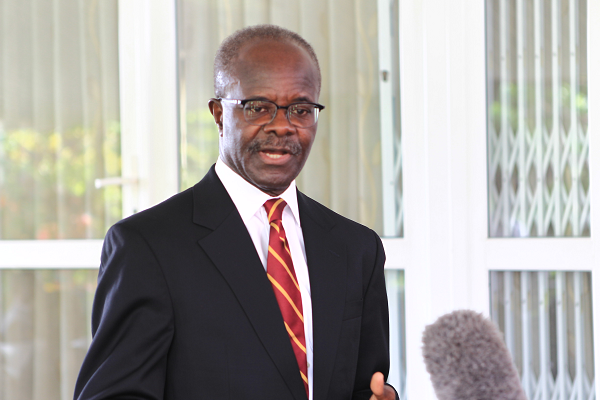
Addressing journalists at Coconut Grove Regency Hotel in Accra on Friday, Dr Nduom insisted that the focus of Groupe Nduom is not revenge or confrontation, but rebuilding a financial institution that once served millions of ordinary Ghanaians across the country.
“Today is not a time to quarrel, to sow hatred or be negative,” he said. “We are moving with faith in the Lord and confidence in our abilities to change what has been negative into something positive that we can all be proud of.”
His remarks came days after the Court of Appeal, in a significant ruling delivered on May 21, 2026, quashed the Bank of Ghana’s 2019 decision to revoke the licence of GN Savings and ordered the immediate restoration of the institution’s operating licence and assets.
Dr Nduom described the ruling as long-awaited justice after nearly seven years of legal and operational uncertainty.
The veteran entrepreneur reflected emotionally on the difficult period preceding the revocation of the licence in August 2019, describing the experience as one marked by sustained pressure from regulators, political actors and public commentators who, in his view, underestimated the critical importance of indigenous financial institutions.
“Prior to that fateful day in 2019 when the GN Savings licence was revoked, we lived through two years of stress and pressure,” he said.
Despite the painful experience, Dr Nduom repeatedly emphasised reconciliation, national development and economic recovery, stating that Groupe Nduom intends to comply fully with the orders of the Court while working constructively within Ghana’s legal framework.
“We are taking instructions from the Court of Appeal,” he stressed. “The court used the word ‘immediately’. We believe everyone who believes in the rule of law will respect that order.”
The Court of Appeal directed the Bank of Ghana to restore GN Savings’ specialised deposit-taking licence forthwith and instructed the receiver to hand over control and management of the institution’s assets to shareholders immediately.
For Dr Nduom, however, the case transcends legal victory. He argued passionately that the return of GN Savings represents an opportunity to restore banking services to underserved communities and revive small-scale enterprise across the country.
Tracing the history of the institution back to 1997, Dr Nduom recounted how the business began as First National Savings and Loans after nearly a decade of planning, consultations and regulatory processes before operations officially commenced in May 2006.
From modest beginnings in a converted boys’ quarters behind Coconut Grove Hotel, the institution expanded steadily into one of Ghana’s most extensive indigenous financial networks, eventually reaching over 300 branches and serving more than 1.2 million customers nationwide.
Unlike many commercial banks concentrated in urban centres, GN Savings and later GN Bank built a reputation for penetrating rural and underserved communities, providing banking services in towns where formal financial institutions were virtually absent.
Dr Nduom highlighted the institution’s role in promoting financial inclusion, supporting micro-enterprises and pioneering mobile interoperability systems that enabled seamless money transfers between mobile networks and banks long before such systems became mainstream.
He cited examples of traders, contractors and small business owners across regions including the Volta, Upper East and Northern Regions who depended heavily on GN Bank’s network to conduct business securely and efficiently.
According to him, the collapse of the institution created a vacuum that remains unfilled to this day.
Dr Nduom linked the absence of such grassroots banking services to broader economic challenges confronting rural communities and small enterprises.
“Ghana is not only Accra or Kumasi,” he observed. “It is the small businesses in the towns and villages that hold the economy together.”
He disclosed that Groupe Nduom has already begun preparations to resume operations in compliance with the court’s ruling, revealing that the reopening process will begin with selected branches where ownership and operational issues are clear.
The first branch expected to reopen will be located at Elmina Esuakyir in the Central Region, in a property personally linked to his family.
Workers, electricians and contractors are already on-site preparing the facility for operations, he said, expressing confidence that the branch could become operational within weeks.
He further revealed that many former employees, landlords and customers have enthusiastically reached out to support the institution’s return, with some communities even volunteering labour and assistance to facilitate reopening efforts.
“At our peak, we directly employed over 2,000 people and supported nearly 3,500 jobs including security and service providers,” he stated. “We intend to bring those opportunities back.”
Dr Nduom also disclosed that prior to the 2019 revocation, GN Bank had secured a proposed US$20 million facility from the United States Overseas Private Investment Corporation (OPIC), intended to support traders and small businesses, but the arrangement collapsed after the licence withdrawal.
Dr Nduom maintained that Groupe Nduom’s mission remains rooted in national development rather than corporate ambition.
“We did not build ourselves to become the richest or biggest bank,” he said. “Our mission was always to bring formal and safe banking to the doorstep of every Ghanaian.”
Latest Stories
-
6th Inter Tourism Expo comes off in Cape Coast this October; register now
6 minutes -
Afenyo-Markin accuses government of diverting attention from cocaine seizures linked to Ghana
6 minutes -
GJA gives Armed Forces 14 days to account for alleged assaults on Sika Official, Bullet TV’s Philip Abutiate
8 minutes -
PAC gives Community Water Agency 30 days to recover GH¢10m in unpaid water bills from public institutions
10 minutes -
Major Accra roads to get facelift ahead of Ghana’s 70th Independence anniversary – Agbodza
31 minutes -
Account for GH¢650bn allocated to existing programmes before new economy – Oppong Nkrumah to gov’t
42 minutes -
‘You’re an action man’ – Abena Osei-Asare hails Rent Commissioner’s hostel fee crackdown
43 minutes -
Mahama directs Finance Minister to allocate GH¢1bn for Housing Fund in 2027 Budget
50 minutes -
NPP celebrates Bawumia on birthday, prays for 2028 election victory
50 minutes -
Mahama recounts ‘exhausting and frustrating’ struggle to find a home as a young spouse
55 minutes -
‘Take damaged banknotes to commercial banks for replacement’ – BoG warns against repairing cedi notes for resale
1 hour -
Lebanon’s Hezbollah gets $200 million from Iran to help displaced, sources say
1 hour -
Bisa Kdei to launch annual Highlife music event ‘The Convention’
1 hour -
BoG cautions public against digital financial fraud, ‘double-your-money’ schemes
1 hour -
WPL 2026/27: Ampem Darkoa Ladies to start title defence against Northern Ladies
1 hour