

Audio By Carbonatix
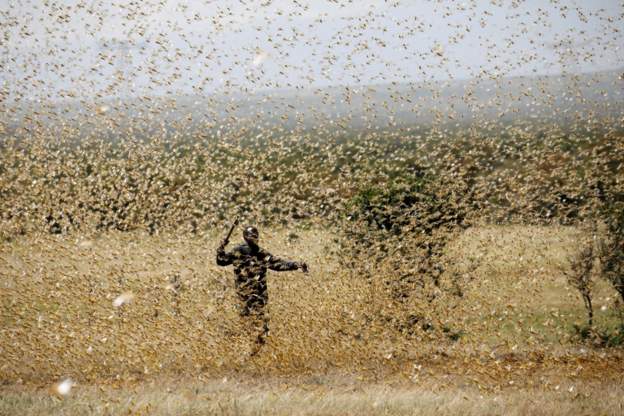
New swarms of locusts are increasing the risk of food insecurity for millions of people in East and Central Africa who are already reeling from the impact of Covid-19 and flooding, humanitarian agency Oxfam has said in a new report.
Locust invasions in recent months are estimated to have destroyed thousands of hectares of crops in Kenya, Somalia and Ethiopia.
Heavy rains that have led to flooding have also created favourable conditions for the breeding of locusts.
The latest generation of swarms, feared to be as big as 400 times larger than the original swarms, are expected to hatch in June when crops are ready for harvest
East Africa’s Desert Locust Control Organisation has told the BBC that the coronavirus pandemic has hindered efforts to control the invasion as importing pesticide to the region has become expensive.
Last week the World Bank approved $160m (£130m) for Djibouti, Ethiopia, Kenya and Uganda in the form of grants and low-interest loans to help farmers and herders impacted by the invasions.
Latest Stories
-
NDC threatens sanctions over oversized campaign posters, gives aspirants 5 days to comply
19 minutes -
Star Oil paid GH¢2.7bn in taxes, levies in nine months of 2026
33 minutes -
Samson’s Take: The rule of law is cheaper before the bulldozer
34 minutes -
GRA blames system failure for delay in issuing receipt over passenger’s customs duty
55 minutes -
Livestream: Newsfile discusses World Cup visa scandal, beach demolitions, education strikes, BRICS bid
59 minutes -
NC-PTAs welcomes end of teachers’ strike, urges parents to prepare children for Monday
1 hour -
Government procures over 2,000 transformers as Ghana’s electricity access hits 89.13% – Energy Minister
2 hours -
UTAG-UG threatens strike on October 19 over unpaid allowance
2 hours -
Let The Constitution direct Chieftaincy to deliver “All Development Is Local”
3 hours -
John Jinapor outlines renewable energy, nuclear power priorities for 2027
3 hours -
Ghana explores centre of excellence for hearing, communication and cochlear implant care
4 hours -
Schizophrenia-related disorders lead mental health cases recorded in Ghana
5 hours -
Dutch authorities enlist Ghana in hunt for fugitive drug lord Bolle Jos
5 hours -
Ghana housing finance conference adopts communiqué to improve affordable housing access
9 hours -
Special Initiatives Minister urges Wa Technical Institute to enrol more girls as EU-backed solar training lab opens
10 hours