

Audio By Carbonatix
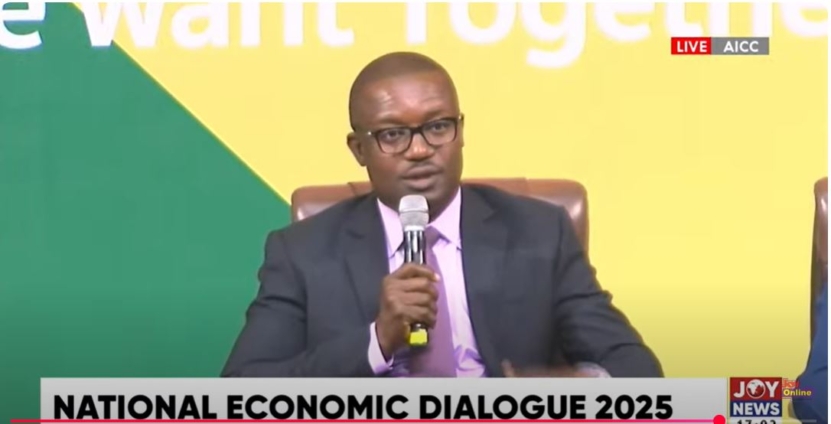
Energy Minister John Jinapor has revealed that Ghana’s energy sector is grappling with outstanding liabilities of approximately GH₵80 billion, with the debt continuing to rise.
Speaking during Day 2 of the National Economic Dialogue, the minister warned that restoring the sector to stability would require clearing this massive debt burden.
“Today, the outstanding liabilities stand at about GH₵80 billion, and it keeps increasing. If we were to fully revive the energy sector, we would need to flush out this debt. Clearly, this situation is unsustainable,” he stated on Tuesday, March 4.
Beyond the existing liabilities, Mr Jinapor highlighted an even more concerning issue—the sector's monthly financial shortfall. According to him, “Our total bill, especially in the power sector, is about $170 million per month, but collections are less than $100 million. This means we are accumulating an additional $70 million in liabilities every month."
Mr Jinapor highlighted inefficiencies within the energy sector, citing financial indiscipline as a major concern. He noted that in 2023, the Public Utilities Regulatory Commission (PURC) approved $200 million as a capital expenditure cap for the Electricity Company of Ghana (ECG), but ECG ended up incurring $700 million, exceeding the approved amount by $500 million.
This excess spending, he explained, was not factored into the tariff structure, worsening the sector’s financial crisis.
The minister further emphasised the need for private sector involvement in managing the energy sector, warning that failure to do so could lead to its collapse.
He disclosed that some power producers have already shut down their plants due to non-payment of their bills, stressing that tough decisions must be made to prevent a total breakdown.
Mr Jinapor also called for an urgent transition from liquid fuel to gas for power generation, arguing that Ghana has stranded gas that is not being utilized, while the country continues to spend heavily on liquid fuel.
He revealed that the cost of liquid fuel this year alone is projected to reach $1 billion, whereas half of that amount could build a gas processing plant that would save the country $600 million annually. He maintained that constructing the plant is non-negotiable, as it would not only cut costs but also reduce corruption and waste in the sector.
Latest Stories
-
Israel-bound flight diverted after fight between pilots
3 minutes -
EchoWave earns praise for sound quality at 10th Women in Worship
13 minutes -
Crackdown on South Africa’s unsafe streets ordered by president to keep women safe
24 minutes -
Banks are responding to improved monetary policy conditions – John Awuah
43 minutes -
Judges’ conference forces further adjournment of Salomey Baffoe case to Oct. 5
55 minutes -
Chorkor community joins AC4NCA clean-up to tackle marine and coastal pollution
1 hour -
GRA assures Tullow of collaboration to settle $393m tax liability without disrupting its petroleum operations
1 hour -
South Korea demands apology from Pyongyang for landmine blasts that injured three
1 hour -
Carlos Queiroz not the sort of coach Black Stars need – Nii Lante Vanderpuye
2 hours -
AFCON 2027Q: ‘Our Black Stars team is gone’ – Former Sports Minister
2 hours -
Prof. Prempeh calls for public review of draft constitutional reform bills
3 hours -
AFCON 2027Q: ‘I have never seen a poor performance from Black Stars like against Gambia’ – Nii Lante Vanderpuye
3 hours -
Bawumia backs insurance sector reforms after engagement with IBAG
3 hours -
Nigeria set to launch National Digital Address System 9 years after Ghana showed the way
3 hours -
Policy rate decision takes time to reflect in lower lending rates – BoG
3 hours