

Audio By Carbonatix
The Savannah Agricultural Research Institute (SARI) has announced it will in November officially request approval from the National Biosafety Authority (NBA) to put genetically modified cowpea variety into the hands of farmers outside confined experimental fields.
The application for environmental release of the Bt cowpea variety which has inherent resistance to pest attacks will be done once an internal review process which is currently ongoing at SARI is completed.
SARI is one of 13 institutes of the Council for Scientific and Industrial Research (CSIR) responsible for the development of improved crop varieties for the benefit of farmers in the northern part of the country and beyond.
For more than 7 years now, the institute has been working on the genetically modified cowpea (beans) variety, known as the Pod-borer resistant cowpea. It is a variety into which genes which are harmful to the destructive Maruca pests but safe for humans has been introduce through genetic engineering, resulting in a product that can help farmers cut down substantially on the use of pesticides.
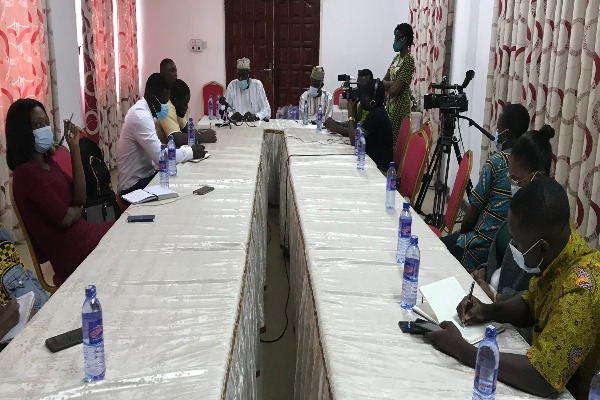
“Maruca vitrata is a troublesome pest... It attacks plants at flowering stage and when pods start forming... It could cause up to 80% yield loss on farmers field… farmers have tried to use pesticides to control it…spraying between 5 and 10 times in the 2 and half months cycle of the crop…” Dr. Jerry Nboyine who is principal investigator on the Bt cowpea project explained at a media briefing in Accra.
“When we conducted these experiments, we realized that when you have this Bt cowpea, the farmer will have to spray for a maximum of two times to control other insects that attacks the cowpea, compared to the 10 times for non-Bt cowpea.
“What this means is, if farmer is spending 40 cedis on a liter of insecticide, and farmer is spraying 10 times, he would have to spend 400 cedis. But if you have Bt, its two times. 80 cedis. So, we are helping the farmers to reduce the cost of producing the crop… And it will help stop pesticide poisoning as well in beans,” he added.
Dr Nboyine explains it will take a while before the product finally gets onto the market. “We have prepared a dossier that has been looked at SARI. We will pick that dossier and submit to the NBA…They will go through it in a detailed way.
"Then once they are satisfied, they give you a permit to grow it outside confinement. So now the permit will allow you to move it to the farmers' field level… We are hoping that by November this year, we will submit the dossier to Biosafety Authority,” he explained.
“The next cropping season is 2021 July. If we get the permit, we go to the different agro-ecologies of the country to plant it with the farmers so they can examine and compare it,” the plant breeder added.
It will be after this planting season that the variety will now be examined by the Plant Variety Release Committee of the Ministry for Food and Agriculture for the final greenlight that will allow for the variety to get onto the market.
Former Director General of the Council for Scientific and Industrial Research Prof. Walter Alhassan explained there is nothing harmful about genetically modified crops.
“Biotechnology has been used commercially since 1996. Then it was 1.7 million hectares or so. Now they have about 197 million hectares. About 26 countries are in it. 70 countries are using it. The thing has grown dramatically. So, Ghana and African countries should not be left behind,” he said.
“We cannot wait for this product to go through the regulatory process and get into the hands of farmers… The technology is home grown. They can move the gene into another cowpea variety forever. And the farmers can save the seeds because it is not a hybrid plant material.
"Although scientists advise… that you don’t recycle the thing (seeds) for too long because you have genetic erosions. So, you have to go to the scientists but for heaven sake, we are not going outside the country to get germplasm,” Prof. Alhassan added.
Dr. Issoufou Abdourhamane, West Africa Cowpea Project Manager at the African Agricultural Technology Foundation (AATF) which is a project partner told the media genetically modified crops have proven to be safe for several years and will pose no harm to Ghanaians
“Too bad our countries have become flooded with European NGOs urging us to move against GMOs. And now they are scaring us against science generally, telling farmers not to apply fertilizer, not to apply any modern technique, not to plant hybrids.
"This is what is going on in the rural areas and people in big cities who have no clue are listening to them,” he observed.
Latest Stories
-
UG warns public against fake resumption and hall fees notice
27 minutes -
‘Follow Ghana’s steps’ – IMF Africa Director hails economic gains
58 minutes -
Kwame Nkrumah’s son Gamal dies; burial scheduled for Saturday in Egypt
1 hour -
Ghana will beat IMF’s upgraded 5.7% growth forecast – Ato Forson
1 hour -
Middle East tensions, global risks to shape November policy rate decision – BoG Governor
1 hour -
MTN Ghana to invest $1.1bn over three years, deploy 500 new sites in 2026
1 hour -
15 arrested over alleged sand-winning activities along new Accra-Kumasi Expressway project
1 hour -
Agriculture slows to 3.9% as Ghana’s economy grows by 6%
2 hours -
Government launches rCOMSDEP to promote responsible mining in Western Region
2 hours -
Foreign Affairs Ministry procures 20 pickups to improve passport services
2 hours -
Oil prices retreat as investors weigh supply outlook, Middle East tensions
2 hours -
Mahama Ayariga highlights Jimi reclamation project as effort to tackle flooding
3 hours -
Ayine pushes duty-lawyer scheme to protect suspects at police stations
3 hours -
Stephen Amoah criticises 20% digital services tax as excessive
3 hours -
Ghana secures $3.5bn investment commitments to revive oil and gas sector – Jinapor
3 hours