

Audio By Carbonatix
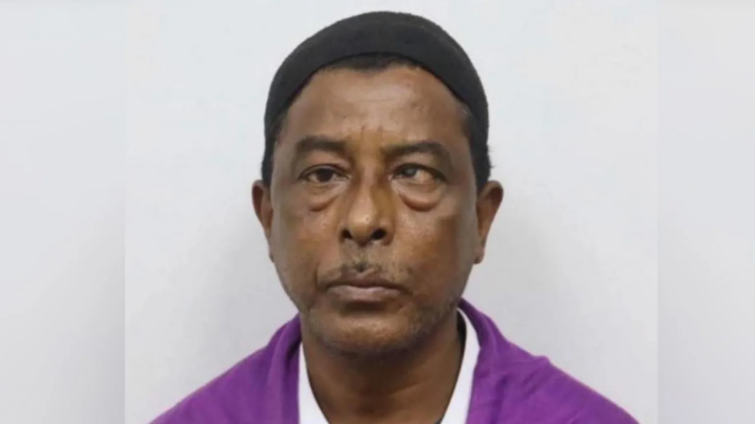
The death in the US of "nearly blind" refugee Nurul Amin Shah Alam, who was found outdoors in freezing temperatures days after his release from federal immigration custody, has been ruled a homicide in New York state.
The Erie County Medical Examiner's Office said Shah Alam's death in the city of Buffalo was caused by "complications of a perforated duodenal ulcer, precipitated by hypothermia and dehydration".
The designation of homicide may include negligent acts or omissions, the local officials said. It does not imply intent to cause harm or death, or indicate criminality.
In response, a US Customs and Border Protection (CBP) spokesman told the BBC it was "another hoax being peddled by the media and sanctuary politicians to demonise our law enforcement".
"This death had NOTHING to do with Border Patrol," the spokesman said, adding that Shah Alam died almost a week after he was released by Border Patrol.
The body of Shah Alam was found on 24 February - five days after agents dropped him off at a coffee shop.
Afterwards, Shah Alam, a Rohingya refugee from Myanmar, was described by Buffalo Mayor Sean Ryan, a Democrat, as "a vulnerable man - nearly blind and unable to speak English".
Fellow Democrats gave further reaction on Wednesday. Shah Alam's death "should not have happened", Erie County executive Mark Poloncarz told reporters. "The death was one that we believe could have been prevented."
New York Governor Kathy Hochul said every individual involved in the man's death "must be held fully accountable".
Erie County District Attorney Mike Keane and New York State Attorney General Letitia James said their offices were reviewing the facts.
The 56-year-old refugee died from an ulcer "precipitated by our body's physiologic response to severe stress", county health commissioner Dr Gale Burstein told reporters. She said one symptom of a perforated ulcer was severe pain.
Officials could not comment on whether Shah Alam had a history of an ulcer or had been treated for one because of the confidentiality of the medical record. The autopsy report could not be released to the public under the law, Poloncarz said.
The Department of Homeland Security (DHS), which oversees CBP, said in a previous statement that Shah Alam had shown "no signs of distress, mobility issues or disabilities requiring special assistance" when he was dropped off.
The department added: "Border Patrol agents offered him a courtesy ride, which he chose to accept to a coffee shop, determined to be a warm, safe location near his last known address, rather than be released directly from the Border Patrol station."
Shah Alam was found dead nearly 6 miles (9.7km) away from the shop.
The temperature in Buffalo averaged 35F (2C) on the day he was released, and dropped to an average of 20F by the day he was found dead, according to the National Weather Service.
In its response on Thursday, CBP also said Shah Alam had a "violent criminal rap sheet".
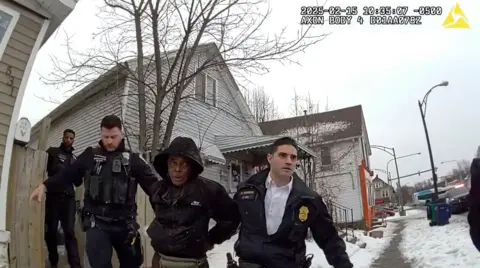
Shah Alam had been arrested by local police in February 2025 after an incident in which two officers sustained minor injuries, the district attorney said. It was as a result of this incident that Shah Alam ultimately ended up in the custody of federal agents.
One of Shah Alam's children, Mohamad Faisal, told Reuters that his father's arrest last year had been due to a misunderstanding with police officers.
His father, he said, had been out for a walk and was using a curtain rod as a walking stick. When Shah Alam got lost and walked onto the property of a Buffalo resident, the resident called the police.
Shah Alam could not understand police commands to drop the curtain rod, and he was arrested, Faisal said.
Video from body-worn cameras released by Buffalo police shows the man holding two black rods when officers appear, and repeatedly saying "sorry". When he does not drop the rods after repeated requests to do so, the officer deploys tasers, and he walks forward swinging the rods until one officer wrestles him to the ground.
The refugee had only been in the US for a few months prior to his arrest, Legal Aid Bureau of Buffalo said.
On 9 February of this year, Shah Alam pleaded guilty to two misdemeanours - possession of a weapon and trespassing. He was released from jail on 19 February when his bond was posted.
As part of that case, US immigration authorities had placed a detainer on him, which is a request that a non-US citizen be taken into custody if they are released.
After taking him into their custody, the federal authorities released Shah Alam after finding he entered the US as a refugee and was not subject to deportation, DHS said.
He was dropped off at a Tim Hortons shop near his last known address, according to the Legal Aid Bureau, which added that his family no longer lived there or in that part of the city.
Shah Alam's son told Reuters the family was not notified of when or where he had been dropped off.
According to police, his lawyer reported him missing on 22 February. Two days later, a passerby found his body on the street.
Latest Stories
-
Don’t turn students away over trunks and chop boxes – GES
3 seconds -
Italian Apple store employees strike on iPhone 18 Pro launch day
10 minutes -
Apple’s Tim Cook sees Australia’s social media curbs as ‘world-leading’, PM says
19 minutes -
Amazon raises minimum hourly pay by $1 to $20 for US operations workers
30 minutes -
Insurance cost has largely remained stable – NPA boss on transport fare pressure
41 minutes -
Multiple unions threaten strikes at Barrick’s flagship Mali gold mine, documents show
60 minutes -
Infantino invited to African summit as he faces challenge to FIFA leadership
1 hour -
NPA boss flags ‘recalcitrant’ transport operators raising fares arbitrarily
1 hour -
GPRTU fare hike put on ice after talks with government – NPA boss reveals
2 hours -
I’m greatly worried – NPA boss on threat of higher transport fares
2 hours -
We are largely import-dependent – NPA boss on Ghana’s fuel vulnerability
2 hours -
Ghana’s fuel market is built for turbulence – NPA’s Edudzi Tamakloe explains why
3 hours -
Postponement not an option as Kenya races to be ready for Afcon 2027
3 hours -
ICE agent shoots and wounds man in Texas as locals demand answers
3 hours -
Ed Sheeran admits ‘mistakes’ at first show since Macklemore controversy
3 hours