

Audio By Carbonatix
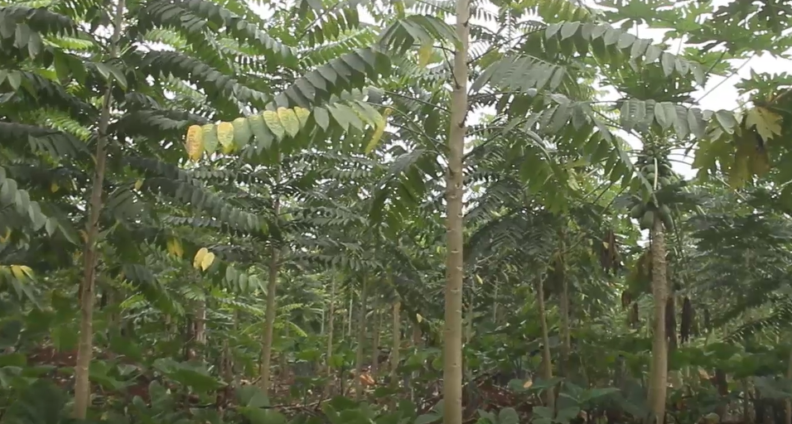
There is a concerted effort to restore Tinte Bepo Forest Reserve at Mankranso in the Ashanti region.
Commercial Plantation Development under the model called ‘Youth in Plantation as Occupation Programme' funded by the Forest Plantation Development Fund Management Board yields positive results.
In 2019, a total of 54 hectares of the area was planted with various tree species such as Ofram, Mahogany and Cedrela, while preparation is underway to plant the remaining hectares.
The planting of the trees has become necessary as temperatures and extreme heat keep rising.
The initiative would not only provide vegetation to the environment but create an economic empowerment program for women.
The programme will restore the forest and increase food production through the adoption of agroforestry systems.
Farmers are allowed to inter-crop foodstuffs with the trees, and over two hundred hectares of the degraded Tinte Bepo Forest Reserve in the Mankranso forest district would be restored.
Deputy Minister of Lands and Natural Resources, Benito Owusu-Bio, says the species planted include teak, Wawa, Mahogany, Cedrela, Ofram, and cassia.
Tinte Bepo was once a beautiful rainforest dominated by economic trees like Odum, Mahogany, Mansomia, Emire, and Danta.
Rainforests provide humans with more than just trees. Lack of vegetation could result in rapidly increasing climate change.
The latest report by the Intergovernmental Panel on Climate Change (IPCC) has projected an increase in average temperatures and heat extremes on the African continent.
According to the report, the continent is likely to experience drier conditions, except for the Sahara and Eastern Africa.
The Director-General of the Centre for Science and Environment (CSE), Sunita Narain, says there is no time to lose on the new Intergovernmental Panel on Climate Change (IPCC) report.
The Director-General of the Indian-based centre says countries will have to work even harder to plant more trees to sequester carbon dioxide.
The report on climate change is the first part of its sixth assessment report that sounds like a dire warning.
Latest Stories
-
Refugees in South Africa face mounting tensions as September 30 deadline looms
15 minutes -
At least 12 dead, dozens missing after vessel capsizes in DR Congo
19 minutes -
Two dead, 14 rescued after accident on Kpetoe-Sarakope road
47 minutes -
AFCON 2027Q: Moroccan referee Mustapha Kechchaf to officiate Ghana-Gambia match
56 minutes -
Our mental health is restored – How Medical Trust Fund is giving doctors hope again
59 minutes -
2027 budget to provide for grain silos – Agric Minister
59 minutes -
Damongo Communique: Democracy Not For Sale
1 hour -
Yusif Sulemana pushes community benefits, national systems in Global Forest Finance Debate
1 hour -
Todays Front pages: Monday, September 28, 2026
1 hour -
WAFU B U-17 Girls Cup: Black Maidens finish tournament with 4-0 win over Cote d’Ivoire
1 hour -
2026 Women’s Super Cup: FC Savannah to face Epiphany Warriors in final on September 29
2 hours -
Ghana’s second chance: How President Mahama’s return offers historic opportunity for transformation
2 hours -
AFCON 2027Q: Alexander Djiku ruled out of clash against Gambia
2 hours -
RCI Immanuel Temple donates supplies to Motherly Love Orphanage
3 hours -
Ghana calls for predictable, people-centred financing to protect tropical forests
3 hours