

Audio By Carbonatix
Governance and public policy analyst, Dr Solahudeen Tando has proposed a fundamental rethink of Ghana's continuing debate over the election of Metropolitan, Municipal and District Chief Executives (MMDCEs), arguing that the country should consider transferring appointment responsibility from the President to Members of Parliament rather than creating another layer of public elections.
Under the proposed model, MPs would appoint MMDCEs as development representatives within a regulated professional framework, with clear qualification and competence standards and safeguards against unrestricted political patronage.
Dr Tando argues that the proposal deserves consideration because Ghana's political culture has already transformed MPs into de facto development agents, although their formal constitutional role remains principally legislative and representative.
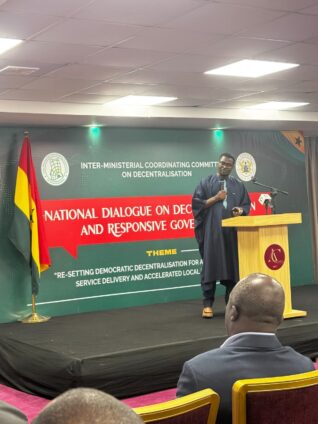
He made the proposal at the National Dialogue on Decentralisation and Responsive Governance in Accra, where he presented a discussion paper titled, “The Next Frontier of Democratic Decentralisation: Strengthening District Assemblies as Territorial Platforms of the Ghanaian State for Integrated Public Service Delivery and Local Development.”
The dialogue brought together government officials, local government practitioners, academics, civil society organisations, development partners and other sector stakeholders to examine the future of Ghana's decentralisation system.
Dr Tando questioned whether the proposed election of MMDCEs adequately resolves the deeper institutional problems confronting local governance.
“What real problem does another election of MMDCEs seek to solve?” he asked.
He argued that the question becomes particularly important when the existing political and institutional realities surrounding MPs are examined.
According to him, MPs routinely campaign on roads, schools, health facilities, sanitation, jobs and other local development priorities. Constituents consequently hold them politically accountable for development outcomes, although formal responsibility for local development rests principally within the District Assembly system.
He noted that the Government's 2026 Position Paper on constitutional reform has itself acknowledged this institutional evolution, describing MPs as having become development agents in their constituencies “by default” and rejecting a recommendation that DACF allocations to MPs be prohibited.
Dr Tando said the development raises a wider accountability question that Ghana must confront before creating another independently elected political office within substantially the same territorial development space.
“If both the MP and MMDCE acquire separate democratic legitimacy within substantially the same development space, who ultimately bears political accountability for constituency development when things go right or wrong?” he asked.
He said the proposed alternative would shift appointment control away from the Presidency and place responsibility closer to an already elected constituency representative.
Under his proposal, however, an MP would not possess unrestricted discretion to appoint any preferred political actor.
Dr Tando proposes a regulated system under which relevant public institutions provide professional safeguards around the appointment process. The Public Services Commission could establish appropriate professional and person specifications, while the role and performance expectations of the MMDCE would align with the applicable district development framework and national development planning architecture.
He argues that such safeguards could make competence an integral part of the appointment process while retaining identifiable political accountability.
The proposal, he acknowledged, represents a significant departure from both the current presidential appointment system and competing proposals for direct popular election.
However, he argued that Ghana's local government debate should not treat an additional election as synonymous with decentralisation.
According to him, election addresses the method through which an officeholder acquires political legitimacy, whereas effective decentralisation also requires attention to authority, administrative capacity, resources, planning, coordination and accountability.
Dr Tando further questioned whether Ghana should create two separately elected political centres that face substantially overlapping constituency-development expectations without first defining the relationship between their mandates.
He maintained that his proposal seeks to institutionalise an existing political reality rather than create an entirely new role for MPs.
“We continue to hold MPs politically accountable for local development irrespective of the formal institutional location of development responsibility. Legislation alone is unlikely to erase that deeply embedded political expectation,” he argued.
He said the central reform question is therefore whether Ghana should continue to treat that political evolution as an anomaly or deliberately structure, regulate and make it accountable.
Dr Tando also called for a broader reconceptualisation of District Assemblies beyond their conventional treatment as local administrative structures.
He proposed that the District Assembly should be understood as “a territorial platform through which the fragmented functional state becomes an integrated local service experience in the delivery of public value.”
Under that conception, decentralisation should ultimately be assessed through the experience of citizens at the local level rather than principally through the number of functions formally transferred or institutions established.
“Decentralisation must make the state coherent at the point where the citizen experiences it,” he said.
Dr Tando acknowledged that the MP-led appointment proposal requires further constitutional and institutional scrutiny, including safeguards against excessive concentration of political authority and arrangements for districts that contain more than one parliamentary constituency.
He nevertheless argued that unconventional proposals should remain open to scrutiny as Ghana searches for durable consensus on local government reform.
“Perhaps MP appointment is not ultimately the answer. I am open to that. But we should not discard the institutional problem simply because one proposed answer is unconventional,” he said.
Latest Stories
-
China pushes back against US on Iran and Cuba in UN speech
13 minutes -
OpenAI, Anthropic CEOs called to appear at Australian AI probe
34 minutes -
T-bills auction: Government exceeds target marginally; yield on 91-day bill remains unchanged
3 hours -
GPL 2026/27: 10-man Aduana hand Kotoko defeat in Kumasi
4 hours -
GPL 2026/27: Medeama ease past Basake Holy Stars
4 hours -
Appiah Adomako writes: Why DVLA must stop treating every expired licence holder as delinquent
4 hours -
Localization must transfer decision-making power, not just project responsibilities
4 hours -
Modernising Ghana’s traditional markets through the 24-Hour Economy markets initiative
4 hours -
New economy will boost local production and create jobs – Finance Minister
5 hours -
Ronaldo on bench as Portugal beat Norway
5 hours -
Republic of Ireland defeat Israel in Debrecen
5 hours -
Real-Time VAT on cross-border digital services – not a new tax and does not violate double taxation principle
5 hours -
Digitalisation, AI key to Ghana’s tourism transformation – GHATOF
6 hours -
Stronger GTA-private sector partnership needed to grow tourism – GHATOF
6 hours -
Amazon eyes Ghana for broadband expansion after talks with Mahama
6 hours