

Audio By Carbonatix
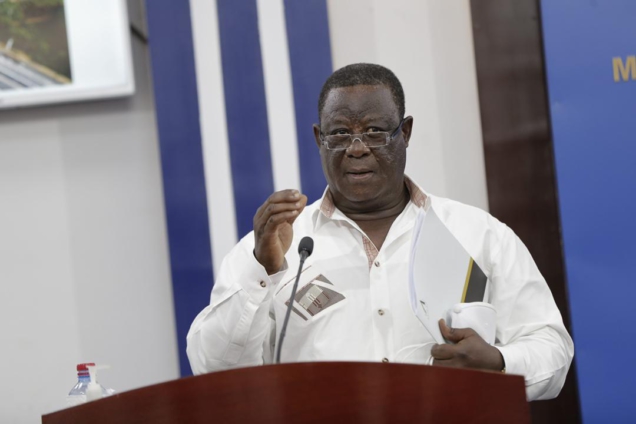
The Roads and Highways Minister, Kwasi Amoako-Attah, has revealed that the government will securitise revenue to be generated from the Electronic Transactions Levy (E-levy) to raise bonds for road construction.
Speaking on the floor of Parliament on Friday, he indicated that the government looks forward to the immediate passage of the E-levy Bill to accelerate the country’s revenue collection drive.
“The government, in its wisdom, has proposed the passage of the E-levy to bring in more revenue to build the road infrastructure of our country for all of us,” he said.
“Government is looking forward to the passage of the E-levy that will bring in greater revenue that will be securitised and then used to raise a bond if possible, to build the road sector infrastructure,” he disclosed.
This disclosure contradicts an earlier indication by the Deputy Finance Minister, John Kumah, that the Electronic Transactions Levy or E-Levy will not be used as collateral for the government’s debt.
Addressing the inaugural ceremony of the Ashanti Regional Youth Parliament on March 2, Mr. Kumah, emphasised that the government lacks no liquidity to be unable to pay public workers and undertake projects in the country.
“We need revenue to construct roads. We have a huge infrastructural gap in our country. The road tolls were giving the country 78 million cedis annually.
“The e-levy was going to give about 6.9 billion cedis. If Ghana was going to set aside 1.5 billion cedis from the e-levy to construct roads. It means there is an increase in the IPC’s capacities. Therefore, it’s untrue the E-levy will be used as collateral,” he said.
But the Roads and Highways Minister said “it is government’s policy is to bring in a better form of collection because the toll revenue is built in the proposed E-levy.”
E-Levy
Finance Minister, Ken Ofori-Atta, during the presentation of the 2022 budget announced that government intends to introduce an Electronic Transactions Levy (E-levy).
The Levy, he revealed, is being introduced to “widen the tax net and rope in the informal sector.”
The proposed Levy, which was expected to come into effect in January 2022, charges 1.75% on the value of electronic transactions.
It covers mobile money payments, bank transfers, merchant payments, and inward remittances. There is an exemption for transactions up to GH¢100 per day.
Although the government has argued that it is an innovative way to generate revenue, scores of citizens and stakeholders have expressed varied sentiments on its appropriateness, with many standing firmly against it.
Even though others have argued in support of the Levy, a section of the populace believe that the 1.75% E-levy is an insensitive tax policy that will deepen the already prevailing hardship in the country.
Latest Stories
-
Kwaku Azar writes: A-G vs OSP
18 minutes -
Mfantsipim–Adisadel rivalry built excellence, not division – Sam Jonah
42 minutes -
Vice President launches Mfantsipim’s 150 years of shaping Ghana’s greatest mind
59 minutes -
I assure Otumfuo, Mahama will join him to commission KNUST Teaching Hospital by end of this year – Haruna Iddrisu
2 hours -
Barcelona dominate derby to extend La Liga lead
2 hours -
Gov’t to roll out free special education for persons with disabilities from July 1 – Education Minister
2 hours -
Importers and Exporters Association declares full support for Publican AI port system
2 hours -
“We used it to test our officiating officials’ readiness” – Bawah Fuseini after CAA Athletics event
2 hours -
Volleyball emerges as Ghana’s fastest rising sport
3 hours -
National Sports Fund needs strong leadership from the top – Administrator David Wuaku
3 hours -
JoySports Exclusive: Steve McLaren in talks with GFA after expressing interest in Black Stars job
3 hours -
Fire guts auto parts warehouse at Bubuashie, one fire officer injured
3 hours -
I owe my victory to coach Ofori Asare – Allotey after winning WBA Africa Gold Super Flyweight belt
3 hours -
Church of Pentecost supports over 2,000 BECE candidates in Obuasi with career guidance seminar
5 hours -
Brandon Asante and Coventry all but promoted to Premier League despite Sheffield Wednesday draw
5 hours