

Audio By Carbonatix
On May 31, 2002, in Seoul, Senegal stepped onto the World Cup stage for the first time and delivered one of the greatest upsets in tournament history.
They beat France.
Not just any France. The defending world champions.
The reigning European champions. A side glistening with superstars: Thierry Henry, Zinedine Zidane, Patrick Vieira, Marcel Desailly.
Senegal, by contrast, had barely two players with more than 30 caps, most earning their wages in the very league of their former colonizers.
This was more than football. It was history confronting itself.
In the 30th minute, Papa Bouba Diop met El Hadji Diouf’s cut-back with a thunderous finish. He ripped off his shirt, sprinted to the corner flag, and laid it there like an offering. His teammates danced around it in a circle of pure joy. Senegal held firm for a 1-0 victory.
France, which failed to score a single goal across the entire group stage, went home in disgrace.
That night did not merely eliminate the holders. It rewrote the Senegalese football psyche.
The enduring shadow of 2002
The Lions of Teranga marched on, defeating Sweden in extra time and reaching the quarter-finals further than England, Argentina, or co-hosts South Korea. The image of Diop’s celebration, the raw audacity of that run, became myth.
A generation of Diouf, Fadiga, Cissé, and Diop did more than win matches.
They shattered a mental ceiling. Senegal, they proved, could stand toe-to-toe with the giants and emerge victorious.
When Aliou Cissé, a warrior from that 2002 squad, led Senegal to their first Africa Cup of Nations title in 2022, with Sadio Mané slotting the decisive penalty, the circle appeared complete.
The spirit had been passed on.
Twenty-four years later, that shadow lingers over every training session and team meeting. It is inspiration, yes, but also a silent, unrelenting pressure. A standard the current generation must not only match, but also honour.
The unresolved wound of 2026
In January 2026, Senegal reached the AFCON final against hosts Morocco in Rabat. They won 1-0 after extra time on the pitch. Yet in the dying moments of normal time, a disputed penalty award to Morocco sparked chaos.
Senegalese players briefly walked off in protest before returning. Two months later, CAF’s appeal board stripped Senegal of the title on a technicality, awarding Morocco a 3-0 forfeit victory. Senegal has appealed to the Court of Arbitration for Sport.
The case remains unresolved.
The scar runs deep. On the field, Senegal had proven itself Africa’s strongest. Off it, they were reminded painfully of football’s political fragility. That combustible mix of justified pride and lingering grievance travels with them to New Jersey.
Mané’s final dance
At the heart of this team stands Sadio Mané. At 34 and playing for Al-Nassr, this is almost certainly his last World Cup. Senegal’s all-time leading scorer, the man who converted the 2022 AFCON-winning penalty, now carries both legacy and the urgency of farewell.
No longer the lightning winger of his Liverpool peak, Mané has evolved into a profoundly intelligent forward linking play, timing runs with surgical precision, and delivering in the moments that matter.
In a squad bridging generations, he is the emotional compass and spiritual heir to 2002.
Pape Thiaw’s identity
Since his appointment in December 2024, coach Pape Thiaw has forged a Senegal side defined by controlled aggression and remarkable consistency.
They favour a compact 4-2-3-1 or 4-3-3, sitting in a narrow mid-block, absorbing pressure before exploding into swift, vertical transitions.
The midfield pulses with drive: Pape Matar Sarr surges forward with powerful carries and progressive passes, protected by a disciplined double pivot.
Out wide, Ismaïla Sarr offers directness; Iliman Ndiaye brings guile and close control, while Nicolas Jackson threatens in behind. Defensively, they are a fortress. Kalidou Koulibaly commands the backline with imperious calm.
In qualifying, Senegal conceded just three goals in ten matches, a testament to their tactical maturity.
This is intelligent, pragmatic football designed to disrupt superior possession sides. It is, in essence, the spiritual successor to the approach that humbled France in 2002.
The 2026 reckoning
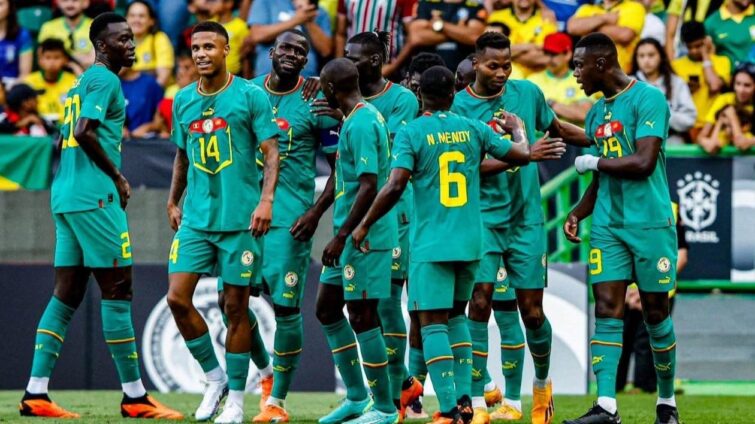
Drawn in Group I with France, Norway, and Iraq, Senegal opens their journey against the French on June 16 at MetLife Stadium.
The fixture instantly conjures ghosts of Seoul.
This time, Senegal arrives not as debutant dreamers but as a battle-hardened, tactically coherent unit unbeaten in competitive matches under Thiaw, with impressive results including a historic friendly victory over England. France, for all their talent, cannot afford complacency.
In 2002, Senegal had nothing to lose and shocked the world. In 2026, they carry history, scars, soaring expectations, and a clear tactical blueprint.
The question is no longer whether Senegal can beat France.
It is whether they can do it again this time beneath the full weight of legacy, in the crucible of generational transition, with unfinished business burning in their veins.
Some teams simply know how to trouble France.
On June 16 in New Jersey, the Lions of Teranga will seek to remind the world that they remain one of them.
Latest Stories
-
Ghana’s BRICS move requires clear strategy to manage risks – Godfred Bokpin
56 minutes -
Pay teachers realistic income – Duncan Amoah to gov’t
1 hour -
Bechem to become chicken capital of Ghana – Mahama projects
1 hour -
Gov’t targets recruitment of 16,500 health professionals in 2026
2 hours -
Two-week strike will not derail academic calendar – GNAT President
2 hours -
Headmaster detained after BBC investigation into alleged sexual abuse of students
2 hours -
GNAT pushes for clear implementation procedures of teachers’ conditions of service
2 hours -
Recurrent strikes threaten quality of education and academic calendars – Prof Bokpin
2 hours -
‘Cockroach’ group leaders among hundreds detained in Delhi protest
2 hours -
Don’t let speed of information become your judgement – CJ tells new lawyers
3 hours -
World Cup visa scandal: People have leveraged public office to facilitate fraud – Senyo Hosi
3 hours -
Glut! Farmers count losses as prices crash, customers happy
4 hours -
GSA postpones auction of unserviceable vehicles
4 hours -
Man charged with attempted murder after stabbing
4 hours -
World Cup visa scandal: Senyo Hosi says issue goes beyond calls for Sports Minister’s resignation
4 hours