

Audio By Carbonatix
An Associate Professor at the School of Law, University of Ghana, Prof. Kwadwo Appiagyei-Atua says coups can sometimes become necessary under certain conditions.
Where there seems to be no means of change in governance, where economic instability gets exacerbated and the country is on the verge of collapse due to activities of the ruling government, a coup is justified, Prof. Appiagyei-Atua said.
However, those carrying out the coup must do so with the mindset of going back to constitutional rule after providing solutions to the underlying challenges within the country.
"Sometimes, a coup is necessary but with a caveat. Where there are no means to change government, where there's a high level of instability, where the country is tearing apart, a coup d'etat may be justified."
"But, those that orchestrate the coup should not have in mind that they'll want to take over the regime and rule; they just want to restore democracy. So after a coup d'etat is successfully undertaken, immediate steps should be taken to return the country to democracy," he said on JoyNews' Newsfile on Saturday.
The Professor also cautioned that coups do not offer better solutions compared to democratic regimes. In most cases, they have made situations worse, he added.
He believes the military belongs in the barracks and it is an institution that is supposed to be apolitical.
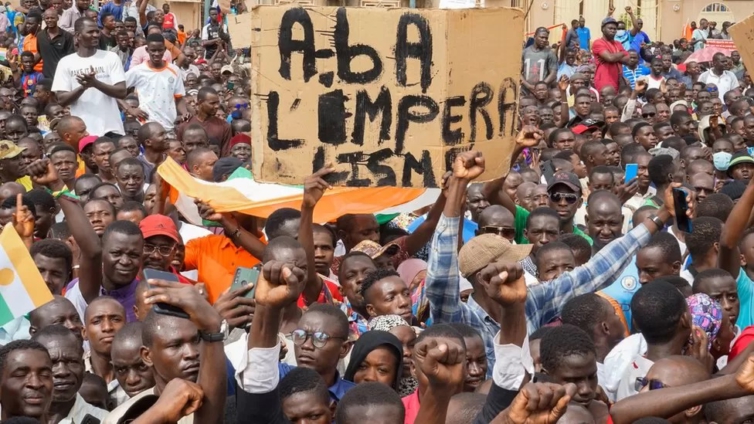
His comment follows the recent coup in Niger by its military. This brings to five the number of coups as far as Niger is concerned.
The military takeover is reportedly informed by corruption, and bad governance amongst others by the governing administration.
Already, ECOWAS says it will be forced to impose sanctions and may also resort to military intervention if the country does not return to constitutional order.
But experts say due to geopolitical interests, ECOWAS would think twice about the said military intervention.
It is also believed that the West African bloc's sanctions if issued might not have any effects given that its previous ones have not yielded desired results.
On his part, the Director of Faculty, Academic Affairs and Research at the Kofi Annan International Peacekeeping Training Centre (KAIPTC), Professor Kwesi Aning insists the approach by ECOWAS to resolve the coup in Niger is not appropriate.
Prof. Aning says the bloc is just trying to follow its protocols, which may not be needed in the current circumstance.
According to him, the bloc seems not to have learnt from past events and how the sub-region of Africa has transformed.
"I think they're adopting an automatic response; you've made a coup d'etat, the protocol says this, we'll have to suspend you. ECOWAS doesn't seem to be learning from history and doesn't seem to be learning from the way the sub-region has transformed," he said on the AM Show on Friday.
Latest Stories
-
Christian Council rejects proposed five-year presidential term
1 second -
UKGCC/Ecobank PLC Golf Invitational caps off investment summit with renewed focus on partnerships and growth
13 seconds -
NCCE must be well funded to promote civic education – Sheikh Aremeyaw Shaibu
43 seconds -
Republic Bank-JoyNews Habitat Fair heads to Ho Sports Stadium for 4th clinic set for October 16-18
51 seconds -
AMA orders Accra shops, markets to close from 6am to noon for National Sanitation Day
54 seconds -
Dangote defends $16bn Kenya refinery as residents raise compensation, environmental concerns
2 minutes -
Work begins on 160-bed Western North Regional Referral Hospital – Kwakye Ofosu
3 minutes -
GPRTU says non-member commercial vehicles pose challenge to road safety enforcement
3 minutes -
Fuel transport licensing gaps could enable abuse and diversion – Transparency International Ghana
5 minutes -
Former Youth and Sports Minister questions Carlos Queiroz appointment process, alleges possible corruption
6 minutes -
NHIA targets 80% population coverage under 2026–2028 strategic plan
9 minutes -
MTTD must intensify enforcement against unregulated drivers – NRSA
9 minutes -
NRSA proposes separate registration and number plates for Okada riders
11 minutes -
National PTA backs striking teacher unions, urges Mahama to intervene
16 minutes -
Israel-bound flight diverted after fight between pilots
21 minutes