


Audio By Carbonatix
Rates of female genital mutilation (FGM) have fallen dramatically among girls in Africa in the last two decades, according to new research.
The study, published in BMJ Global Health, cited a "huge and significant decline" among under-14s.
The practice involves removing all or part of a girl or woman's external genitalia, including the clitoris.
Some societies treat it as a rite of passage, but human rights groups say it is inhumane and physically dangerous.
In the worst cases, victims can haemorrhage to death after they are cut, or die of infections.
Chronic pain, infertility and menstrual problems can also follow, as well as potentially fatal childbirth complications.
Unicef, the UN children's agency, estimates that 200 million women and girls have undergone FGM worldwide - mostly in parts of Africa and the Middle East.
What did the figures show?
Using data from 29 countries and going back to 1990, the report's authors found that the biggest fall in cutting was in East Africa.
The prevalence rate there dropped from 71% of girls under 14 in 1995, to 8% in 2016, the study said.
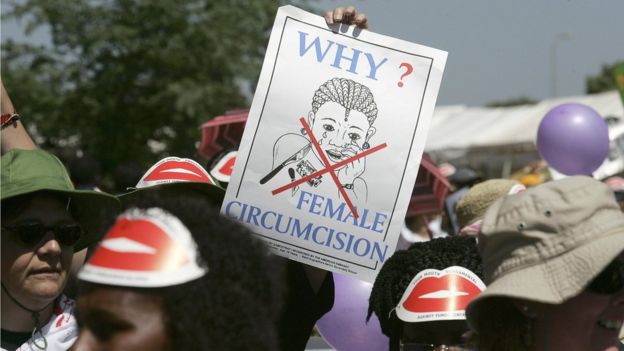
A demonstration against female genital mutilation in Nairobi
Some countries with lower rates - including Kenya and Tanzania, where 3-10% of girls endure FGM - helped drive down the overall figure.
In North Africa, the rate fell from almost 60% in 1990 to 14% in 2015.
West Africa also saw a significant drop, from 74% of girls in 1996, to 25% in 2017.
However, campaigners have observed that while younger children are most at risk, older teenagers and young women are also affected by FGM - and the study did not include them.
"We are pleased to see that the numbers are coming down in a lot of countries," said Emma Lightowlers, a spokeswoman for the Africa-focused campaign group 28TooMany. "But it doesn't tell the whole story and there are other groups where cutting takes place after the age of 14.
"It takes place in teenagers, or in fact, even in women in preparation for marriage," she told the Thomson Reuters Foundation.
The team behind the report, which includes scientists based in Britain and South Africa, used data gathered for the Demographic Health Survey and Unicef, which covered almost 210,000 children.
Female genital mutilation
- Includes "the partial or total removal of the female external genitalia or other injury to the female genital organs for non-medical reasons"
- Practised in 30 countries in Africa, and some in Asia and the Middle East
- An estimated three million girls and women worldwide are at risk each year
- It is commonly carried out on young girls, often between infancy and the age of 15
- Often motivated by beliefs about what is considered proper sexual behaviour, to prepare a girl or woman for adulthood and marriage, and to ensure "pure femininity"
- Dangers include severe bleeding, problems urinating, infections, infertility and increased risk of childbirth complications and newborn deaths
Source: World Health Organization
Why did the study find a drop in FGM?
Ngianga-Bakwin Kandala, a professor of biostatistics at the UK's Northumbria University and the study's lead author, told the BBC the team hadn't looked at the reasons why FGM rates were falling. However, he has "a working hypothesis" that it's down to the attitude of mothers.
"Many international organisations have invested a lot of money... the mothers have been educated," he said.
"If there is any change, we'll be seeing it perhaps through the decision they're going to make for their daughters."
Some parents may simply fail to report having had their daughters cut, he admits - especially in countries which have made FGM illegal.
"That is possible because [in this study] we are relying on the goodwill of the mothers reporting that their daughter was circumcised. There may be fear of the law, or the stigma attached to it.
"In Senegal, for example, we know that people have made public declarations. A huge event - people will gather, and you pledge that you will not be doing this to your daughter. In terms of reporting, then you may be feeling embarrassed having to report that you have done it. This is a very valid point."
Activists hope further research will now examine changes in attitudes to FGM around the world, so the data can be considered in its full context.
Latest Stories
-
Labour Minister wants SOEs to help shape new public pay system
2 hours -
IPEC will ensure Equity and Sustainability in SOEs Compensation
3 hours -
White House bars CNN from travelling with Trump on Air Force One
3 hours -
Fennis wins second consecutive ITF J60 title in Accra
3 hours -
Spain beat England in thriller after Kane penalty miss
3 hours -
GPL 2026/27: Zaidan’s late goal ends Hearts of Oak unbeaten start
3 hours -
CEOs demand clarity on pay harmonisation, board autonomy as FWSC engages SOEs bosses over IPEC transition
4 hours -
2026 Women’s Super Cup: FC Savannah, Epiphany Warriors maintain top spots ahead of final group games
4 hours -
‘Is EOCO responsible for determining lawyers’ fees?’ – Baffour Awuah
4 hours -
David Beckles claims second J60 Accra title
4 hours -
No France cocaine suspect linked to Mahama, Vice President’s security details – NACOC
4 hours -
Anwelle Foundation launched in Jirapa to tackle poverty, youth unemployment
5 hours -
Joy Sports Editor Fentuo Tahiru Fentuo to moderate inaugural Music Meets Football Summit in Zambia
5 hours -
Court premises too volatile for Baffour Awuah’s attempted arrest by EOCO – Inusah Fuseini
5 hours -
Drug bust: Under no circumstances will NACOC leadership be compromised – Twum-Barimah
5 hours