


Audio By Carbonatix
The African Union has suspended Sudan's membership "with immediate effect", amid an upsurge of violence in the capital that has seen dozens killed.
The pan-African body has warned of further action if power is not transferred to a civilian authority - a key demand of pro-democracy protesters.
Opposition activists say a paramilitary group has killed 108 people this week, but officials put the figure at 46.
Residents said pro-government militia were all over the capital Khartoum.
The violence intensified on Monday when security forces stormed a weeks-long sit-in outside military headquarters in the capital. It is the deadliest incident since veteran President Omar al-Bashir was ousted by the military in April after months of peaceful protests.
Talks between opposition activists and the ruling interim military council have since broken down.
What did the African Union say?
"The AU Peace and Security Council has with immediate effect suspended the participation of the Republic of Sudan in all AU activities until the effective establishment of a Civilian-led Transitional Authority, as the only way to allow the Sudan to exit from the current crisis," the AU tweeted on Thursday.
The decision was made unanimously by members at an emergency meeting of the AU in Addis Ababa that lasted more than five hours.
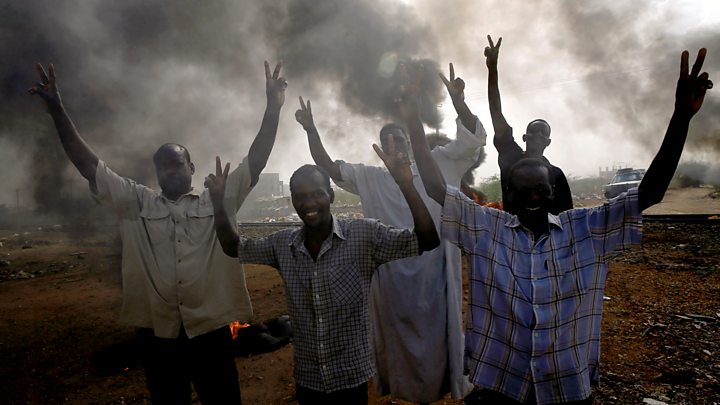
Sudan’s military attacks protestors
The chairman of the African Union commission, Moussa Faki Mahamat, on Monday called for an "immediate and transparent" investigation into the killings.
Ethiopian Prime Minister Abiy Ahmed was heading to Khartoum on Friday to try to mediate between the two sides, Reuters news agency reported, quoting diplomatic sources.
What's the latest?
The Sudanese authorities spoke out for the first time on Thursday about the death toll, denying that it was as high as 100 and claiming it was "at most" 46.
Doctors linked to the opposition say the figure is as high as 108, and that 40 bodies were pulled from the River Nile in Khartoum on Tuesday.
The deputy head of the military council, Mohammed Hamadan, defended the violent suppression, claiming that the protesters had been infiltrated by rogue elements and drug dealers.
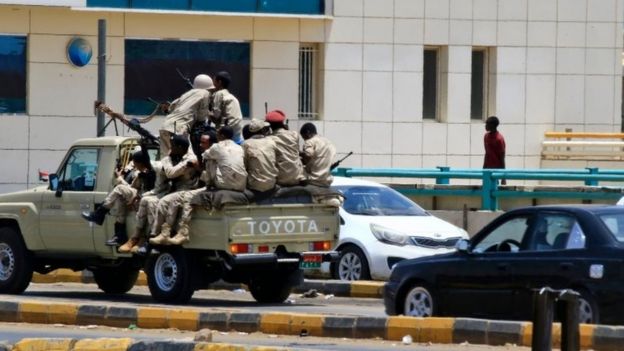
Security forces continue to patrol the streets of Khartoum, three days after Monday's violence
Meanwhile, residents in Khartoum told the BBC they are living in fear, with much of the city in lockdown in the wake of the killings.
Numerous reports said a paramilitary unit, the feared Rapid Support Forces (RSF), was roaming the city's nearly deserted streets on Monday, targeting civilians.
Formerly known as the Janjaweed militia, the RSF gained notoriety for brutal atrocities in the Darfur conflict in western Sudan in 2003.
Doctors afraid to go to work
By Catherine Byaruhanga, BBC News, Khartoum
People are still coming to terms with the violence of the last few days. At the former sit-in area - there are torn and charred posters as well as burnt-out tents. The fear is that more of the dead could still be there.
Security forces seem to outnumber civilians on the streets of the capital. Reports continue to come in of their brutal crackdown.
At Ibrahim Maleek Teaching Hospital - the doctors and nurses have not come to work because they're afraid of being targeted. Instead, it is the medical students who are treating patients.
Thirty-three-year-old Mohanned Mirghani said he was shot at close range by the Rapid Support Forces. "They shot me from close range; the RSF were the distance that you are from me now," he said. "Two of my friends were also shot but I don't know what happened to them."
It is hard to get a proper sense of what happened. One big hindrance is the fact that the military rulers have cut off the internet.
What happened to talks?
Sudan has been controlled by a military council since pro-democracy protests ended President Bashir's 30-years of authoritarian rule.
Demonstrators had been occupying the square in front of the military headquarters, while their representatives had negotiated with the military council and agreed a three-year transition that would culminate in elections.
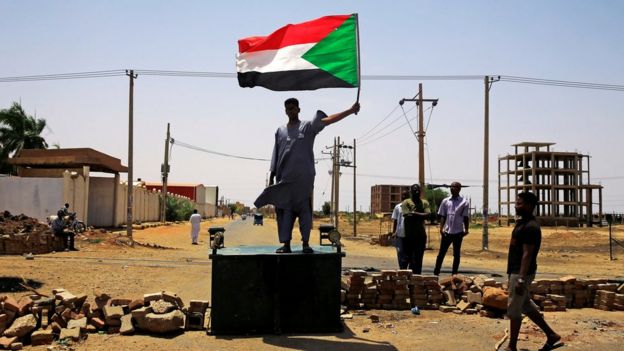
Pro-democracy protesters want the military council to hand over power to civilians
But after security forces swept in and opened fire on unarmed protesters in the square on Monday, the head of the military council - General Abdel Fattah al-Burhan - announced that the agreement was cancelled and an election would take place within nine months.
After an appeal from Saudi Arabia to resume talks, Gen Burhan reversed course and said the military council would "open our arms to negotiate with no restriction".
But the offer was rejected by the opposition activists, who said the military council could not be trusted after the crackdown.
Latest Stories
-
Labour Minister wants SOEs to help shape new public pay system
3 hours -
IPEC will ensure Equity and Sustainability in SOEs Compensation
4 hours -
White House bars CNN from travelling with Trump on Air Force One
5 hours -
Fennis wins second consecutive ITF J60 title in Accra
5 hours -
Spain beat England in thriller after Kane penalty miss
5 hours -
GPL 2026/27: Zaidan’s late goal ends Hearts of Oak unbeaten start
5 hours -
CEOs demand clarity on pay harmonisation, board autonomy as FWSC engages SOEs bosses over IPEC transition
5 hours -
2026 Women’s Super Cup: FC Savannah, Epiphany Warriors maintain top spots ahead of final group games
5 hours -
‘Is EOCO responsible for determining lawyers’ fees?’ – Baffour Awuah
5 hours -
David Beckles claims second J60 Accra title
5 hours -
No France cocaine suspect linked to Mahama, Vice President’s security details – NACOC
6 hours -
Anwelle Foundation launched in Jirapa to tackle poverty, youth unemployment
6 hours -
Joy Sports Editor Fentuo Tahiru Fentuo to moderate inaugural Music Meets Football Summit in Zambia
6 hours -
Court premises too volatile for Baffour Awuah’s attempted arrest by EOCO – Inusah Fuseini
6 hours -
Drug bust: Under no circumstances will NACOC leadership be compromised – Twum-Barimah
6 hours