

Audio By Carbonatix
Fighting is continuing in parts of Sudan despite a 72-hour ceasefire largely holding.
Speaking via phone from Omdurman, the city adjoining the capital Khartoum, the BBC's Mohamed Osman says fighting broke out near TV and radio buildings.
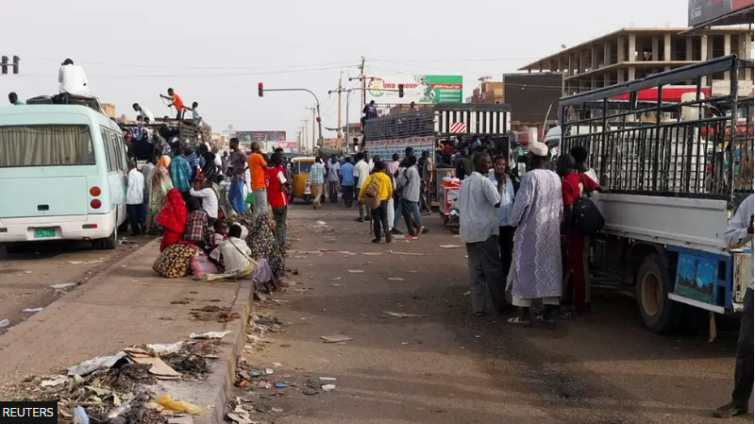
There is no fuel and a lack of doctors, and people are struggling to access food and money, our correspondent adds.
Sudan's army chief has reportedly approved extending the ceasefire - due to expire on Friday - for 72 hours.
Gen Abdel Fattah al-Burhan gave initial approval to the proposal from the regional African bloc Intergovernmental Authority on Development, Reuters news agency reports.
The proposal suggests sending envoys from the Sudanese army and rival group Rapid Support Forces (RSF) to Juba in South Sudan to discuss the details.
The current ceasefire began at midnight local time (22:00 GMT) on Monday bringing a pause to a conflict which erupted on 15 April amid a power struggle between the leaders of the army and the RSF.
People in Khartoum and Omdurman are finding it difficult to find clean water and food and access to cash, our correspondent says.
Explosions and gunfire could still be heard on Wednesday, with warplanes in the air, although it was quieter than before the ceasefire and the situation was good enough for evacuations to continue.
Our correspondent says he and his family find it difficult to sleep because of the explosions and shooting.
Gangs have also been looting homes and empty buildings, targeting cars and vehicles, he adds. Local people fear what will happen after the ceasefire ends.
Both sides still man checkpoints but these are fewer in number as some troops have withdrawn to other areas.
The warring factions both claim to control important places like airports and army headquarters. There is no internet access and phone lines are poor.
At least 459 people have been killed since the fighting broke out though the actual number is thought to be much higher.
Earlier the World Health Organization said it expected "many more" deaths due to disease, a lack of access to food and water and disruption to health facilities.
Several countries have evacuated their nationals since the ceasefire took hold.
A boat evacuating more than 1,600 people from dozens of countries arrived in Saudi Arabia on Wednesday and both Germany and France say all their citizens have now left the country.
The first flight bringing British national home landed at Stansted on Wednesday, via Larnaca in Cyprus.
Some 536 British nationals have been evacuated from Sudan on six flights, the Foreign, Commonwealth and Development Office said.
The chairman of the Nigerians in Diaspora Commission confirmed to the BBC that evacuations of stranded Nigerian students in Sudan had started.
It is thought there could be up to 5,000 Nigerians living in Sudan, and that 3,500 of them are students.
However, a UK-born student in Sudan said she did not have enough petrol to get to rescue flights.
Samar Eltayeb, 20, from Birmingham, has been sheltering with a relative outside Khartoum since fighting began.
The third-year medical student at Sudan's National University has been waiting to be evacuated to join her parents and siblings in the UK.
"We have have no gas, and the petrol stations are empty," Ms Eltayeb said. "There'll be constant flights within the next few days, but if I can't find gas to get there, then I'm stuck."
Buses carrying evacuees are continuing to leave Khartoum despite soaring prices of fuel and bus tickets.
Meanwhile, former Sudanese politician Ahmed Haroun said that he and other former officials are no longer in jail.
Reports emerged this week of a prison break at Kober in Khartoum- where Ahmed Haroun was serving a sentence alongside Omar al-Bashir, Sudan's former president.
The Sudanese army said Bashir was moved from the prison to a military hospital before the fighting erupted.
Both Bashir and Haroun are facing charges by the International Criminal Court for their alleged role in the atrocities in the western Sudanese region of Darfur.
On Tuesday, Haroun confirmed in a statement aired on Sudan's Tayba TV that he and other Bashir loyalists who served under him had left the jail - but said he would be ready to appear before the judiciary whenever it was functioning.
Latest Stories
-
Benedict Okyere Yeboah: Ghana’s football problem goes beyond sacking a coach
3 minutes -
GPL 2026/27: Darkwah Wiafe’s winner sees All Blacks beat Kotoko
9 minutes -
ITF World Tour : Patel Wins Boys’ Singles Final at J100 Accra
21 minutes -
Ghana must pursue BRICS partnership if it brings economic benefits – Kpebu
24 minutes -
Success and Wright Claims J100 Accra Girls’ Doubles Championship
25 minutes -
ITF J100: America’s Wright wins J100 Accra Girls’ Singles Title
31 minutes -
Expedition hopes to find aviator Amelia Earhart’s plane on remote island
32 minutes -
US seeks changes to rejected $109m health compact with Ghana – Mahama
1 hour -
Nine dead in mass shooting at Pennsylvania home
1 hour -
‘Time for Ukraine to get new president,’ says Trump after Zelensky condemns diesel deal
1 hour -
Hincapie injury adds to Arsenal issues after Guimaraes rescue act
2 hours -
Henderson scores twice as Chelsea thumb Bournemouth
2 hours -
Photos: Mentapulse Africa convenes health and labour summit to address talent retention
2 hours -
Mahama inspects Nkokɔ Nketenkete plant, eyes Bechem as chicken capital
2 hours -
Ghana not seeking full BRICS membership, applying as Partner Country – Ablakwa
2 hours