

Audio By Carbonatix
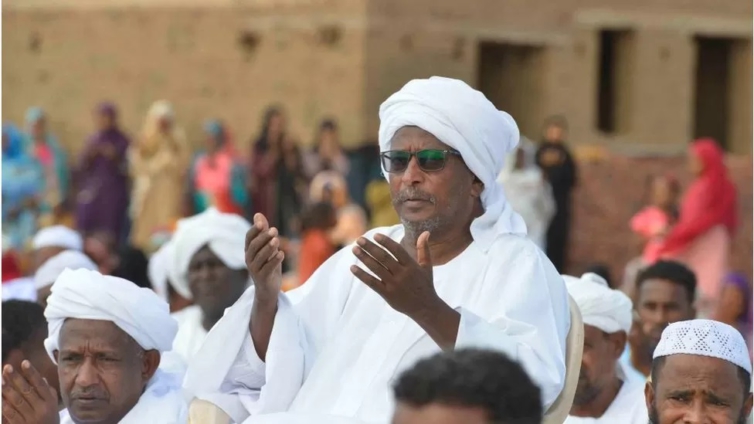
Muslims in Sudan have been celebrating Eid al-Adha amid the sound of gunfire despite a ceasefire announced by the warring military groups.
Residents have told the BBC that heavy artillery and airstrikes were heard in Khartoum state.
"It doesn't feel like Eid," said Zahra Saeed, adding that the streets are "empty" and that people are "scared".
"Last night I couldn't sleep because of the sounds of the gunfire," Ms Saeed added.
Others say they are too afraid to even attend the outdoor prayers which are normally a central part of the day: "For the first time in my life I didn't go," said 22-year-old former medical student Walaa Ibrahim.
Instead, many people prayed in their own homes.
"Now the airstrike is being carried out, they don't respect people, they don't respect the importance of... such occasions," the ex-student added.
Sudan is currently in its 10th week of a war which started in April, amid a power struggle between the country's military and a paramilitary group called the Rapid Support Forces (RSF).
Since then, more than 500,000 people have fled Sudan, according to UN figures from just over a week ago, while roughly 2.2 million people have fled their homes within the country.
Precise figures on the number of people killed in the fighting are difficult to establish, but it is believed to be well over 1,000, including many civilians caught in the crossfire.
As well as the fighting, many Sudanese are also struggling to celebrate Eid properly because they don't have enough money.

As part of Eid al-Adha, Muslims who can afford to sacrifice a sheep or goat and share the meat between family, friends and the poor.
This is because Eid al-Adha, means "festival of sacrifice" and commemorates the time when, according to the Qur'an, the Prophet Ibrahim was ordered by Allah to sacrifice his son - and as he was about to do so, the boy was exchanged for a ram.
"Every Eid we used to buy a sacrificed sheep, but this Eid the situation is quite difficult because of war and because most of us did not get paid. We cannot pay for sacrifice sheep due to the high prices," said Mohammed Abboud Soliman, a cattle trader from West Kordofan state.

The usual sweet Eid treats from bakeries are also in short supply. In Omdurman, one of three cities that make up Greater Khartoum, bakeries have been looted.
One resident told the BBC: "Two bakeries have been exposed to robbery and unfortunately one of the bakers was killed. These two bakeries were very important as their production was fulfilling the need of a large area.
"Houses are daily subject to looting and robbery. The situation is deteriorating."
Latest Stories
-
GAEC must retain nuclear scientists for Ghana’s nuclear ambitions – Minister
30 minutes -
Man reportedly mistaken for game and shot by hunter dead in forest
32 minutes -
19-year-old mason jailed 15 years for defiling seven-year-old pupil
37 minutes -
Ghana’s banking sector assets rise 20.47% to GH¢500.2bn – BoG Governor
41 minutes -
22 injured as Sprinter bus overturns at Sege after tyre burst
42 minutes -
UN housing expert urges Ghana to strengthen Rent Control Department amid housing affordability concerns
51 minutes -
Delta-BCI partnership reaches 166,000 people with breast cancer education
1 hour -
Power restoration fault suspected in Kumasi Central Market fire
6 hours -
The 7-foot giant of Ngleshie Amanfro: Seven-foot Ghanaian Ephraim Saawa dreams of joining the national basketball team
7 hours -
Government promises support for Kumasi Central Market fire victims
7 hours -
Vibes The Movie: Big Ghun’s Ghanaian film earns five nominations at 2026 REFFA
7 hours -
‘I’m a fulfilled man’—Justice Korbieh on missing out on Supreme Court despite two nominations
8 hours -
MamaCare CEO warns unresolved conflicts among health workers could undermine maternal and neonatal care
8 hours -
Health professionals urged to translate medical knowledge into practice to save mothers
8 hours -
Retired judge Justice Francis Korbieh charges 1,568 new lawyers to uphold integrity
9 hours