

Audio By Carbonatix
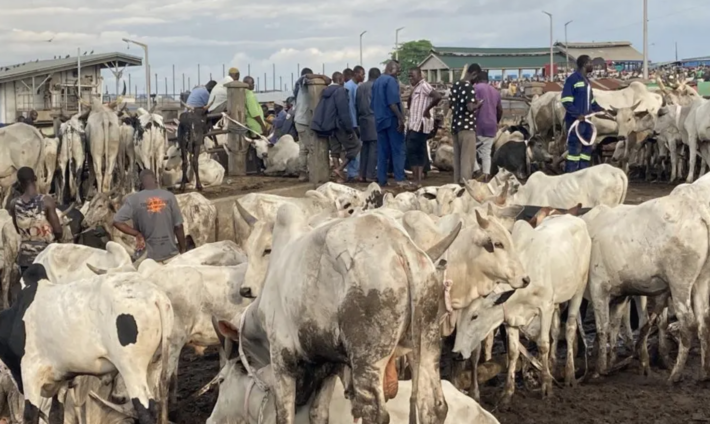
This year’s Eid-ul-Adha has triggered a surge in the prices of bulls and rams as Muslims commemorate Prophet Ibrahim’s willingness to sacrifice his son Ismail as an act of obedience.
The sudden spike in demand for these sacrificial animals has led to a significant increase in their prices in Asesewa in the Upper Manya Krobo district, with several sellers cashing in on festive fervour to reap hefty profits.
Reports show the price of cattle, rams, and other sacrificial animals has also risen across various parts of the country.
According to Islamic tradition, Eid al-Adha, popularly known as the “Festival of Sacrifice,” is the holier of the two Islamic holidays celebrated globally each year.
Mr. Basaru Tanko Khalid, a livestock farmer at Akateng in the Upper Manya Krobo district of the Eastern region, told Ghana News Agency in an interview that the spike in the dollar has further boosted the prices of animals including rams, bulls, cows, sheep, and camels.
“Depending on what you can afford, my rams start from GHS 3,000.00 to GHS 5,000.00, and my cattle vary from GHS 7000.00 to GHS 30,000.00,” he stated.
“We have also raised the price because raising animals is very time-consuming, and the veterinarian officers’ medications have become more costly; otherwise, I would lose money.”
He pointed out that everything had become expensive and that the government should take targeted measures to lower the cost of veterinarian care and other expenses related to raising animals.
“I used to raise fish and poultry, but I had to stop because feed prices had skyrocketed and I was unable to continue,” he added.
“For that reason, I started raising rams and cattle because I won’t have to spend any money on feed other than grasses and other materials like plantain and cassava peels.”
Another seller, Mr. Salifu Inusah Kwaranga said that instead of concentrating only on chicken, the government ought to look at the entire livestock sector.
He noted that although the cattle business was lucrative, people who were not patient and determined would lose focus since it is a demanding, long-term economic venture, and that it required government support.
“I bought a bull for GHS 10,000.00 but between 2016 and 2020, the same size of bull was sold for GHS 3000.00 to GHS 4000.00 cedis, but today it has been tripled, and you can't ask why it is so expensive,” he stated.
He explained that “everything, including the cassava and plantain peel they get from the chop bar operators, are being sold at higher prices.”
Mr. Muniru Shaibu, who buys and sells goats, lambs, and bulls, stated that even a goat costs more than GHS 2,000.00 in the Afram Plains.
He noted that the bull market price was expected to increase from GHS 20,000.00 to GHS 50,000.00 next year due to the poor economy caused by rapid depreciation of the cedi.
His business partner, Nailah Asamawu Rashid remarked that they ended up with sheep because they had expected to get a bull for 3,000 cedis.
“It has taken us by surprise how the price has risen out of nowhere, and if the government does not intervene, things will spiral out of control,” she added.
She also mentioned that, given the current high prices in the country, she was wondering how she could earn money for Hajj in 2025.
Latest Stories
-
Late Solanke strike salvages 10-man Spurs draw at Man United
9 minutes -
Gender Ministry to monitor welfare of Nana Akua Addo’s children amid domestic violence case
16 minutes -
Benedict Okyere Yeboah: Ghana’s football problem goes beyond sacking a coach
25 minutes -
GPL 2026/27: Darkwah Wiafe’s winner sees All Blacks beat Kotoko
31 minutes -
ITF World Tour : Patel Wins Boys’ Singles Final at J100 Accra
44 minutes -
Ghana must pursue BRICS partnership if it brings economic benefits – Kpebu
47 minutes -
Success and Wright Claims J100 Accra Girls’ Doubles Championship
47 minutes -
ITF J100: America’s Wright wins J100 Accra Girls’ Singles Title
54 minutes -
Expedition hopes to find aviator Amelia Earhart’s plane on remote island
54 minutes -
US seeks changes to rejected $109m health compact with Ghana – Mahama
1 hour -
Nine dead in mass shooting at Pennsylvania home
2 hours -
‘Time for Ukraine to get new president,’ says Trump after Zelensky condemns diesel deal
2 hours -
Hincapie injury adds to Arsenal issues after Guimaraes rescue act
2 hours -
Henderson scores twice as Chelsea thumb Bournemouth
2 hours -
Photos: Mentapulse Africa convenes health and labour summit to address talent retention
2 hours