

Audio By Carbonatix
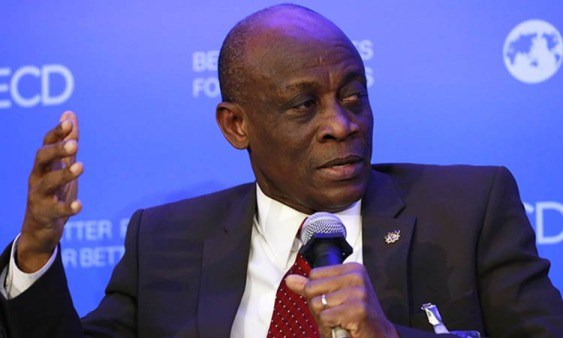
Former Finance Minister, Seth Terkper, has expressed worry that Ghana is facing restricted access to external markets for financing, due to its current level of public debt, risk of debt distress, amongst others.
This he believes have kept interest rates high in the country.
Commenting on a debate between the Bank of Ghana and renowned chief and investment banker, Togbe Afede XIV, Mr. Terkper said the challenges within the fiscal economy is making it difficult for the country to raise enough funds at favorable interest rate, a situation he describes as a major contributor to the high cost of credit.
“Ghana is facing restricted access to external markets, given current level of public debt, risk of debt distress and ratings agencies’ downgrades. Hence, the question is whether the limited domestic market can accommodate most of this financing without private sector “crowding” and, yes, higher interest rates.”
Ghana received nearly $5 billion dollars in Covid-19 aid and loans between 2020 and 2021.
But Mr. Terkper pointed out that the Central Bank’s own role in financing the government and its silence on other non-transparent financing schemes requires attention.
“Will BoG come to the rescue again since Covid-19 may not be sufficient excuse for more aid or grants? Ghana has received nearly $5 billion (over 30 billion or three-fifths of tax revenue in recent years) in Covid-19 aid and loans between 2020 and 2021”, he questioned.
Citing the previous government position under the 2014 International Monetary Fund Extended Credit Facility programme, he said the government then implemented a zero-financing policy, despite its own crisis such as disruption in gas supply from the West Africa Gas Pipeline.
“The NDC was compelled, under the 2014 International Monetary Fund Extended Credit Fund Programme, to implement a zero-financing policy, despite its own crisis—even if belittled as not comparable to Covid-19.”
“These include the disruption in gas supply from WAGPL (Nigeria), turret bearing issues with the FPSO, and a major fall in crude oil prices (budget estimate of $99 per barrel reduced to $40 per barrel from late-2014 to 2016 when it left office).”
Reduction in interest rates is not only due to disinflation process
He also said despite the Central Bank attributing the fall in Policy Rate between the latter part of 2016 to September 2021 to the disinflation process, a full 4-year view from 2013 showed that various interest rates had started to decline with the “smart-borrowing” initiative.
“BoG attributes the fall in Policy rate (25.5% at end-2016] to 13.5% in September 2021 to its disinflation policy. A full 4-year view from 2013 will show that various interest rates had started to decline with the “smart-borrowing” initiative that started in 2013. Indeed, inflation declined to single digits in periods prior to 2013.
“Secondly, on disinflation, BoG fails to mention the change in “basket” or method for calculating inflation in 2018, similar to the effect of rebasing the GDP with new basis periods as 2006 and 2013”, he added.
Latest Stories
-
3rd Republic Bank-JoyNews Habitat Fair Clinic ends on a high note after three days of strong patronage
1 minute -
Ten climbers missing after avalanche hits Himalayan base camp
38 minutes -
NPP had more permanent fuel relief measures than current GH¢2 diesel cut – Amin Adam
1 hour -
Photos from the 3rd Republic Bank-JoyNews Habitat Fair Clinic
1 hour -
Ethiopia’s army promises restraint amid fears of new civil war
1 hour -
Amin Adam calls for review of fuel taxes as diesel prices remain above GH¢18
2 hours -
World Vision Ghana, Ahafo districts sign MoU for universal WASH coverage
2 hours -
When the gold engine stutters: What Ghana’s Cedi and reserves are telling us about the new economic architecture
3 hours -
Two reportedly die after being trapped in mining pit at Juaboso
3 hours -
Petrosol cleans up Wa Municipal Hospital, to donate medical equipment
3 hours -
‘If NPP was ‘insensitive’ over fuel prices, NDC must accept same description now’ — Amin Adam
3 hours -
KiDi brings the hits to London in sold-out UK headline concert
3 hours -
The last goodbye of Ghanaian shot dead in the US
4 hours -
MCC opens door to Ghana again as MiDA revives development partnership
4 hours -
CSIR moves to turn scientific research into jobs, national growth
4 hours