

Audio By Carbonatix
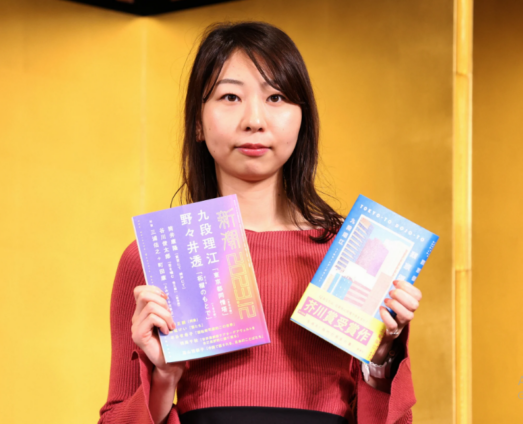
After Japanese author Rie Kudan won one of the country’s most prestigious literary awards, she admitted she’d had help from an unusual source — ChatGPT.
“I plan to continue to profit from the use of AI in the writing of my novels, while letting my creativity express itself to the fullest,” said the 33-year-old, who was awarded the Akutagawa Prize for the best work of fiction by a promising new writer on Wednesday.
The author then confirmed at a press conference that around 5% of her book “The Tokyo Tower of Sympathy” — which was lauded by committee members as “practically flawless” — was word-for-word generated by AI.
The novel centers around the dilemmas of an architect tasked with building a comfortable high-rise prison in Tokyo where law breakers are rehabilitated, and features AI as a theme.
Kudan said that, in her own life, she would consult ChatGPT about problems she felt she couldn’t tell anyone. “When the AI did not say what I expected,” she said, “I sometimes reflected my feelings in the lines of the main character.”
The author is not the first artist to generate controversy by using artificial intelligence, at a time where many creatives feel their livelihoods are threatened by the technology.
Last year, Berlin-based photographer Boris Eldagsen withdrew from the Sony World Photography Awards after revealing his winning entry in the creative photo category was created using the technology.
Meanwhile, authors like George R. R. Martin, Jodi Picoult and John Grisham joined a class action lawsuit against OpenAI, the company behind ChatGPT, last year, saying it used copyrighted work while training its systems to create more human-like responses.
And more than 10,000 authors, including James Patterson, Roxane Gay and Margaret Atwood, signed an open letter calling on AI industry leaders to obtain consent from authors when using their work to train large language models — and to compensate them fairly when they do.
Writer and prize committee member Keiichiro Hirano took to X, the social media company formerly known as Twitter, to say the selection committee did not see Kudan’s use of AI as a problem.
“It seems that the story that Rie Kudan’s award-winning work was written using generative AI is misunderstood… If you read it, you will see that the generative AI was mentioned in the work,” he wrote. “There will be problems with that kind of usage in the future, but that is not the case with ‘Tokyo Sympathy Tower.’”
But while some on social media expressed interest in Kudan’s creative use of AI and said they were now more interested in her work, others called it “disrespectful” to other authors who wrote without the help of the technology.
Latest Stories
-
Iran war lands ‘triple blow’ to flood-ravaged Sri Lankans
5 minutes -
Gunmen kill at least 11 people at Afghanistan picnic spot
19 minutes -
Woman, 25, in court for stealing baby at Bogoso
20 minutes -
Trump unveils giant gold-accented victory arch design for US capital
23 minutes -
We spoke to the man making viral Lego-style AI videos for Iran. Experts say it’s powerful propaganda
28 minutes -
Hungarians vote in big numbers on whether to end Orbán rule and elect rival
29 minutes -
At least 30 feared dead in crush at Haitian tourist site
29 minutes -
Boxing: Abdul Ahmed wins WBA Africa Cruiserwight title after dispatching Nigeria’s Eradeye
42 minutes -
Nearly 2,000 displaced, schools damaged as windstorm wreaks havoc in Gushegu
1 hour -
Ghana’s Derrick Kohn to work under Marie-Louise Eta as she becomes first woman to coach men’s Bundesliga team
1 hour -
Accra Open Championships conclude with strong performances ahead of African Championships
1 hour -
Ghana to begin camping with 12 athletes after Accra Open Championships – Bawa Fuseni
2 hours -
Anthony Joshua declines showdown with Tyson Fury but admits they ‘probably’ clash next
2 hours -
Tyson Fury dominates Makhmudov, calls out Joshua next
2 hours -
I have supported highway authority financially to fix roads in my constituency – A Plus
3 hours