


Audio By Carbonatix
A vacation is often an inspiring experience -- but that inspiration can take many forms. Following a holiday to a game reserve a couple of years ago, Paula Ansley was inspired to ask her husband Les a rather unusual question: Would it be possible to make gin using elephant dung?
This strange inquiry came after a game ranger had explained to her how elephants are particular about the food that they forage, yet absorb less than half of what they eat -- meaning much of their diet of plants remains in their dung.
Les, a South African, had moved to the UK years earlier, where he met Paula. Both worked as professors in different fields of biology, but after leaving academia they hatched a plan to move to South Africa to start a business that could contribute to conservation and give back to the community.
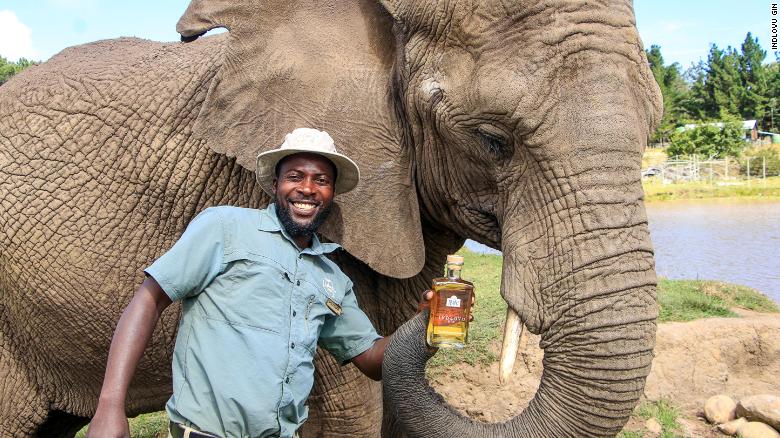 A guide at Knysna Elephant Park with a bottle of Indlovu Gin
"We contacted Botlierskop [Game Reserve in the Western Cape] and we said, do you think you could send us some elephant dung?" explained Les Ansley. "They said, yeah sure, no problem, and they mailed us some elephant dung and we started looking at how to prepare it."
The dung is dried and goes through a sanitization process, before it is rinsed and dried again says Ansley, making it entirely safe to drink. The final dry product is then infused into the gin.
Each bottle is marked with the GPS coordinates of where the dung was found and the date it was collected, Ansley added. "You can see that it's the winter in Kruger or summer in Botlierskop," he said. "It's an additional story."
But doesn't the gin taste like ... dung? "It's got an earthy, grassy-type flavor," said Ansley. "Depending on where we collect the botanicals or which elephants we collect botanicals from, the gin flavor is going to change slightly."
As well as including classic gin flavorings like juniper and coriander, Indlovu Gin takes its taste from extracts of the elephants' diet of roots, grasses, fruit and bark -- including aloe and acacia.
Since its first batch in November last year, the South African company has produced 6,000 liters and now exports to Europe and other African countries.
It recommends a retail price of around $34 a bottle and donates 15% of its profits to the Africa Foundation to support the conservation of elephants. While Les Ansley acknowledges the reception to elephant dung gin has been mixed, he says some customers have been pleasantly surprised by its taste.
"We were very aware that if we are making a gin from dung, we have to make a good gin," said Ansley. "Otherwise it's only ever going to be gimmicky."
A guide at Knysna Elephant Park with a bottle of Indlovu Gin
"We contacted Botlierskop [Game Reserve in the Western Cape] and we said, do you think you could send us some elephant dung?" explained Les Ansley. "They said, yeah sure, no problem, and they mailed us some elephant dung and we started looking at how to prepare it."
The dung is dried and goes through a sanitization process, before it is rinsed and dried again says Ansley, making it entirely safe to drink. The final dry product is then infused into the gin.
Each bottle is marked with the GPS coordinates of where the dung was found and the date it was collected, Ansley added. "You can see that it's the winter in Kruger or summer in Botlierskop," he said. "It's an additional story."
But doesn't the gin taste like ... dung? "It's got an earthy, grassy-type flavor," said Ansley. "Depending on where we collect the botanicals or which elephants we collect botanicals from, the gin flavor is going to change slightly."
As well as including classic gin flavorings like juniper and coriander, Indlovu Gin takes its taste from extracts of the elephants' diet of roots, grasses, fruit and bark -- including aloe and acacia.
Since its first batch in November last year, the South African company has produced 6,000 liters and now exports to Europe and other African countries.
It recommends a retail price of around $34 a bottle and donates 15% of its profits to the Africa Foundation to support the conservation of elephants. While Les Ansley acknowledges the reception to elephant dung gin has been mixed, he says some customers have been pleasantly surprised by its taste.
"We were very aware that if we are making a gin from dung, we have to make a good gin," said Ansley. "Otherwise it's only ever going to be gimmicky."
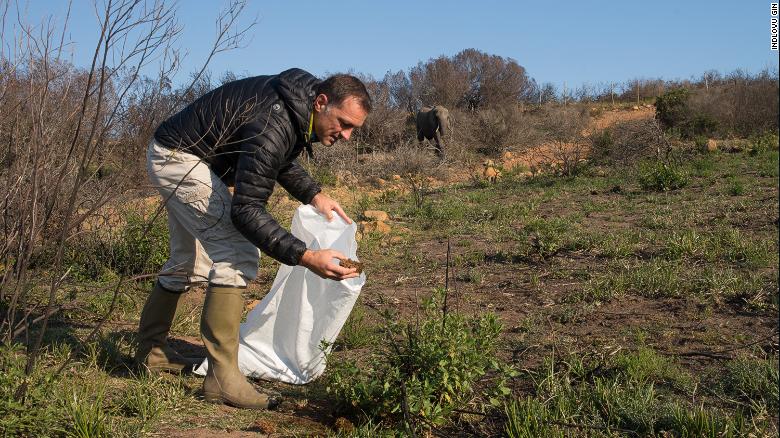 Les Ansley collects elephant dung in Botlierskop, a game reserve in South Africa
Elephant dung gin is one of an increasing number of craft gins in South Africa.
At the inaugural South Africa Craft Gin Awards last August, there were over 110 entries, many using local ingredients such as rooibos and botanicals from the Karoo desert.
Starting out as novice gin makers, the Ansleys enlisted the expertise of distiller Roger Jorgensen to show them the ropes. Joorgensen says his distillery produced South Africa's first craft gin in 2007, before the country's gin boom started around 2013.
"I was on my own for a couple of years, but others soon joined in with some interesting gins," said Jorgensen. "Now there are at least 280 gin brands in Cape Town alone."
Drinks research firm ISWR estimates South African gin consumption rose from 518,000 nine-liter cases in 2013 to almost 1.8 million in 2018. Globally, it expects gin consumption to rise to over 10 million cases by 2023.
Les Ansley collects elephant dung in Botlierskop, a game reserve in South Africa
Elephant dung gin is one of an increasing number of craft gins in South Africa.
At the inaugural South Africa Craft Gin Awards last August, there were over 110 entries, many using local ingredients such as rooibos and botanicals from the Karoo desert.
Starting out as novice gin makers, the Ansleys enlisted the expertise of distiller Roger Jorgensen to show them the ropes. Joorgensen says his distillery produced South Africa's first craft gin in 2007, before the country's gin boom started around 2013.
"I was on my own for a couple of years, but others soon joined in with some interesting gins," said Jorgensen. "Now there are at least 280 gin brands in Cape Town alone."
Drinks research firm ISWR estimates South African gin consumption rose from 518,000 nine-liter cases in 2013 to almost 1.8 million in 2018. Globally, it expects gin consumption to rise to over 10 million cases by 2023.
A guide at Knysna Elephant Park with a bottle of Indlovu Gin
"We contacted Botlierskop [Game Reserve in the Western Cape] and we said, do you think you could send us some elephant dung?" explained Les Ansley. "They said, yeah sure, no problem, and they mailed us some elephant dung and we started looking at how to prepare it."
The dung is dried and goes through a sanitization process, before it is rinsed and dried again says Ansley, making it entirely safe to drink. The final dry product is then infused into the gin.
Each bottle is marked with the GPS coordinates of where the dung was found and the date it was collected, Ansley added. "You can see that it's the winter in Kruger or summer in Botlierskop," he said. "It's an additional story."
But doesn't the gin taste like ... dung? "It's got an earthy, grassy-type flavor," said Ansley. "Depending on where we collect the botanicals or which elephants we collect botanicals from, the gin flavor is going to change slightly."
As well as including classic gin flavorings like juniper and coriander, Indlovu Gin takes its taste from extracts of the elephants' diet of roots, grasses, fruit and bark -- including aloe and acacia.
Since its first batch in November last year, the South African company has produced 6,000 liters and now exports to Europe and other African countries.
It recommends a retail price of around $34 a bottle and donates 15% of its profits to the Africa Foundation to support the conservation of elephants. While Les Ansley acknowledges the reception to elephant dung gin has been mixed, he says some customers have been pleasantly surprised by its taste.
"We were very aware that if we are making a gin from dung, we have to make a good gin," said Ansley. "Otherwise it's only ever going to be gimmicky."
Les Ansley collects elephant dung in Botlierskop, a game reserve in South Africa
Elephant dung gin is one of an increasing number of craft gins in South Africa.
At the inaugural South Africa Craft Gin Awards last August, there were over 110 entries, many using local ingredients such as rooibos and botanicals from the Karoo desert.
Starting out as novice gin makers, the Ansleys enlisted the expertise of distiller Roger Jorgensen to show them the ropes. Joorgensen says his distillery produced South Africa's first craft gin in 2007, before the country's gin boom started around 2013.
"I was on my own for a couple of years, but others soon joined in with some interesting gins," said Jorgensen. "Now there are at least 280 gin brands in Cape Town alone."
Drinks research firm ISWR estimates South African gin consumption rose from 518,000 nine-liter cases in 2013 to almost 1.8 million in 2018. Globally, it expects gin consumption to rise to over 10 million cases by 2023.
DISCLAIMER: The Views, Comments, Opinions, Contributions and Statements made by Readers and Contributors on this platform do not necessarily represent the views or policy of Multimedia Group Limited.
DISCLAIMER: The Views, Comments, Opinions, Contributions and Statements made by Readers and Contributors on this platform do not necessarily represent the views or policy of Multimedia Group Limited.
Latest Stories
-
Hawa Koomson pledges experienced and mature leadership of NPP women’s wing
30 minutes -
Young woman found dead at Kasoa Peace Town
1 hour -
Playback: The Law examined lawful arrest in Ghana
1 hour -
Mahama urges African governments to treat healthcare as an investment, not budget cost
2 hours -
Bawumia congratulates John Boadu and new NPP executives, pledges support ahead of 2028
2 hours -
‘No talent should be left out’ – Bawumia pledges inclusive NPP campaign for 2028
2 hours -
Prof. Mike Oquaye recounts how he blocked the Special Prosecutor’s attempt to arrest Bawku Central MP
2 hours -
Make health sovereignty a priority for Africa – Mahama
3 hours -
Dorimon Naa, Wa West DCE lead massive clean-up exercise; threaten sanctions against recalcitrant residents
3 hours -
Photos from Adom FM Y2K Jam
3 hours -
Praye Tiatia steals the show at Adom FM Y2K Jam [Watch]
3 hours -
Boakye Agyarko congratulates John Boadu, pledges support for NPP leadership
3 hours -
Antwi HiMight thrills fans with Antwi ne Antwi hits at Adom FM’s Y2K Jam [Video]
4 hours -
Amb. Edward Boateng congratulates Boadu, Kodua on election wins
4 hours -
John Boadu pledges to rebuild NPP from grassroots and restore ‘winning machinery’
4 hours