

Audio By Carbonatix
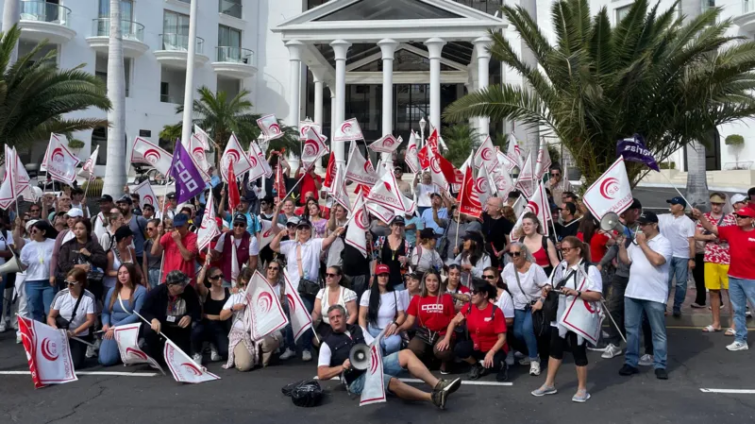
Holidaymakers heading to Tenerife in the Canary Islands are warned to prepare for disruption as hotel workers take part in strikes at the start of the Easter bank holiday weekend.
Organisers say workers on the island are striking on Thursday and Friday in a row over pay and conditions.
The industrial action was due to be across the Canary Islands but an agreement was reached on Gran Canaria, Lanzarote and Fuerteventura.
Unions say around 80,000 hotel workers on Tenerife, La Palma, La Gomera and El Hierro will still take action.
The UK Foreign Office warned travellers to expect disruption over the Easter weekend and to check their tour operator's advice and follow the advice of authorities.
By law, strikers have to provide a "minimum service" but the Comisiones Obreras union, which called the strike, says hotel cleaning, food and entertainment do not fall into this category.
It says suggestions that minimum service should include things such as reception and concierge or cleaning, restaurants and cooking, infringe upon the workers' right to strike.
"The imposition of minimum services constitutes an illegitimate, disproportionate, and legally unsustainable restriction on the fundamental right to strike," the union said in a press release.
For many holidaymakers the noise of protests is disruptive and there are noticeably fewer people by the poolside.

Fernando Cambon Solino is among those protesting.
He moved to Tenerife for work.
"Everybody knows the Canary Islands," he said. "You come here and you enjoy the sun, the beaches, the view. But it's not the same for the people who are working here."
Rodrigo Padilla is a journalist in Tenerife and was at a protest supporting his mother who works as a waitress.
He said the issue was with both pay and conditions.
"My mother leaves the house at 6am and it takes three or four hours to get to work and the same after her shift."

Advertisement
The industrial action comes after a series of protests last year in the Canary Islands and Spanish mainland over mass tourism.
Locals say tourism has pushed up housing costs beyond a sustainable level for people to live on the islands.
They stress they are not against the tourism industry, which makes up 35% of the Canaries' economy, but there was a need for a more sustainable model that factored in environmental impacts such as water shortages and which puts less pressure on costs and housing.
Latest Stories
-
US seeks changes to rejected $109m health compact with Ghana – Mahama
59 seconds -
Nine dead in mass shooting at Pennsylvania home
18 minutes -
‘Time for Ukraine to get new president,’ says Trump after Zelensky condemns diesel deal
21 minutes -
Hincapie injury adds to Arsenal issues after Guimaraes rescue act
30 minutes -
Henderson scores twice as Chelsea thumb Bournemouth
39 minutes -
Photos: Mentapulse Africa convenes health and labour summit to address talent retention
51 minutes -
Mahama inspects Nkokɔ Nketenkete plant, eyes Bechem as chicken capital
58 minutes -
Ghana not seeking full BRICS membership, applying as Partner Country – Ablakwa
59 minutes -
Woman injures three people in third Poland school knife attack in a week
1 hour -
Ghana should join BRICS as partner, not member – NPP Bono East Regional Secretary
1 hour -
Ghana High Commission warns nationals in South Africa over protests in Johannesburg, Durban
1 hour -
Mahama praises Roads Minister for keeping Big Push contractors on their toes
1 hour -
World Cup Visa Scandal: ‘My client has not collected money for visas’ – Ampofo Ankrah’s lawyer
1 hour -
US immigration officials defend ICE agents who shot man in same car as child
1 hour -
Commentator Katie Zacharia picked as new White House press secretary
2 hours