

Audio By Carbonatix
Uganda's National Drug Authority has admitted it knew HIV medicine was being used to fatten up animals in 2014 but did not warn the public.
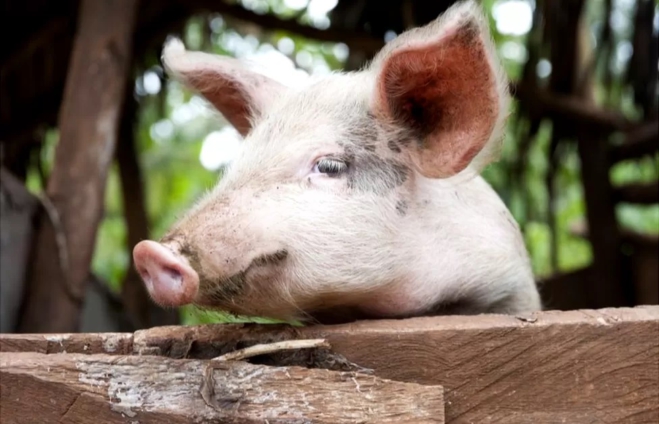
The regulator's senior drugs inspector Amos Atumanya told parliament it became aware anti-retrovirals were being given to pigs and chickens to treat them.
Mr Atumanya said that for humans, consuming small quantities of the drugs in food could be dangerous.
But the NDA has since tried to downplay his comments.
A spokesman said that if there was a health risk it would have warned the public, while the NDA's job was to regulate drugs not food or animal feed.
A recent report by the prestigious Makerere University found that more than a third of chicken and 50% of pork it tested contained traces of anti-retroviral drugs. The meat was sourced from markets in the capital, Kampala, and the northern city of Lira.
Appearing before Uganda's House Committee on HIV/Aids, Mr Atumanya said the National Drug Authority had carried out an investigation in 2014 into the use of anti-retrovirals (ARVs) in animal farming. However, while a report was published, it did not issue a public warning for fear of hurting the country's food exports "if we blow it out of proportion".
"So we were trying to find other means in which we could manage that situation," he said.
One respondent to the study by Makerere University's College of Health Sciences, said pigs that were given anti-retroviral drugs "grow faster and fatter and are sold off quickly".
But Mr Atumanya said this could cause serious problems for humans who ate the meat and became infected with HIV.
"You are likely to develop resistance to these ARVs," he said. "In the future if you need them, then you'll find this ARV is not working for some."
Around 1.4 million people in Uganda are living with HIV/Aids, according to the United Nations.
The NDA's report back in 2014, found that anti-retrovirals were mainly used to treat African swine fever which is also known as Pig Ebola and currently has no cure. It also verified claims that ARVs were being used to treat Newcastle disease in chicken.
Following Mr Atumanya's remarks, however, a spokesman for the NDA defended its decision to not publicise its findings.
"The NDA is mandated to regulate the drugs, not food or animal feeds," he said.
"If there was any public health threat concerning the drugs under the use, NDA will be the first one to come out and warn the public as we always do.
"The NDA remains vigilant and committed to ensuring that Ugandans have access to safe, efficacious and quality medicines."
He added that the regulator had launched several actions to stop the misuse of drugs, which led to several arrests and prosecution.
Latest Stories
-
Bagbin officially summons Parliament to sit September 29
17 minutes -
Average lending rate stood at 15.9% as of August 2026
17 minutes -
Repeated cocaine seizures could hurt Ghana’s trade reputation – CDM
33 minutes -
Baffour Awuah’s failed arrest, parliamentary immunity & PDS bail conditions
39 minutes -
Stop producing research that ends up on shelves – Prof Dittoh challenges Ghanaian academics
40 minutes -
Ghana’s growing youth population could become unemployment time bomb — Alan Kyerematen warns
46 minutes -
Ghana signs agreement with Intel to expand AI for Youth programme
47 minutes -
AFCON 2027Q: ‘Our goals are clear’ – Carlos Queiroz on qualification
47 minutes -
Use legal means to achieve legal ends – Kyei-Mensah-Bonsu on MP’s attempted arrest
49 minutes -
Government pledges support for fashion industry through skills, technology and market access
56 minutes -
Gender Minister joins First Lady at OAFLAD summit as Ghana pushes stronger support for women, children
57 minutes -
Black Queens defender Susan Ama Duah signs for Mexican side Tigres
58 minutes -
Carlos Queiroz’s real test begins as Ghana face Côte d’Ivoire in Bouaké
58 minutes -
Social Audit Committee monitoring helping improve development projects in Tano North – Mehoso CEO
1 hour -
IFC, LMI Holdings expand partnership to power Ghana’s industrial growth
1 hour