

Audio By Carbonatix
The 80th Session of the United Nations General Assembly (UNGA80) convened at a moment of profound global uncertainty. From the wars in Ukraine, Sudan, and Gaza to the accelerating climate crisis, leaders from across the world used their podium time to call for reform, justice, and renewed multilateralism. Among the most compelling interventions were those of President William Ruto of Kenya, President John Mahama of Ghana, and President Alexander Stubb of Finland.
Their speeches, though shaped by different national contexts, converged on common themes: the urgent need for UN reform, the inequities of the global financial architecture, and the moral imperative of peace and climate action.
Yet beneath the rhetoric of reform lies a quieter but equally critical measure of commitment: the financial contributions of member states. The UN’s ability to function depends not only on lofty declarations but also on the timely fulfilment of assessed contributions. Here, the record is uneven—and telling.
The Voices of Reform: Kenya, Ghana, and Finland
President Ruto’s address was pragmatic and solution-oriented. He pressed for Africa’s rightful place on the Security Council, citing Kenya’s leadership in Haiti as proof of the continent’s peacekeeping capacity. He also positioned Africa as a climate solutions hub, pointing to Kenya’s 93% renewable energy base and the Nairobi Declaration as evidence that the continent is not merely a victim of climate change but a leader in green innovation.
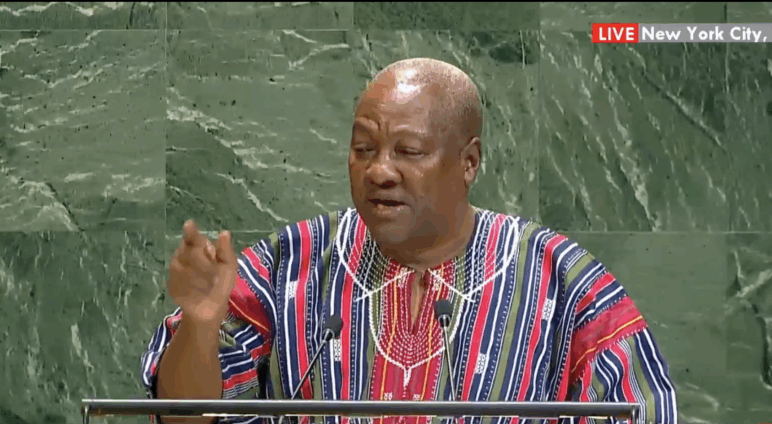
President Mahama’s speech was more historical and justice-driven. He declared that “the future is African,” but warned that this future would be stunted without structural reform. He demanded reparations for slavery and colonization, condemned atrocities in Gaza, and called for a “reset agenda” for both the UN and global financial institutions. His framing was unapologetically bold: Africa must not only be included but must be recognized as central to the global order.
President Stubb of Finland, meanwhile, spoke from the vantage point of a small but principled state. He emphasized values, law, and diplomacy, condemning wars as “failures of humanity.” He supported Security Council expansion, including permanent African seats, and urged the UN to adapt or risk irrelevance. It was a call for balance: reform, yes, but anchored in universal principles.
Together, these speeches painted a picture of a world in transition—where Africa demands recognition, Europe calls for principled reform, and the Global South insists on justice in finance and climate.
The Honour Roll: Who Pays, Who Delays
The UN’s Honour Roll—the list of countries that have paid their regular budget assessments in full—offers a sobering counterpoint to the speeches. In 2024, only 142 member states managed to honour their full assessments at some point during the year. By August 2025, the number stood at 127 member states who had paid in full. This means that nearly one-third of the UN’s membership had not met their obligations, underscoring the fragility of the institution’s financial base.
The Honour Roll is more than an accounting exercise. It is a measure of credibility. Calls for reform ring hollow when not backed by financial responsibility. The UN cannot function on rhetoric alone; it requires the steady flow of contributions to fund peacekeeping, humanitarian aid, and development programmes.
Africa’s Top Contributors in 2024 and 2025
Despite economic constraints, several African states have consistently honoured their obligations and emerged as leading contributors on the continent:
South Africa: $7.7 million in 2024; $8.5 million in 2025
Nigeria: $5.7 million in 2024 (though not yet on the 2025 Honour Roll as of August)
Egypt: $4.4 million in 2024; $6.1 million in 2025
Algeria: $3.4 million in 2024; $2.96 million in 2025
Morocco: $1.7 million in 2024; $2.0 million in 2025
Kenya: $945,000 in 2024; $1.26 million in 2025
These figures demonstrate both continuity and growth. South Africa and Egypt, in particular, have increased their contributions, reflecting their aspirations for continental leadership. Kenya’s rise above the $1 million mark in 2025 is also symbolically significant, aligning with President Ruto’s reformist voice at UNGA80.
Ghana’s Silence on the Honour Roll
In contrast, Ghana’s absence from the Honour Roll since 2022, when it last paid $689,441, is striking. At a time when President Mahama is calling for a global reset and demanding Africa’s rightful place in the Security Council, Ghana’s failure to meet its own assessed contributions undermines its moral authority. The gap between rhetoric and responsibility is not unique to Ghana, but it is particularly glaring given the boldness of its UNGA80 address.
This is not merely a matter of bookkeeping. Non-payment weakens a country’s influence in negotiations, risks the loss of voting rights under Article 19 of the UN Charter, and erodes credibility in calls for reform. For a nation that positions itself as a voice of Africa and the Global South, financial discipline is as important as diplomatic eloquence.
The Price of Global Leadership
The UNGA80 speeches remind us that the world is at a crossroads. Reform of the Security Council, restructuring of global finance, and urgent climate action are all necessary. But these ambitions require resources. The Honour Roll is a reminder that leadership is measured not only by words but by deeds—and in the UN system, deeds are often denominated in dollars.
For Africa, the lesson is clear. To demand a greater voice, the continent must also demonstrate greater consistency in meeting its obligations. South Africa, Egypt, Nigeria, Algeria, Morocco, and Kenya are showing the way. Ghana, despite its eloquence, must catch up.
As the UN marks its 80th anniversary, the credibility of its reform agenda will depend not only on speeches in New York but also on the quiet, essential act of paying one’s dues. In the end, the price of global leadership is both political and financial—and those who aspire to shape the future must be willing to shoulder both.
****IMANI’s Criticality Analysis of Governance and Economic Issues September 22–27, 2025
Latest Stories
-
Banks accounted for 86% total enquiries for credit in 2025
15 minutes -
Over 25m enquiries conducted by financial institutions for credit appraisals, others in 2025
31 minutes -
Venezuelan man shot by ICE in Texas is charged with assault
46 minutes -
Eiffel Tower chief to quit after female staff replaced by men during religious visit
54 minutes -
South Africa to clean up high-risk areas after 12 women killed
1 hour -
Kpandai case sets the precedent – Habib Iddrisu challenges Speaker’s rejection of drug probe
1 hour -
Habib Iddrisu questions Speaker Bagbin’s rejection of motion after Parliament recall
2 hours -
More than 400 detained as France student protests escalate
2 hours -
Ballon d’Or Power Rankings: Lamine Yamal leads race for Golden Ball ahead of Rodri and Kane
3 hours -
‘Nothing worked for us’ – Gideon Mensah takes responsibility for Gambia defeat
3 hours -
Habib Iddrisu says rejected motion was exactly what triggered Parliament recall
4 hours -
Spain announces ban on evictions after protests over 87-year-old woman’s removal from flat
4 hours -
Habib Iddrisu ‘very surprised’ as Speaker rejects Parliament recall motion
4 hours -
Speaker’s decision to reject recall motion catches Dep Minority Chief Whip off guard
5 hours -
2026 Women’s Super Cup: FC Savannah beat Epiphany Warriors to win trophy for first time
5 hours