

Audio By Carbonatix
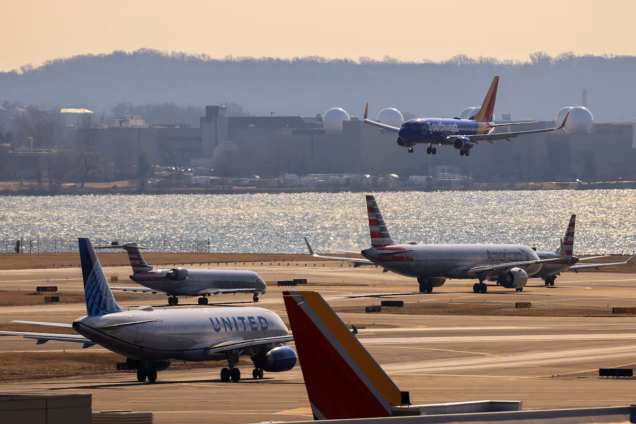
The Federal Aviation Administration said it will investigate a close call that occurred on Friday between a Delta Air Lines flight and a U.S. Air Force jet near Reagan Washington National Airport.
The incident follows a mid-air collision on January 29 near the same airport involving a passenger jet a U.S. Army helicopter, which killed 67 in the first deadly U.S. passenger airline crash in 16 years.
A series of troubling near-miss incidents over the past two years has raised concerns about U.S. aviation safety and the strain on understaffed air traffic control operations.
On Friday, Delta Flight 2389, an Airbus A319 headed for Minneapolis, was cleared for takeoff around 3:15 p.m. ET (1915 GMT), while four U.S. Air Force T-38 Talons were inbound to nearby Arlington National Cemetery for a flyover, the FAA said.
The Delta jet received a cockpit collision warning alert that another aircraft was nearby, and controllers issued corrective instructions to both aircraft, it said.
Senator Amy Klobuchar, who represents Minnesota, called the incident "unbelievably dangerous and thank God people are safe. My first call to Department of Defense tomorrow: why are your planes flying 500 feet (150 meters) below passenger jets full of Minnesotans."
The Pentagon said it was aware of reports about Friday's incident but did not have an immediate comment.
Delta, which said there were five crew on board and 131 passengers, said "the flight crew followed procedures to maneuver the aircraft as instructed... We will cooperate with regulators and aviation stakeholders in any review of this flight."
CNN, citing audio captured by website LiveATC.net, reported the Delta pilot asked controllers if there was "an actual aircraft about 500 ft below us" as the commercial jet left the airport. The controller responded "affirmative," CNN said.
The January collision raised questions about the military's failure to use a key safety system known as ADS-B on helicopter training flights.
The FAA has since imposed permanent restrictions on non-essential helicopter operations around Reagan and barred helicopters and passenger jets from flying near each other.
The FAA's actions followed two urgent safety recommendations made by the National Transportation Safety Board after the collision.
Last month, a Southwest Airlines LUV.N flight was less than 200 feet behind a business jet when the Southwest pilot aborted the landing and made an emergency maneuver to narrowly avoid a collision at Chicago Midway Airport.
On March 1, more than a dozen flights on final approach to Reagan National received false cockpit collision warnings, prompting at least six to abort landings.
The FAA and a senator said it was prompted by government testing of counter-drone technology.
Latest Stories
-
Ghana, 3 others face large financing needs, debt servicing costs – World Bank warns
2 hours -
Eurobond repayment: Ghana faces US$6.4bn repayment burden between 2027 and 2030 – World Bank
3 hours -
Government to add 100 new ambulances to national fleet in 2027
3 hours -
Ex-Spurs player Vega set to run for FIFA president
3 hours -
Arteta signs new contract with champions Arsenal
4 hours -
Former Man City player Silva comes out of retirement
4 hours -
‘I have a screen in my office’ – Akandoh on real-time emergency bed tracking
4 hours -
Government begins pilot of national emergency bed management system
4 hours -
GRA forms 9-member committee to probe alleged missing containers at Tema Port
4 hours -
Foreign Minister inspects VFS Global Visa Centre, highlights commitment to service quality standards
5 hours -
Declan Rice close to agreeing new Arsenal deal
5 hours -
‘Draining’ few days for Gauff after online racist abuse
5 hours -
Media worker, journalist remanded over alleged GH¢800,000 fraud
5 hours -
PAC sends Ghana Water hearing back, demands Minister and MD appear over financial status
5 hours -
Foreign Affairs Minister inspects 20+ visa centres, demands better conditions for Ghanaian applicants
6 hours