

Audio By Carbonatix
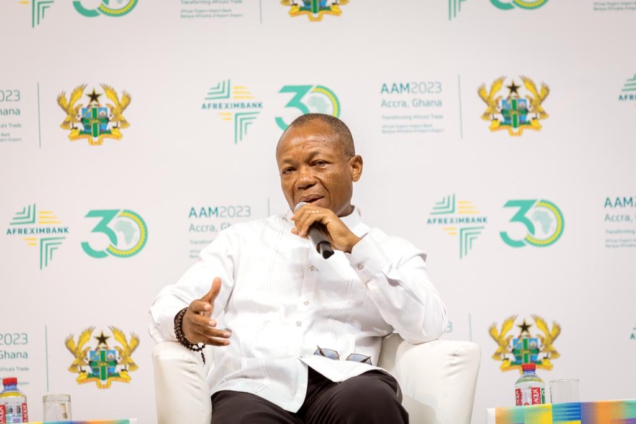
The Chief Executive Officer of Development Bank Ghana (DBG), Kwamina Duker, has reiterated his outfit’s commitment to supporting and building bankable and competitive local businesses that can pit their strength against consumer alternatives coming mostly from foreign markets.
Mr. Duker was speaking at the 30th Annual Meeting of the African Export-Import Bank (Afreximbank) in Accra, as a panelist during a plenary discussion with other distinguished industry captains, development experts and policy makers on the topic “Leveraging the Power of Intra-African Trade for Commodity Based Industrialisation”.
The panel discussions, which were a part of a series of sessions at the gathering sought to highlight the peculiar challenges that beset African economies when it comes to adding value to the extracted raw materials before being exported to foreign markets.
The objective of the discussions was to find ways to break the cycle of exporting unfinished goods and importing finished products much to the detriment of the respective African economies and also on how to take control of Africa’s commodities and expand the value chain systems so as to be able to create the necessary socio-economic development.
Addressing how small to medium size enterprises are being integrated into the industrialisation process, Mr. Duker indicated that for a very long time the focus has been on the extractive sector and that has caused little investment into human capital, thus denying us the opportunity of moving up the value chain.
According to DBG’s Chief Executive Officer, “moving up the value chain is critical but also complex because once you move up from the extraction or the out-grower phase, you come into the market forces phase which you must be able to respect in order to thrive”.
He added that, “for us as a development bank, we are focused on changing mindsets of the local businesses and making them bankable businesses that can be competitive on the global market.”
He further explained that, it is essential for businesses that have been able to move up the value chain to have a mindset to compete especially due to alternatives consumers are presented with on the market and to achieve that, such businesses must be bankable so as to overcome the market forces.
In addition, Mr. Duker emphasised the importance of setting a “criteria for success” for local businesses where, businesses after a period of receiving support, must be able to take-off and run by themselves so as to achieve sustainable prosperity. According to him, this will be a measure of success of the investment placed into such businesses.
Other panelists for the session on “Leveraging the Power of Intra-African Trade for Commodity Based Industrialisation” were Professor Théophile T. Azomahou, Executive Director, Africa Economic Research Consortium, Dr. Carlos Lopez, a Professor at the University of Cape Town, Ms. Florie Liser, President & CEO, Corporate Council on Africa, Ms. Ahunna Eziakonwa, UNDP Assistant Administrator & Regional Director for Africa, Mr. Antonio Pedro, Acting Secretary, United Nations Economic Commission for Africa and Mrs. Kanayo Awani, Executive Vice President, Intra-Africa Trade, Afreximbank.
African Export-Import Bank (Afreximbank) is a Pan-African multilateral financial institution mandated to finance and promote intra-and extra-African trade. Afreximbank deploys innovative structures to deliver financing solutions that support the transformation of the structure of Africa’s trade, accelerating industrialization and intra-regional trade, thereby boosting economic expansion in Africa.
DBG is a Development Finance Institution established by the Government of Ghana, in accordance with the Development Finance Act, 2020. DBG acts as an enabler for businesses in Ghana and as a long-term capital provider in the market. DBG’s mission is to foster strong partnerships to finance economic growth, create jobs and build capacity for SMEs, and to provide long-term financing and de-risking services underpinned by technology and evidence-based research/insights.
DBG aims to promote Environment Social and Governance (ESG) excellence within the businesses the bank supports. The bank has received funds from the World Bank, European Investment Bank, Kreditanstalt Für Wiederaufbau (KfW), and the African Development Bank.
Latest Stories
-
The Inconvenient Truth: We cannot pray for the cure while protecting the disease
30 seconds -
MTN Ghana trains civil society organisations on artificial intelligence
37 minutes -
GoldBod FX framework aims to make dollar supply predictable – Acheampong
1 hour -
How does a Ghanaian team make it to the BAL?
1 hour -
Ghana’s investment climate presents opportunities for industrial growth and job creation.
1 hour -
‘I paid thousands to a company for jobs that never came’
2 hours -
SSNIT intensifies informal sector enrolment drive with Techiman float
2 hours -
Ghana seeks long-term mining investments that benefit local communities – Armah-Kofi Buah
2 hours -
GHATOF demands compensation for 85 businesses affected by La Pleasure Beach demolition
2 hours -
Bono Regional Minister calls for investor education to drive economic growth
2 hours -
Ghana’s Ambassador to China, Kojo Bonsu, presents credentials to Nepalese President
2 hours -
Fairtrade Africa’s Cocoa Hubs Project strengthens rural service centres in cocoa-growing communities
2 hours -
MPs are not development officers – Edem Kpotosu
2 hours -
SEC cautions investors against fraudulent investment schemes
2 hours -
Land Ministry urges rCOMSDEP operators to reserve earnings for land reclamation
2 hours