

Audio By Carbonatix
The drastic AI revolution is spreading across society, fueled in part by many new exciting emerging strands such as agentic AI, which is currently driving several innovations.
Agentic AI can be described as AI enriched with the ability to take initiative and undertake autonomous action because it understands the goal of the user and is able to contextualise effectively. This more advanced type of AI is reshaping the financial sector by enhancing efficiency, reducing human error, and unlocking new capabilities in data analysis and decision-making.
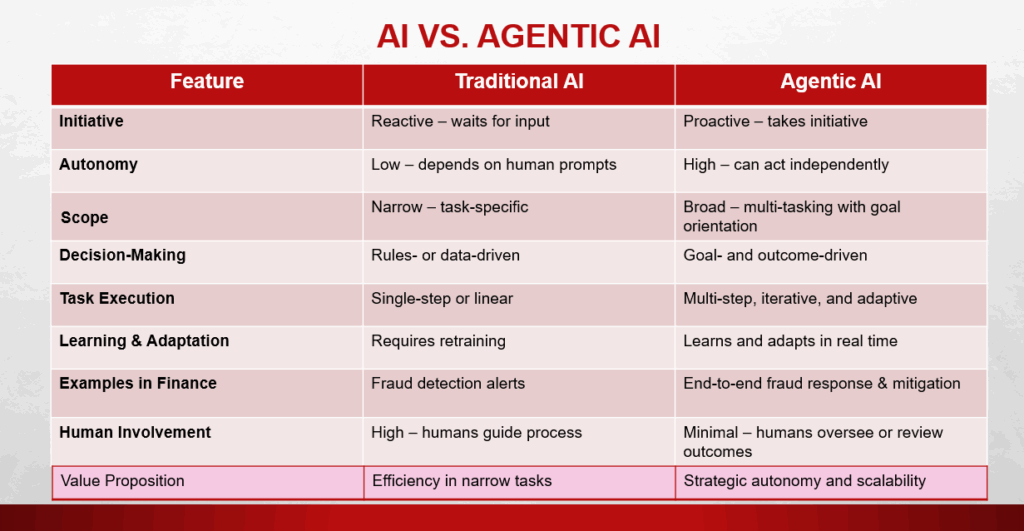
Traditional AI differs from agentic AI in many ways. Traditional AI usually performs tasks by following predefined algorithms, data-driven patterns, or using trained responses. The key characteristics of so-called traditional AI include reactiveness; that is to say they respond to inputs but do not take initiative, are often designed with a narrow scope, meaning they focus on specific tasks such as image recognition or fraud detection and are heavily dependent on human prompts.
On the other hand, agentic AI takes the capabilities of traditional AI a step further by assuming the role of an “agent” which is an independent system which can set its goals, make decisions, and take initiative to accomplish tasks with minimal human intervention.
In other words while traditional AI needs significant human input, in contrast, agentic AI is proactive and can act in a lot of ways without human intervention, making it important for tasks which do not require ongoing human intervention. The power of Agentic AI is premised on its ability to undertake sophisticated reasoning backed by iterative planning to autonomously solve complex, multi-step problems.
Agentic AI comes with a deep ability to undertake planning and reasoning since it can break complex tasks into steps, adapt plans and optimise its operations plus it is interactive and iterative meaning it can engage in learning, multi-step processes and make adjustments based on the exigencies of a peculiar situation. For example, while a traditional AI model might flag suspicious transactions for a human to review, an agentic AI system does not only detect these frauds, it can also takes steps to investigate, freeze accounts, notify affected users, and recommend relevant policy updates without any human intervention.
How Does Agentic AI Work?
Agentic AI systems rely on vast amounts of data often from multiple data sources to be able to solve complex, multi-step problems by independently analysing these problems, developing solutions through sophisticated reasoning, execution capabilities and iterative planning. Agentic AI typically applies a four-step process for problem-solving through perceiving (extracting insights from the environment), reasoning (use of a large language models to act as a reasoning engine), acting (quickly executing tasks based on formulated plans constrained by guardrails) and learning (ability to continuously improve its performance through a feedback loop).
A key concept in agentic AI is data flywheel, which refers to a self-reinforcing cycle where data continuously improves an AI system’s performance, fueling continuous learning, optimization, and value creation. In fintech, a data flywheel enables an AI-driven credit scoring system to continuously improve loan decisions by learning from borrower behaviour, which generates more data and enhances future predictions.
Agentic AI in Fintech
It is important to point out that agentic AI is still experimental with a growing number of potential use cases. Similarly, the potential applications of agentic AI in Fintech are growing, from simple tasks such as customer service to more complex use cases. For instance, in customer service, an AI agent could provide a simple question-and-answer service, whereas agentic AI takes this a notch higher by checking a client’s outstanding loan balance while recommending which amount to pay and when to pay thereby helping the client make optimal decisions relating to personal loan management.
Agentic AI can be applied in autonomous trading where these agents can independently execute trades based on real-time data and market analysis, optimizing investment strategies without human intervention. Fraud detection and risk management is an important use case of agentic AI, here, these systems can continuously monitor financial transactions, identifying anomalies and flag risks more efficiently than traditional rule-based systems. Agentic AI offers better personalized financial services by enabling hyper-personalization; analyzing user behaviour, goals, and preferences to tailor banking, investment, and advisory services for a unique user. Agentic AI is also very powerful when it comes to proactive complex decision-making. In contrast to traditional AI tools, agentic systems can set up and pursue financial objectives, adapt to evolving conditions and provide real-time strategic insights. Lastly, agentic AI can improve operational efficiency when it comes to automating complex workflows such as loan processing and compliance checks thereby reducing costs and improving scalability.
The benefits of working with Agentic AI are numerous including facilitating human-machine collaboration, enhanced innovations, greater ability to automate tasks with less human elements and increasing speed of delivery of specific tasks. Although agentic AI comes with a lot of potential benefits, some challenges, risks and problems are associated with its usage including making mistakes. This requires ensuring that agentic AI systems decision making processes are carefully calibrated to guarantee they can make trusted decisions.
Also, it is important to ensure there is a mechanism to enable human decision-makers to intervene when needed. Further, the principle of scaffolding can be applied where the agentic AI system is deployed under strict human supervision and oversight is protensively removed as the agentic AI experience and performance grows better. Some of these challenges with agentic AI can be resolved by establishing the right feedback loop which adjusts AI models as they learn about their performance.
In conclusion, AI is fast evolving, we are still far from a future where AI systems can work fully independently and intelligently, however, recent advancements in agentic AI are bringing this dream to reality sooner than later by enabling greater productivity, innovations and provision of insights for effective decision making. Agentic AI is providing the tools for our fast-evolving digital age where intelligent assistants are proactive instead of serving as passive tools.
Dr. Kwami Ahiabenu is a Technology Innovations Consultant
E-mail: kwami@mangokope.com
Latest Stories
-
Ghana departs for ITF World Team Cup Africa qualifiers in Rabat
15 minutes -
GPL 2025/26: Vision FC, Holy Stars play out goalless draw in Tema
22 minutes -
Ministry of Gender condemns violent assault in Cape Coast, urges urgent action
28 minutes -
Bank of America to pay out $72.5m over Epstein lawsuit
35 minutes -
African Union Chair urges dialogue amid rising tensions in Somalia
42 minutes -
African Union mourns passing of former Algerian President Liamine Zeroual
43 minutes -
Howo trailer crash on Kpeve–Asikuma road
1 hour -
Heavy rains sweep across Ghana, parts of Accra flooded
2 hours -
Asantehene urges swift completion of KNUST Hospital following Parliamentary approval
2 hours -
Three Lebanese journalists killed in Israeli strike, say broadcasters
3 hours -
Antonelli wins to become youngest title leader
3 hours -
Impakers Creative Hub CEO Freda Cudjoe inducted into Corporate Ghana Hall of Fame 2026
3 hours -
See the areas that will be affected by ECG’s planned maintenance today, Sunday, March 29
5 hours -
Flood alert: GMet warns of dangerous downpours across Ghana today
6 hours -
‘Groundbreaking but an uphill struggle’ – Amanda Clinton breaks down UN slavery resolution
6 hours