

Audio By Carbonatix
The Council for Scientific and Industrial Research (CSIR) has introduced an early detection technology known as ‘Spore Smart Collector’ to help farmers identify crop diseases before they spread.
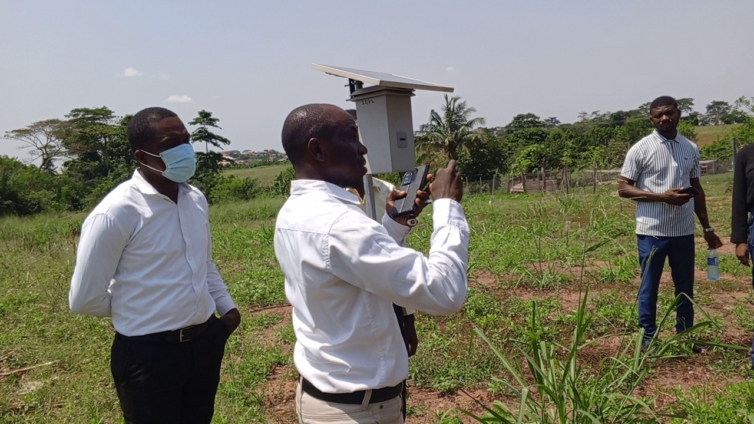
A demonstration meeting brought together farmers, Agricultural Extension Officers, Directors from the Ministry of Food and Agriculture (MOFA), and research scientists to discuss the benefits and possible rollout of the technology.
Country Lead and a Senior Research Scientist, Dr Kwesi Atta Aidoo Snr, explained that the SporeSmart Collector “captures fungal spores within the environment. So in the lab, we can detect the kind of disease that can happen in the field.”
He said the device collects fungal spores from the air on farms, and samples are sent to the laboratory for analysis. This allows experts to detect potential diseases early and advise farmers on preventive action before crops are affected.
Dr Aidoo also addressed concerns about the security of the device when installed on farms.
“Security-wise, we haven’t recorded anything yet in Ghana. For the commercial farmer, it will be in the field, which is being fenced, and there will be a security person or somebody in the field. For security-wise in terms of theft and all that, I don’t think there’s a problem because it’s already in Brazil on the field and they haven’t recorded any theft as yet and we hope that here in Ghana too we'll not record anything like that,” he added.
Luke Murrell of MMV Sense in the UK, who participated in the demonstration, highlighted key challenges that must be addressed before the technology can be expanded nationwide.
“One would be training. Because if we’re going to go from one small installation to many, many thousands of farms, there’s a big training activity that needs to be done, particularly with extension officers,” he said.
He also pointed to financing and building a sustainable service model as important steps for scaling up the project.
“One’s going to be financing the programme, financing the creation of a service. So I think it’s about finding the right partners, finding the right funding models, and a way to pay for this type of service,” he explained
Discussions have been held with the Ministry of Food and Agriculture on possible support, including private-public partnership models. For now, the focus remains on piloting the Spore Smart technology in selected farming communities before expanding it across the country.
Latest Stories
-
Afenyo-Markin’s lawsuit against Sammy Gyamfi takes focus away from development – Kpebu
4 minutes -
FWSC urges media to guard against misinformation in proposed IPEC transition
4 minutes -
Zimbabwean author denies using AI to write award-winning story
26 minutes -
GTEC’s letter directing public universities to reopen by October 16 is unprofessional – GAUA
27 minutes -
Suspect in viral video assaulting wife jailed for 3 months
27 minutes -
GAUA insists strike will end only after Fair Wages addresses market premium issue
27 minutes -
Kpemka seeks compensation as he sues BOST over alleged unlawful termination
30 minutes -
GES asks applicants to check status of 2026 promotion applications on October 15
54 minutes -
Kobe Boujee joins Olympics.com team for Dakar 2026 Youth Olympic Games
1 hour -
Slaty egret’s shifting nesting sites offer clues to changing ecosystems
1 hour -
First phase of arrears for promoted teachers to be paid on Friday – Haruna Iddrisu announces
1 hour -
Caveman Watches partners with Mfantsipim School for 150th anniversary
2 hours -
We’ll pursue GH¢15m defamation suit against Sammy Gyamfi to its logical conclusion – Afenyo-Markin’s lawyers
2 hours -
Martin Kpebu urges Afenyo-Markin not to return to court over Sammy Gyamfi lawsuit
2 hours -
GRA submits preliminary report on drug shipment case to Mahama – Commissioner-General
2 hours