


Audio By Carbonatix
Zambia's vice-president has called for a radical change in the eating habits of the nation, saying people should ditch the staple, maize meal, for more nutritious foods - a proposal akin to telling Italians to stop eating pasta.
Maize meal is hugely popular across much of southern and East Africa - research shows that sub-Saharan Africa consumes 21% of the maize produced in the world.
Zambian Vice-President Inonge Wina's appeal for a change in diet comes at a time when parts of her country and some neighbouring states have been hit by poor rainfall and food shortages - a recurring problem caused, in part, by climate change.
The crisis has led to 1.7 million Zambians - or 18% of the population - experiencing severe food insecurity, with about 40% of children under five years stunted, according to the UN-linked ReliefWeb information portal.
To tackle the problem, Ms Wina said people needed to vary their diet by eating more millet, sorghum, cassava, and sweet potatoes.
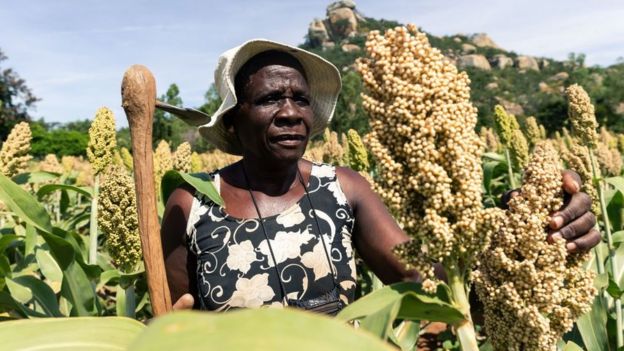
Sorghum is regarded as a high-energy grain
"The gradual shift from predominantly maize-based meals is good for the nation as more nutritious foods will have space at our tables," she was quoted by the state-owned Daily Mail news site as saying.
"The switch to more nutritious foods is one of the low-cost and effective ways of addressing stunting and malnutrition in the country," Ms Wina said.
But she faces a formidable challenge to change eating habits.
Many people eat maize meal twice or three times a day. Some say they have not eaten unless they have had maize meal, which is known as nshima in Zambia, nsima in Malawi, sadza in Zimbabwe, papa or pap in South Africa and Lesotho, and ugali in Kenya.
Resistance to new dishes
The maize meal is boiled with water, and a bit of salt is added. It is then folded into the desired texture, making it a quick, cheap and easy dish.
It can also be fermented and served at breakfast as porridge, or cooked in a more dense form for lunch and dinner, when is it often served with meat, vegetable stews and sour milk.
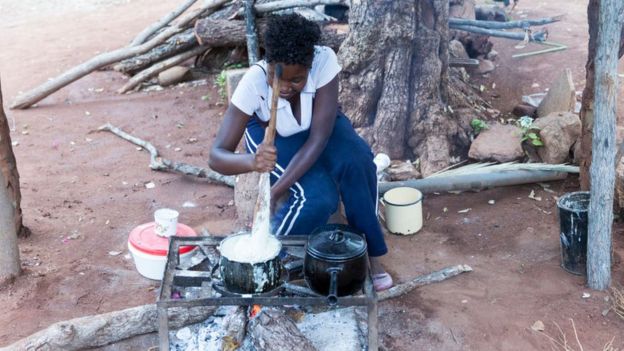
Maize meal is popular because it is cheap
Clifford Chirwa, a fourth-year student at the University of Zambia, said he doubted the government would succeed in getting people to eat less of it.
"It's not possible because every culture has a specific food which is considered to be a staple. Just like you have jollof rice in Nigeria, nshima is typically Zambian," he told the BBC.
Agreeing with him, Olipa Lungu, who runs a restaurant at a busy market in the capital Lusaka, said her efforts to change the menu had failed.
"Nshima stands out. The only other food that people like are chips but even those I make only when there's a special order," she said.
Government subsidies
But Ms Wina's proposal has won the support of the Zambia National Farmers Union (ZNFU).
"With the advent of climate change, we have to start looking at various options of food. We have been too dependent on maize yet we grow crops such as sorghum, rice and millet," ZNFU spokesman Kakoma Kaleyi told the BBC.
"We rarely eat other foods. I think that our culinary tastes should change. This is the right call by the vice-president," he added.
Some nutritionists say the maize meal sold in supermarkets is highly processed and therefore lacks nutrients, vital for the health of our skin, hair and brain.
When eaten in its original form, maize contains nutrients such as vitamin A, vitamin C, iron and fibre, but all the goodness is lost if it is over-processed, they say.
Maize meal is popular, especially in poor families, because it is often subsidised by governments, South African dietician Thandolwakhe Msomi told the BBC.
"So if you're looking at introducing other grains and have them become a staple in homes, we would need similar interventions by those in power," she added.
Latest Stories
-
Labour Minister wants SOEs to help shape new public pay system
4 hours -
IPEC will ensure Equity and Sustainability in SOEs Compensation
5 hours -
White House bars CNN from travelling with Trump on Air Force One
6 hours -
Fennis wins second consecutive ITF J60 title in Accra
6 hours -
Spain beat England in thriller after Kane penalty miss
6 hours -
GPL 2026/27: Zaidan’s late goal ends Hearts of Oak unbeaten start
6 hours -
CEOs demand clarity on pay harmonisation, board autonomy as FWSC engages SOEs bosses over IPEC transition
6 hours -
2026 Women’s Super Cup: FC Savannah, Epiphany Warriors maintain top spots ahead of final group games
6 hours -
‘Is EOCO responsible for determining lawyers’ fees?’ – Baffour Awuah
6 hours -
David Beckles claims second J60 Accra title
7 hours -
No France cocaine suspect linked to Mahama, Vice President’s security details – NACOC
7 hours -
Anwelle Foundation launched in Jirapa to tackle poverty, youth unemployment
7 hours -
Joy Sports Editor Fentuo Tahiru Fentuo to moderate inaugural Music Meets Football Summit in Zambia
7 hours -
Court premises too volatile for Baffour Awuah’s attempted arrest by EOCO – Inusah Fuseini
7 hours -
Drug bust: Under no circumstances will NACOC leadership be compromised – Twum-Barimah
7 hours