

Audio By Carbonatix
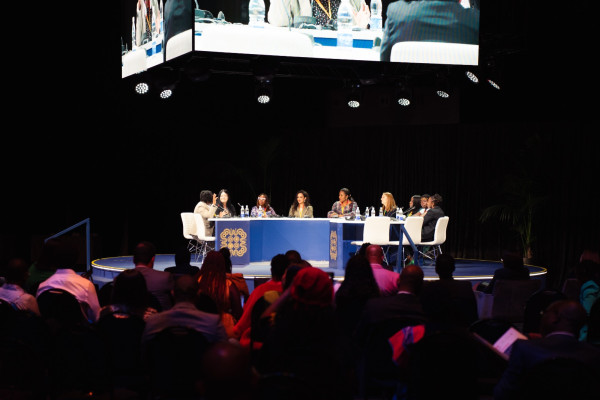
Featuring a diverse group of influential women leaders in the energy sector, a Women in Energy Roundtable Discussion was held during the African Energy Week (AEW) 2023 conference and exhibition. The panel explored innovative strategies and collaborative efforts to ensure access to affordable and reliable energy for all Africans, with women at the forefront of progress.
Moderated by Grace Orife, CEO of Adelaar Energy, the roundtable was hosted by the African Women Business Energy Network and bp SA.
The discussion kicked off with Sarah Baashan, Head of Global Insights and Engagements, Saudi Aramco, providing insight into how Africa can address its current energy challenges while also ensuring a sustainable future. She stated that, “We need to increase energy generation capacity while guaranteeing that energy produced is affordable. At the same time, we should not forget decarbonization, as it is crucial for a healthy environment.”
Baashan added that the continent hosts the world’s youngest workers, and therefore, should prioritize creating more job opportunities to advance sustainable socioeconomic development. Ibi Ogunbiyi, Partner at Olaniwun Ajayi, added that the continent needs to adopt a “compromised strategy where we are having hydrocarbons producing baseload power and off-grid and other renewable systems providing access to underserved communities.” She also believes that, “Gas should serve as a transition fuel.”
Additionally, the panel identified a lack of adequate infrastructure and project financing across the value chain as key challenges hindering the expansion of African energy economies. Commenting on how the continent can address infrastructure deficits, Oluseyi Afolabi, Principal Consultant/CEO at Reservoir and Facilities Solutions Nigeria, stated that it starts with African governments prioritizing the development of assets which allow secure and resilient generation and transportation of energy to both rural and urban communities.
“Investments in the research and development of innovative solution needs to also be prioritized while streamlining the deployment of projects and ensuring construction is fast-tracked. Lastly, there is a need for maximizing value addition in local content development in projects rollout,” added Afolabi.
Echoing Afolabi’s notion, Allyson Anderson Book, Chief Sustainability Officer at Baker Hughes, said increasing investments in Africa’s capacity building initiatives is crucial for the diversification of Africa’s energy mix and for the continent to be able to reduce the reliance on international aid.
Commenting on the factors that have influenced the current state of Africa’s energy industry, Taelo Mojapelo, CEO of bp SA, stated that, “Energy demand is growing by at least 3% a year while investments in new projects have been slow. We have also failed to define our own principles, hence we have significant inequality which are compromising [progress regarding] Sustainable Development Goals. We need to exploit all the energy resources we have including coal, gas and oil before we do into the transition.”
Ayanda Noah, Chairperson of South Africa’s Central Energy Fund, provided insight into best practices for the continent to improve its current energy status. According to Noah, governments should improve cooperation with the private sector, and that “Connectivity and collaboration at the basic level is crucial. Africa has tangible examples of interconnectivity success projects such as the Southern African Power Pool which we can maximize to enhance energy security. Women have the potential to be innovative, coming up with out-of-the-box solutions to critical energy challenges.”
Amb. Martha Nyamal Choat, Deputy Managing Director and CEO, Nile Petroleum Corporation, shared similar remarks, adding that for African projects to be able to attract private investments, governments need to ensure security and market stability which are absent in an increasing number of African countries.
Shirley Webber, Head of Natural Resources&Energy at ABSA, concluded the session by adding that in addition to market stability, governments need to prioritize Environmental Social Governance and the adoption of a mix of financing mechanisms for the different energy infrastructure development projects.
#AEW2023 – organized by the African Energy Chamber – takes place this week in Cape Town under a mandate to make energy poverty history by 2030. Keep following www.aecweek.com for more exciting information and updates about Africa’s premier energy event.
Distributed by APO Group on behalf of African Energy Chamber.
Latest Stories
-
Interest payments to average a high 20% of government revenue over next 4 years
1 hour -
Strategy of accumulating foreign reserves, gold carries high fiscal cost – S&P Global
1 hour -
Weak institutional arrangements, high debt servicing constrain Ghana’s rating – S&P
1 hour -
Bond market: Turnover declined by 28% to GH¢1.56bn
2 hours -
Volta Region National Public Speaking contest advances drug prevention conversation
2 hours -
New health training facility at Ampoma-Jema to address admission shortfalls, but Minister flags missing amenities
2 hours -
Black Challenge unveiled with sights set on Amputee World Cup glory
3 hours -
Pay striking teachers before expressway spending, Dr Kingsley Agyemang tells government
3 hours -
Customs intercepts assault rifle, two pistols and 610 rounds of ammunition at Tema Port
4 hours -
PKO boxers secure wins at Odwira Festival
4 hours -
South Tongu Records Rise in Teenage Pregnancy
4 hours -
Cabinet threw out US health compact faster than anything I’ve seen – Mahama
4 hours -
MoFA urges Finance Ministry to reverse World Bank food programme withdrawal over GH¢643m commitments
4 hours -
NAGRAT demands signed timelines before calling off strike
5 hours -
National Investment Quiz: West Africa SHS, St. Louis SHS advance to semi-finals
5 hours